Your basket is empty.
Continue Shopping
Block Party Socks
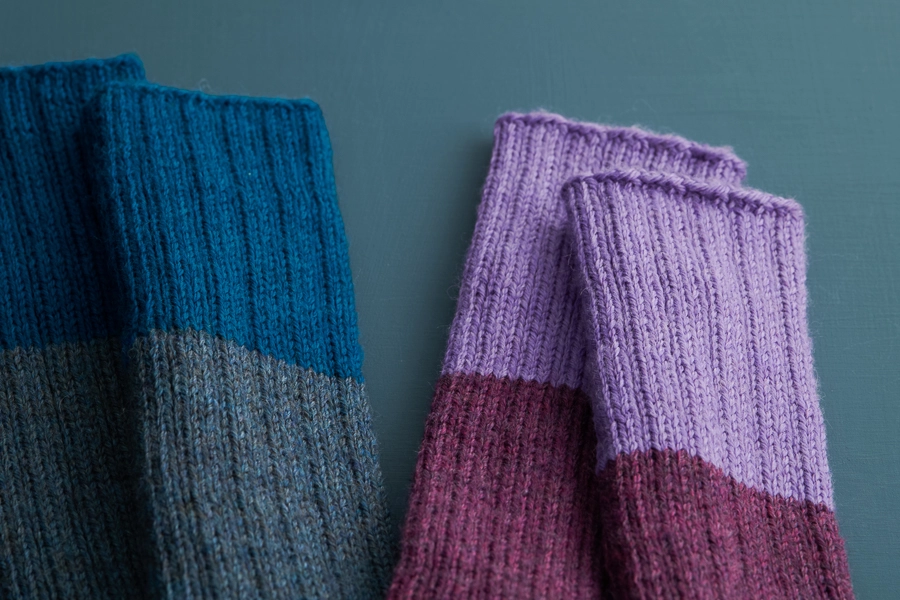
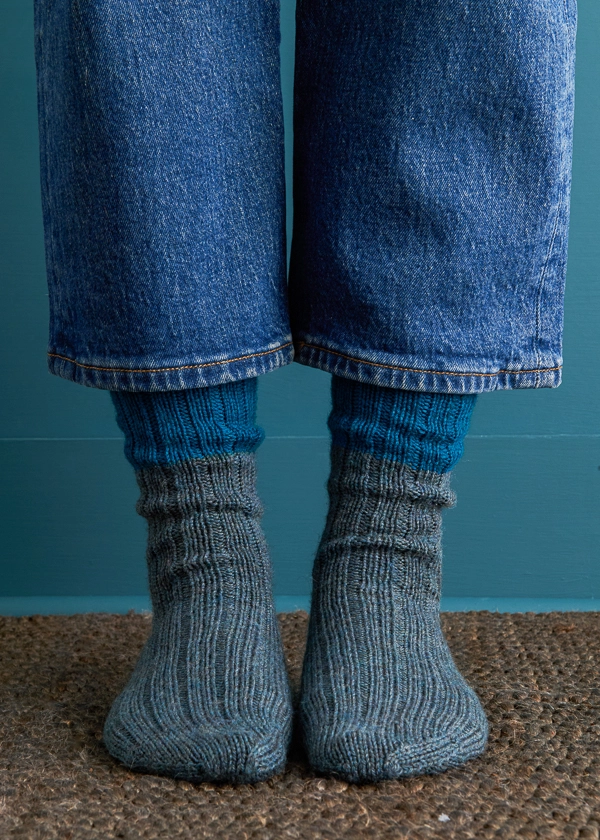
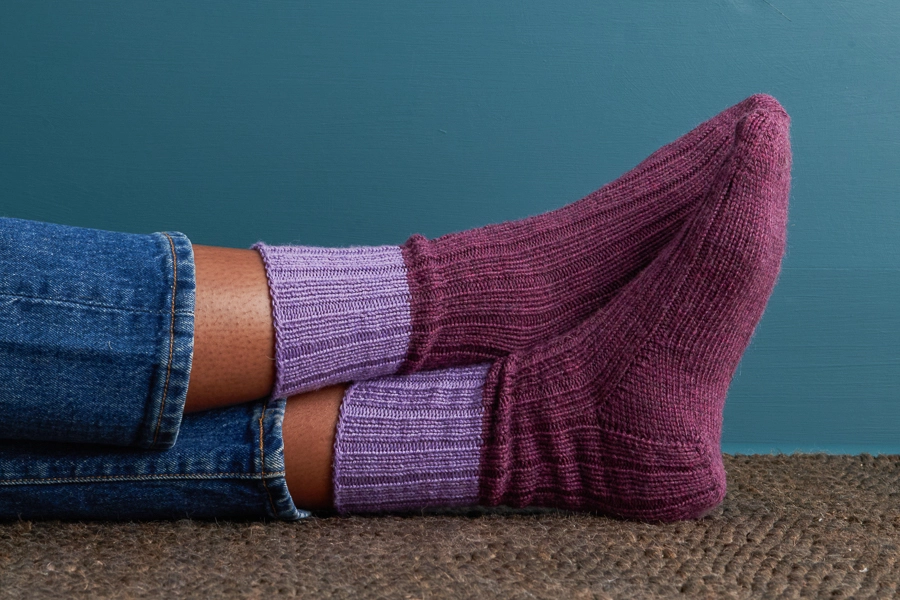
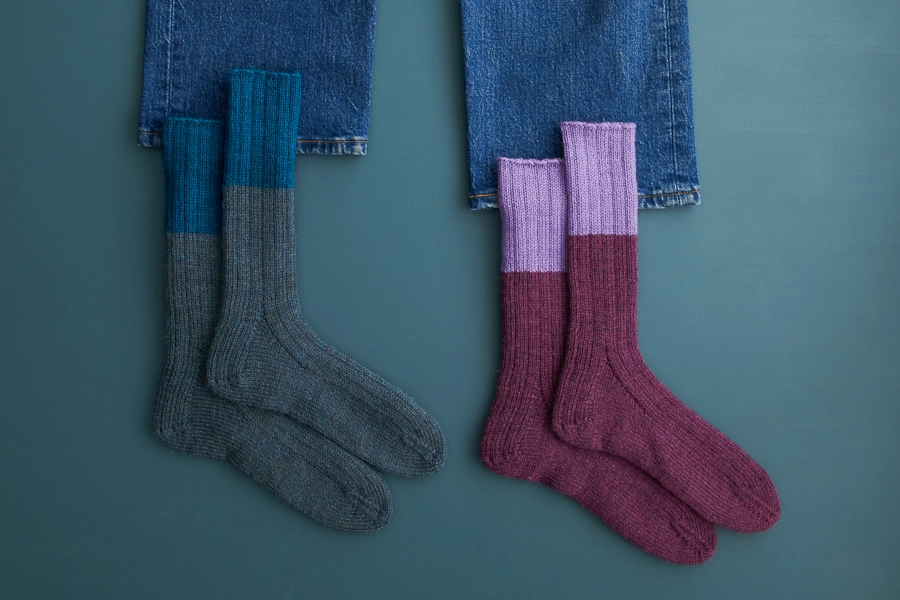
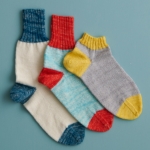
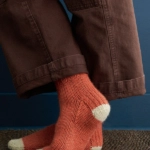
Our Block Party Socks bring the party right down to your toes! Knit with our new Daily Wool Sport, a very soft and hardworking yarn made to be worn on repeat, these fun color-block socks are an open invitation to play.
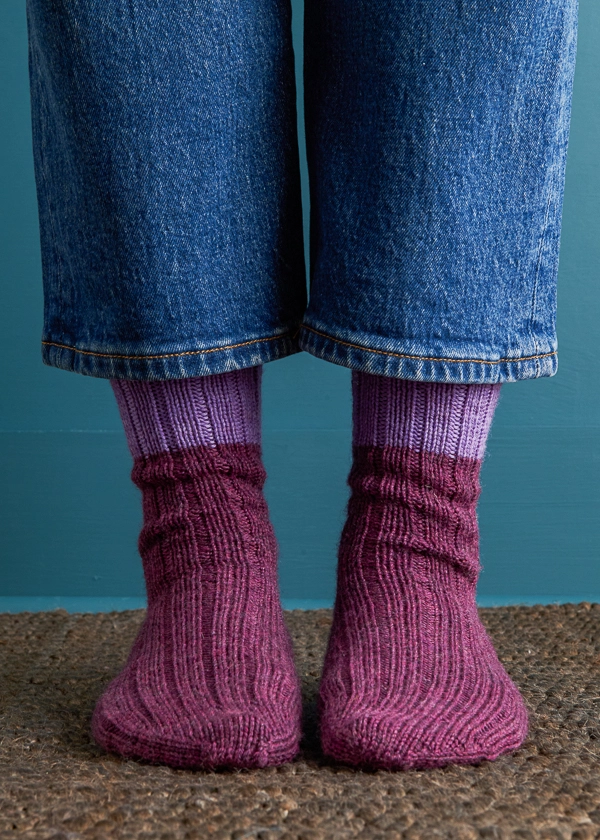
Everyone will get a great fit from these crew-length socks, with 4 sizes to choose from, an adjustable foot length, and springy 3×1 ribbing that hugs every contour of calves, ankles, and insteps.
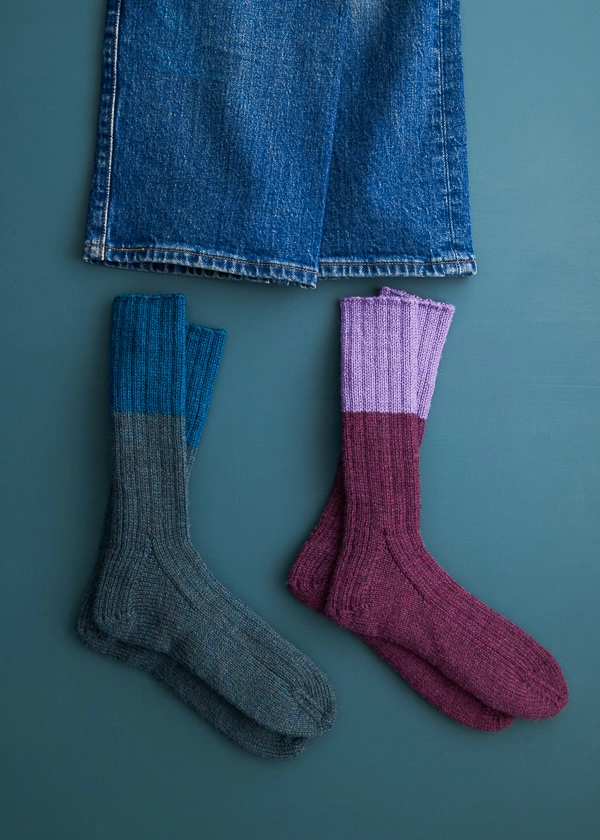
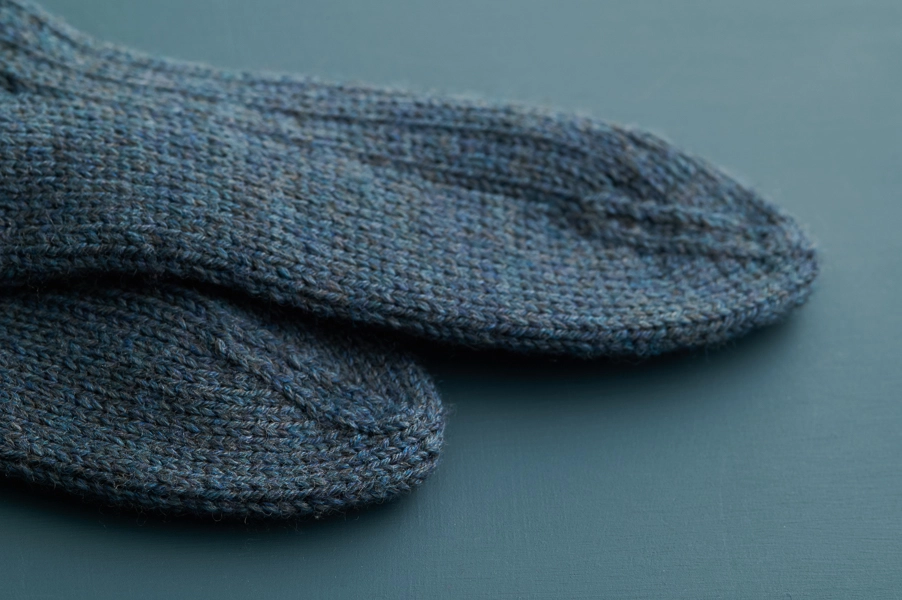
You knit the Block Party Socks from the top down, the steady rhythm of the ribbing carrying you through a color remix partway down the leg. Easy to knit and thoughtfully designed, every detail contributes to an effortless, clean finish—from cleverly camouflaged gusset shaping to a heel flap and instep that maintain the ribbing without missing a beat.
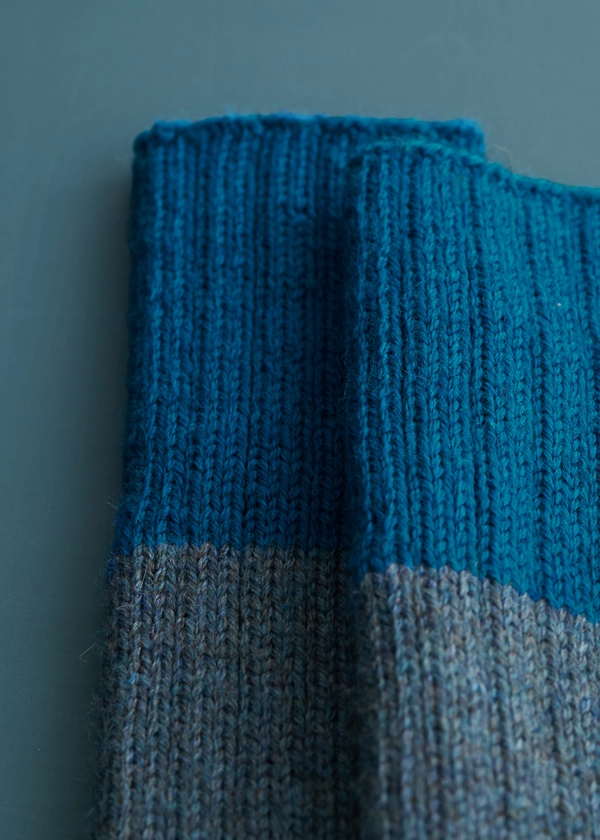
With a joyful bounce to its step, Daily Wool Sport is 100% incredibly soft superwash wool, which yes, means you can machine wash and dry it! And its slender sport weight and tidy 4-ply spin make super comfy socks that knit up at a lively pace without feeling bulky.
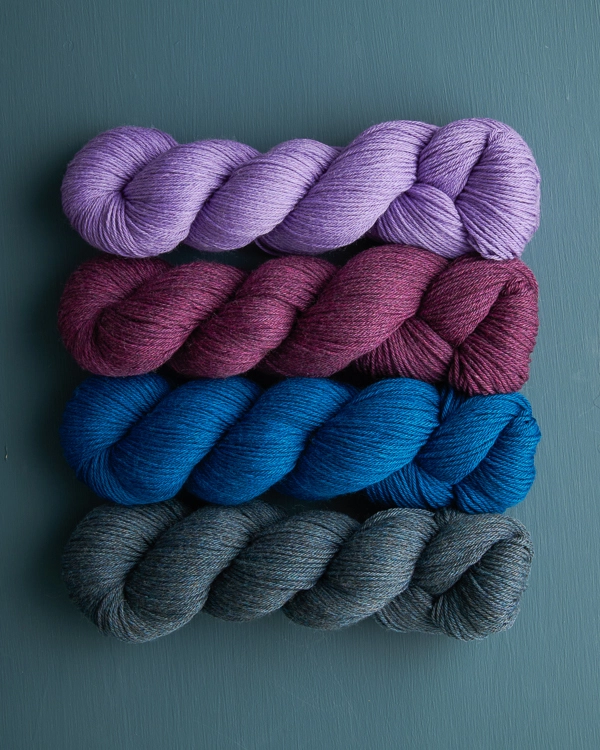
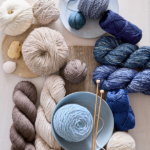
Choose a pair of colors from a palette of 24 heathered shades and let them mix and mingle. You’ll need a skein or two of your main color, plus just a little bit of your contrast color. Depending on the size you make, you might have enough yarn left over to make another pair in reverse!
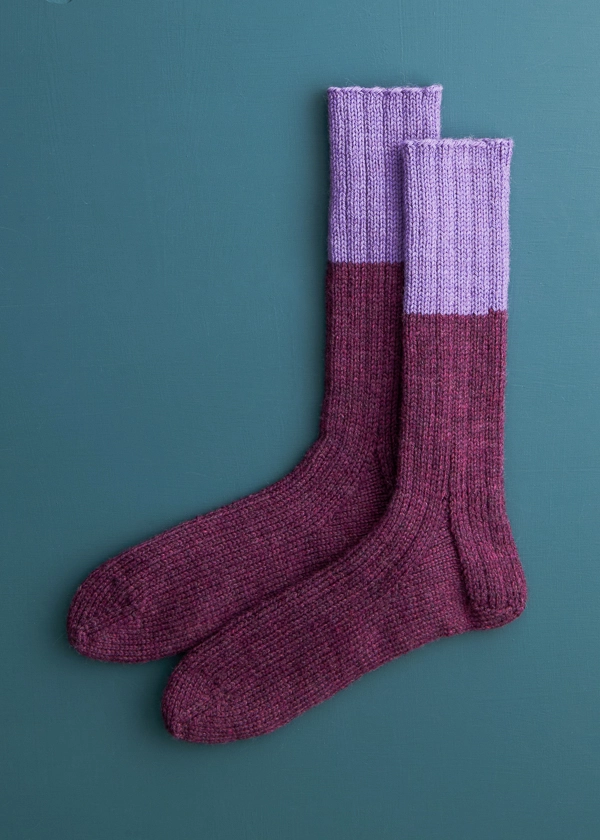
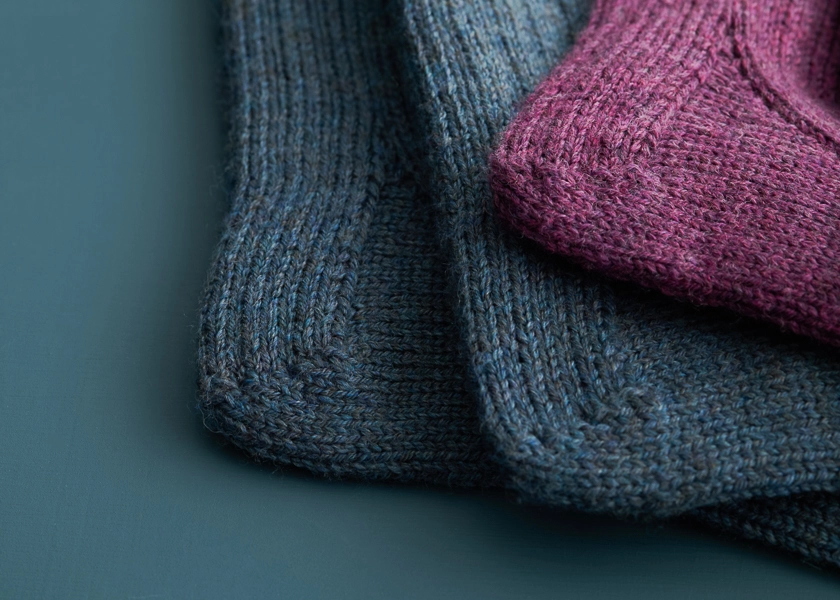
Find a reason to celebrate and cast on for your own Block Party Socks in Daily Wool Sport, a cheerful pick-me-up you’ll reach for day after day!
Yarn lovers, if you adore the yarn used in this project, you’ll love exploring all of our other yarn collections! Discover over 55 thoughtfully designed yarns in nearly every natural fiber and in every spectacular color you can imagine. Only available here at Purl Soho’s online yarn store, where every skein is created with care and your creativity in mind!
Pattern designed and written by Purl Soho designer, Gianna Mueller. See even more of Gianna’s work on her Instagram!
Story written by Andrea Lotz for Purl Soho.
Want to print this pattern? On desktop, find the “print” icon in the right margin, and on mobile, scroll to the end of the pattern for it. Use the on-screen instructions to remove anything you don’t want to print!
Materials
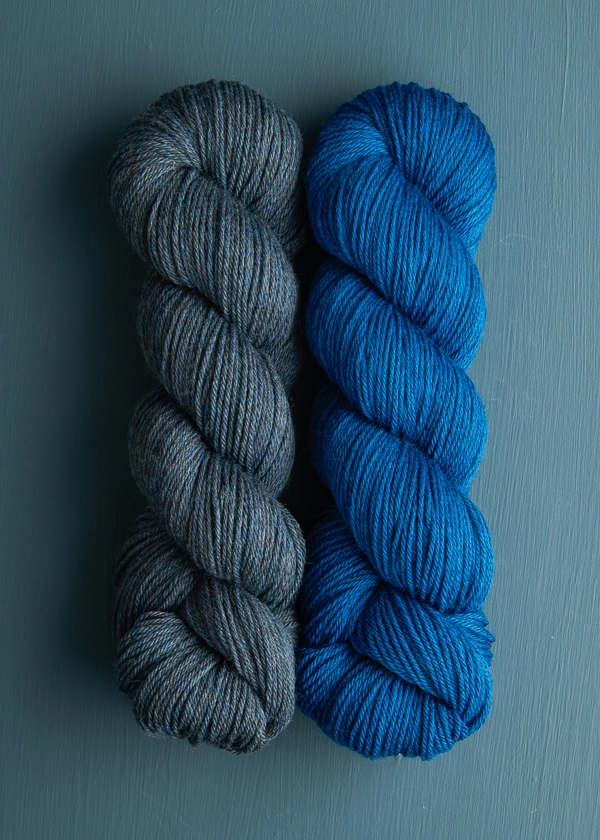
- Purl Soho’s Daily Wool Sport, 100% superwash wool yarn. Each skein of this sport-weight yarn is 300 yards/ 100 grams.
- Main Color (MC): 1 (1, 1, 1–2) skein(s); approximately 85–120 (170–195, 230–250, 295–320) total yards required. We used Teal Storm for one pair of socks and Red Violet for the other.
- Contrast Color (CC): 1 skein; approximately 35 (55, 75, 90) total yards required. We used True Teal with Teal Storm and Ube Purple with Red Violet.
- US 2 (3 mm), 32-inch circular knitting needles for Magic Loop OR a set of US 2 double pointed needles
- Stitch markers, including one unique
GAUGE
36 stitches and 40 rounds = 4 inches in 3×1 rib stitch
28 stitches and 42 rounds = 4 inches in stockinette stitch
SIZES
Little Kid (Big Kid, Adult Small/Medium, Adult Medium/Large)
- Finished Foot Circumference: 4 (5, 6, 7¼) inches, comfortably stretching 2 inches
- Finished Leg Length, from Top of Heel: 5 (7, 8, 8) inches
- Finished Foot Length: Adjustable
Samples: We knit the Adult Small/Medium to fit a women’s US size 7.5.
NOTES
STITCH MULTIPLE
This stitch pattern works over a multiple of 4 stitches.
DOUBLE POINTED NEEDLES OR MAGIC LOOP
This pattern includes instructions for working on either double pointed needles or long circular needles, using the Magic Loop method. We have tutorials for both techniques, so just pick the approach you prefer!
To help decide, visit our How To Knit With Double Pointed Needles Tutorial and our Magic Loop Tutorial.
SLIP STITCHES
On right-side rows: Slip stitches purlwise with yarn in back (wyib).
On wrong-side rows: Slip stitches purlwise with yarn in front (wyif).
PATTERN
LEG
With Contrast Color (CC), loosely cast 32 (40, 48, 56) stitches onto needles, dividing the stitches
among 4 double pointed needles or arranging them on circular needles for Magic Loop (see Notes). We used a basic Long Tail Cast On.
Place unique marker and join for working in the round, being careful not to twist the stitches.
Round 1: *K3, p1, repeat from * to end of round.
Repeat Round 1 until Leg measures 2½ (3½, 4, 4) inches from cast-on edge.
Cut CC.
Join Main Color (MC).
Repeat Round 1 until Leg measures 5 (7, 8, 8) inches from cast-on edge.
HEEL
WORK HEEL FLAP
Set-Up Row 1 (right side): [K3, p1] 2 (3, 3, 4) times, turn work so wrong side is facing you.
Set-Up Row 2 (wrong side): Slip 1 (see Special Instructions), [p3, k1] 4 (5, 6, 7) times, removing end-of-round marker as you come to it; turn work so right side is facing you.
Arrange stitches so 17 (21, 25, 29) Heel stitches are on one needle, then working over just these stitches…
Row 1 (right side): Slip 1 (see Special Instructions), *k3, p1, repeat from * to last 4 Heel stitches, k4.
Row 2 (wrong side): Slip 1, *p3, k1, repeat from * to last 4 Heel stitches, p4.
Repeat Rows 1 and 2 ten (12, 14, 16) more times.
TURN HEEL
NOTE: The “gap” we refer to in this section is the visible space between the stitches caused by having turned the work at that point in the previous row.
Still just working the Heel stitches …
Row 1 (right side): K1, knit 2 together (k2tog), k7 (9, 11, 13), slip slip knit (ssk), k1, turn work so wrong side is facing you. [15 (19, 23, 27) Heel stitches remain]
Row 2 (wrong side): Slip 1, p3, purl 2 together (p2tog), p1, turn work. [14 (18, 22, 26) Heel stitches remain]
Row 3: Slip 1, knit to 1 stitch before gap, ssk (with stitch before and stitch after gap), k1, turn work. [1 stitch decreased]
Row 4: Slip 1, purl to 1 stitch before gap, p2tog (with stitch before and stitch after gap), p1, turn work. [1 stitch decreased]
Repeat Rows 3 and 4 one (2, 3, 4) more time(s). [10 (12, 14, 16) Heel stitches remain]
Next Row (right side): K1, make 1 right (m1R), knit to end of Heel stitches. Do not turn work. [11 (13, 15, 17) Heel stitches]
GUSSET
NOTE: To learn how to pick up and knit, visit our Picking Up Stitches Tutorial and scroll down to the Along A Vertical Edge: Stockinette Stitch section.
Pick-Up Round (right side): Pick up and knit 12 (14, 16, 18) stitches along Heel Flap selvage, place marker (pm); working across on-hold instep stitches, [k3, p1] 3 (4, 5, 6) times, k3, pm; pick up and knit 12 (14, 16, 18) stitches along other selvage of Heel Flap; working across Heel stitches, k6 (7, 8, 9) and place unique marker for new end of round at approximate center of sole. [50 (60, 70, 80) total stitches: 15 (19, 23, 27) instep stitches; 35 (41, 47, 53) stitches for Gussets and sole]
Round 1: Knit to 2 stitches before next marker, p2tog, slip marker (sm), [k3, p1] 3 (4, 5, 6) times, k3, sm, slip slip purl (ssp), knit to end of round. [2 stitches decreased]
Round 2: Knit to one stitch before next marker, p1, sm, [k3, p1] 3 (4, 5, 6) times, k3, sm, p1, knit to end of round.
Repeat Rounds 1 and 2 eight (9, 10, 11) more times, ending with Round 2. [32 (40, 48, 56) stitches remain: 15 (19, 23, 27) instep stitches; 17 (21, 25, 29) sole stitches]
FOOT
Round 1: Knit to one stitch before next marker, p1, sm, [k3, p1] 3 (4, 5, 6) times, k3, sm, p1, knit to end of round.
Repeat Round 1 until Foot measures 1 (1¼, 1½, 1¾) inches less than desired final length, measuring from back of Heel.
Here are final Foot lengths for most sizes (remember to end 1 [1¼, 1½, 1¾] inches shorter than these lengths)…
SMALL KID SIZES
- US size 3 shoe (European 18) = 4⅜ inches
- US size 6 shoe (21) = 5¼ inches
- US size 9 shoe (26) = 6¼ inches
- US size 10C shoe (27) = 6½ inches
- US size 11C shoe (29) = 7 inches
- US size 13C shoe (31) = 7½ inches
BIG KID SIZES
- US size 1Y shoe (European 32) = 7¾ inches
- US size 2Y shoe (33) = 8 inches
- US size 3Y shoe (34) = 8½ inches
- US size 4Y shoe (36) = 8¾ inches
- US size 5Y shoe (37) = 9 inches
- US size 6Y shoe (39) = 9¾ inches
WOMEN’S SIZES
- US size 6 shoe (European 37) = 9 inches
- US size 7 shoe (38) = 9¼ inches
- US size 8 shoe (39) = 9⅝ inches
- US size 9 shoe (40) = 10 inches
- US size 10 shoe (41) = 10⅜ inches
MEN’S SIZES
- US size 9 shoe (European 42) = 10½ inches
- US size 10 shoe (43) = 10¾ inches
- US size 11 shoe (44) = 11 inches
- US size 12 shoe (45) = 11½ inches
- US size 13 shoe (46) = 11¾ inches
TOE
Round 1: Knit to 3 stitches before next marker, k2tog, k1, sm, ssk, knit to 2 stitches before next marker, k2tog, sm, k1, ssk, knit to end of round. [4 stitches decreased]
Round 2: Knit to end of round.
Repeat Rounds 1 and 2 four (5, 6, 7) more times. [12 (16, 20, 24) stitches remain]
Repeat Round 1 one more time. [8 (12, 16, 20) stitches remain]
Partial Round: [Knit to next marker, remove marker] 2 times, k1.
Arrange remaining stitches on two needles, with next 4 (6, 8, 10) stitches on one needle and last next 4 (6, 8, 10) stitches on second needle.
Cut yarn, leaving a 10-inch tail.
FINISHING
NOTE: For help with Kitchener Stitch, please visit our Kitchener Stitch Tutorial!
Hold needles parallel to each other and use the 10-inch tail threaded onto a tapestry needle and Kitchener Stitch to close Toe.
Weave in ends, and then make another sock!
Block both socks by soaking them in soapy room temperature water, then rinse and squeeze out excess water and lay flat to dry. To wash socks after you wear them, do the same, or if you’re using Daily Wool Sport yarn, machine wash alone in cold water and tumble dry low
Share your progress and connect with the community by tagging your pics with #PurlSoho. We can’t wait to see what you make!
Learn About Daily Wool Sport + All Our Beautiful Yarns
This project is incredibly soft and conveniently machine wash- and dry-able in our beautiful Daily Wool Sport, a 100% superwash wool yarn. A round yarn spun from 4 tidy plies, this sport-weight yarn is un-prone to pilling, with a bounce to its step and a lovely stitch definition. Daily Wool Sport is ready to knit and wear on repeat!
More Free Knitting Patterns
- Be sure to explore our growing collection of Daily Wool Sport knitting patterns and cast on!
More Sport-Weight Yarns
- Shop our entire collection of sport-weight yarns (What is sport-weight yarn, really? Learn all about sport-weight yarn in our deep-dive article!)
- If you want to use a different yarn, be sure to take the time to get the correct gauge. Need help? Check our All About Gauge Tutorial, our Yarn Substitution article, and our Complete Guide To Yarn for lots of helpful information.
More Yarns With Similar Fiber
- Shop Daily Wool Worsted, this yarn’s worsted-weight sibling
- Shop machine-washable yarn
- Shop superwash wool yarn
- Shop wool yarn
Looking for more inspiration? Explore all of our knitting patterns (including tons of free knitting patterns) and knitting tutorials, buy one of our many knitting kits and yarn bundles, and shop for beautiful yarn. We have over 55 gorgeous natural fiber yarns in 1,000s of magnificent colors, designed to bring integrity, beauty, and joy to your next knitting project and only available at Purl Soho!



Fabulous
What about using 9 inch circular needles. Doesn’t anyone use those? I love mine! Seems like no one ever includes those in the pattern instructions. I call discrimination. 😉☺️
Hi Judy!
Thank you for writing in! You are absolutely welcome to use 9″ circular needles if they’re your favorite. Many knitters love them, especially for socks, sleeves, and other small-circumference projects. We don’t list them in most pattern instructions simply because not everyone finds them comfortable, and some sections can still require switching to DPNs or Magic Loop depending on the project and knitter.
That said, if 9″ circulars work for you, go for it! Knitting should feel good in your hands, and there’s always room to adapt tools to suit your style. No discrimination here! Just lots of love for knitters who know what they like!
Warmly,
Megan
When I print this to pdf the images are broken. Is there a way to get the pattern with the images for free, or do I need to pay for the pattern with images?
Hi KT!
Thank you for your question! You definitely don’t need to pay for the pattern — it’s completely free, images included.
If the images are breaking when you print to PDF, the best way to handle this is to use the built-in print feature on the pattern page rather than your browser’s print function. On a desktop, you’ll see a small “print” icon in the right column just below the “Save to Favorites” button. On mobile, the print icon appears below the pattern and above the comments. Clicking that icon opens a special print window where you can customize exactly what gets included. When you hover over text or images, they’ll highlight and a small trash icon appears, allowing you to remove anything you don’t want before creating your PDF.
Once you’ve adjusted the layout, click the “PDF” button in the upper left of that window. After it finishes generating, use the “Download PDF” option to save it directly to your computer. We’ve found that downloading the PDF first and then opening it from your computer (instead of viewing it in a browser tab) usually resolves image issues. If you’re still running into trouble, right-clicking or control-clicking the download link and choosing “Download linked file” can also help ensure everything saves correctly.
If the problem continues, feel free to reach out to us at [email protected] and we’ll be happy to help troubleshoot further!
Warmly,
Megan
What would you substitute that would be a wool nylon blend, which is what I thought was the only way to go for socks. Thank you!
Hi Nancy,
We’re glad you asked this and are happy to clarify! While nylon adds durability to socks, it isn’t absolutely necessary to include in sock yarn. All you really need is a stretchy fiber and superwash wool is extra helpful because socks need to be washed more than the average accessory… Another benefit of superwash wool is that they tend to be more resistant to pilling over time. Pilling will make socks run down faster, so it’s something to keep in mind if you’re concerned about longevity.
That said, we don’t have any sport weight yarns with nylon that we can recommend as a substitute for this pattern, but you can always try a standard fingering weight sock pattern like our Easy Heel Colorblock Socks or our Perfect Fit Socks and use our Fine Print or Stormy Superwash Sock yarn instead! Both are made up of superwash merino and nylon, so they’re even better for sock projects!
All the best,
Zha Zha
I think I might have interpreted the heel flap section in correctly. For the flap rows I did the two initial rows and then it said to repeat those rows 14x for the adult small size. So I did a total of 30 rows. But now I think the heel flap is much too long— it’s about 4.5 inches. Can you confirm/help? Thank you!!
Hi Nicole!
Thanks so much for writing in with your question. Great work so far on your Block Party Socks!
I can understand how this could be a little tricky and I’m happy to help!
Your interpretation of the pattern seems spot on! Great work! I wonder if you knit and blocked a gauge swatch before starting? It looks like the row gauge for ribbing should be 10 rounds per inch. So after 30 rounds, you should be close to 3 inches rather than 4.5 inches.
If you’re still running into concerns, please feel free to send us an email (with a photo of your heel flap and a ruler measuring the flap) to [email protected] and we would be glad to take a look for you!
I hope this helps! Please feel free to reach out with any other questions.
Happy knitting!
Hills
That does help— knowing it’s a gauge issue and not that I did too many rows. I checked my gauge for the cuff and it is just over an inch per 10 rows. So I redid the heel flap keeping a tighter gauge and it’s now just under 3.25 inches, so I think I’m in good shape now. Thank you!
Hi Nicole!
I’m so glad to hear this was helpful! I hope you enjoy knitting your Block Party Socks. Please don’t hesitate to reach out with any other questions you might have. We’re always happy to help!
Happy knitting!
Hills
I have reached the “turn heel” section with 25 stitches on my needle. I must be interpreting Row 1 incorrectly because I don’t come up with 25 stitches. I am reading it as K1, K2tog, K2tog, K11, slip, slip, K which only adds up to 19 stitches unless the last K means to go to the end of the row. Please advise. I left my phone number on your message machine if it would be easier to explain it that way. Thank you.
Hi Maxine!
Thanks so much for writing in today. I’m so happy to hear you’re working on the Block Party Socks, and I’m happy to help.
Turning the heels are a bit like short rows, you’ll only work partially across the row before turning the work. I did copy the directions for Row 1 below; I just wanted to note that the k2tog and ssk are not duplicated… it’s written out with the full terminology first, and then we give the abbreviation afterwards so that we can reference that abbreviation moving forward.
Row 1 (right side): K1, knit 2 together, k 11, slip slip knit, k1, turn work so wrong side is facing you. [23 Heel stitches remain].
You’ll only knit 17 of the 23 stitches on your first row.
I hope this helps, and happy knitting!
Hills
I am still having difficulties. If I start the turn heel section with 25 stitches and I only k2tog one time on row 1, why do
I have 23 stitches and not 24? I have made your other sock patterns and never had so many problems. I am not sure what I am doing wrong. Please help! I don’t want to give up.
Hi Maxine,
Thanks so much for your reply. I’m so sorry to hear you’re running into difficulties here, and I’m happy to help.
It’s pretty common for folks to pick up extra stitches when working flat, either through picking up the bar at the end of the row, or by accidentally adding a yarn over when turning the work. The slip slip knit is also a decrease, so you should be decreasing by two stitches to a total of 23 stitches after your first row turning the heel. Each row after that, you’ll decrease by 1 stitch until you’re down to 15 stitches.
If you still run into trouble, I’d suggest scheduling a 1-on-1 Help session so we can work through it together. We would love to help!
Happy knitting,
Hills
any advice for knitting magic loop two socks at a time?
Hi Josephine,
Thank you so much for writing in with your question. I’m so glad the Block Party Socks caught your eye.
I’d suggest checking out this handy tutorial on Magic Loop: Two At A Time. I hope this helps!
Happy knitting,
Hills
Working well! But do you have a video for working heel two at a time on magic loop?
Hi Josephine,
Thank you so much for your reply!
While we don’t currently have a tutorial for the heel portion of the sock-making process, I think that’s a really great idea, and I’d be happy to pass your suggestion along to our team.
In the meantime, I’d recommend using your preferred search engine to search for “turning the heel two at a time.” I hope you find exactly what you’re looking for, but we also would love to work on this together in a 1-on-1 Help session if you’d like!
Wishing you happy knitting!
Hills
Good day
I want to know if you can use more stiches. My husband socks is a 72 stitches when I knit his socks
Hi Antoinette,
Thank you so much for reaching out!
I’m so sorry to share that this pattern is currently only available up to a cast-on of 56 stitches. It would require some substantial reworking on our end to make this pattern available in a larger size, and resources that aren’t currently available to us. We do look forward to offering a wider range of sizes in the future, and I’m really grateful for you reaching out to let us know your interest in resizing this pattern! I will be sure to pass your feedback along to our team.
You might consider taking a look at our Sweet + Simple Socks, or the Easy Heel Colorblock Socks, which both size up to around 80 stitches cast-on, but do feature ribbing in the cuffs.
Thank you again for reaching out, and please don’t hesitate to reach back out in the future.
Happy knitting,
Hills
Q re “turn heel” row 1 (right side) do we do k2tog twice? I think yes to get 27 stitches at end of row 1.
and on row 2 p2tog also twice? I think no to get to 26 stitches at end of row 2.
TY.
Hi Josephine,
Thank you so much for reaching out! Great work on your Block Party Socks so far!
For Row 1 in the heel turn, you’ll want to k2tog once and ssk once. The instructions are written stylistically with the long name and the abbreviation so that we can refer to the abbreviation only later in the pattern. This also applies to the p2tog in Row 2. I’ve included Row 1 written below with just the abbreviations for your reference.
The number of stitches you’re hoping to reach will align with the size of the sock you’ve chosen to make. If you’re making the Adult Medium/Large, you’ll want to reach 27 stitches at the end of Row 1, but if you are making the Adult Small/Medium, for instance, you’ll want to reach 23 stitches. You might enjoy reading more in our article on How to Read a Knitting Pattern.
I so hope this is helpful, and please feel free to reach back out with any follow-up questions!
Happy knitting,
Hills
Hello, Thank you for the wonderful pattern. I am having fun knitting the socks and I looove the daily wool sport. It is a pleasure knitting with such a defined and so soft yarn.
I am working on a MED adult and so, when working the WORK HEEL FLAP SESSION, I am reading SET UP ROW 2 ( wrong side) as:
Slip 1 [p3, k1] 6 times… do I SLIP 1 only once at the beginning of that set up row OR do I SLIP 1 every time for the 6 times I am to repeat the P3k1… (I am capitalizing for my clarity; not intended for yelling ). Thank you for your time.
Hi Julia,
I’m so glad you’re loving the Block Party Socks and Daily Wool Sport! Great work on your socks so far, too!
This is a really great question. You only have to repeat what is listed within the brackets. This means you’ll only be slipping at the beginning of the round.
I hope this works well for you… Please let us know if you run into any other trouble! We’re always here and happy to help.
Happy knitting!
Hills
Hello,
I’m confused on the Heel Flap. For the Set-Up Rows 1 and 2,
these are actually not complete rows, correct? As I read it, Set-Up Row 1 will be 16 stitches for size L and Set-Up Row 2 will be 28 stitches for a total of 44 stitches (total cast on was 56) so I’m not reaching all the way around the sock, right?
I wonder why. Hope you can decipher what my problem is!
Hi Laurie,
Thanks for reaching out! Don’t worry, you’re on exactly the right track for how the Heel Flap is worked because that is the point at which you’ll change from working in the round to working flat.
The “Heel” section is basically a series of short rows that are worked to build out and shape the heel, before continuing in full rounds again to knit the foot of the sock. So you’re correct in thinking that you will only be working those 44 stitches, while the other 12 stitches hang out on your cord until the “Gusset” section.
I hope this gives you a better idea of why/how the heel is created! If you have any other questions, please let me know.
Kindly,
Sam
Hi again,
I’m working along on my Block Party socks (love the yarn) and
I’ve run into trouble on the Gusset. I’ve picked up all stitches on both sides and am at Round 1: where the pattern talks about p2tog…
ssp. I’ve purled 2 together from the knit side, done the steps in
between and am now at the ssp. Do I do this from the knit side (which is how I’m working these socks) or do I need to turn my work?
I don’t think I need to turn it b/c earlier in the pattern you were very specific about when I needed to turn. But the tutorial works from the
purl side. Could you help please?
Thanks!
Hi Laurie,
I’m so sorry to read you’ve run into some trouble with your gusset; socks can sometimes be a little troublesome, and I’m happy to help!
You’re definitely on the right track! The gusset is creating the triangular shaping near the ankle/instep and heel. You’re correct in your approach to reading the pattern; You’ll be working from the same side (the right side) for the whole round, so you don’t need to turn your work. After turning the heel, the gusset transitions into the foot through decreases. Great work!
I can see how it could be a little tricky; usually this decrease is worked from the purl side, which is why the tutorial shows the skill from the purl side. Here, though, you’re working a purled decrease at the point where stockinette moves into a 3 x 1 rib stitch. These gusset decreases should be purl stitches, which create that valley/dip you see near the ankle connecting the instep to the heel. It may be a little bit easier to see this detail on a sock without ribbing… You can see this technique a bit more clearly in our Boot Socks.
I hope this is helpful. If you’re still running into trouble, please feel free to reach back out. We’d be glad to help get you back on track!
Happy knitting,
Hills
Thanks very much for your help on this, Hills.
I’ve got it now–looks like smooth sailing for this part of my socks
(first try with socks:-/ )
Laurie
Hi Laurie,
I’m so glad to read this worked out for you…fantastic job! There’s always something new to learn with knitting, and we’re always here if you run into trouble! Please feel free to reach back out anytime. You’ve got this!
Good luck and happy knitting,
Hills