Your basket is empty.
Continue Shopping
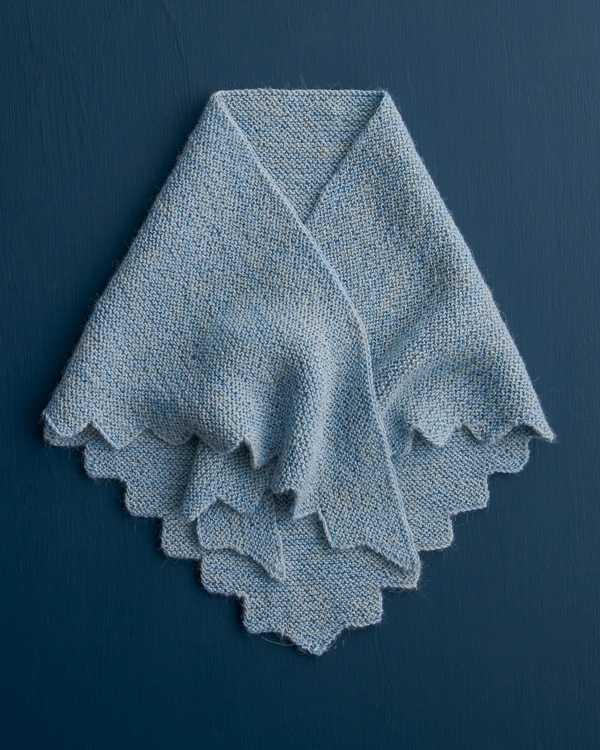
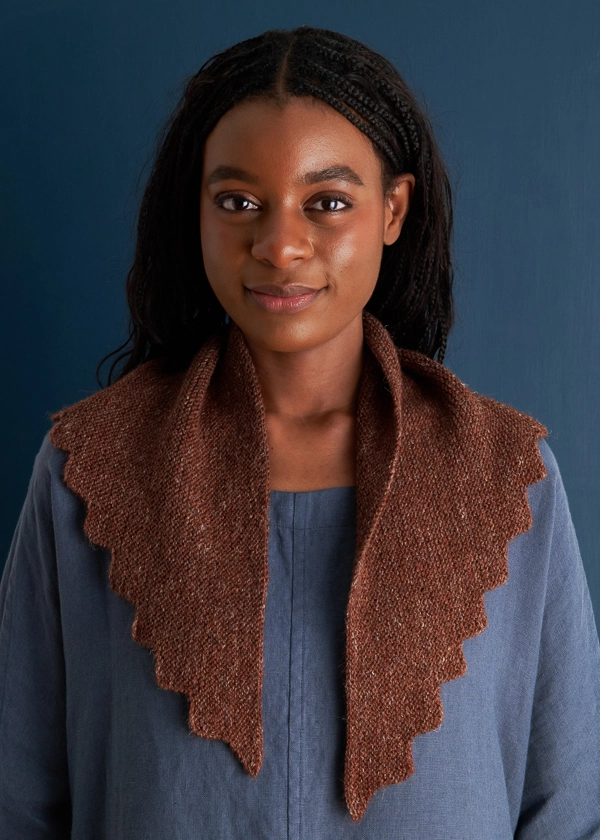
Larkspur Bandana
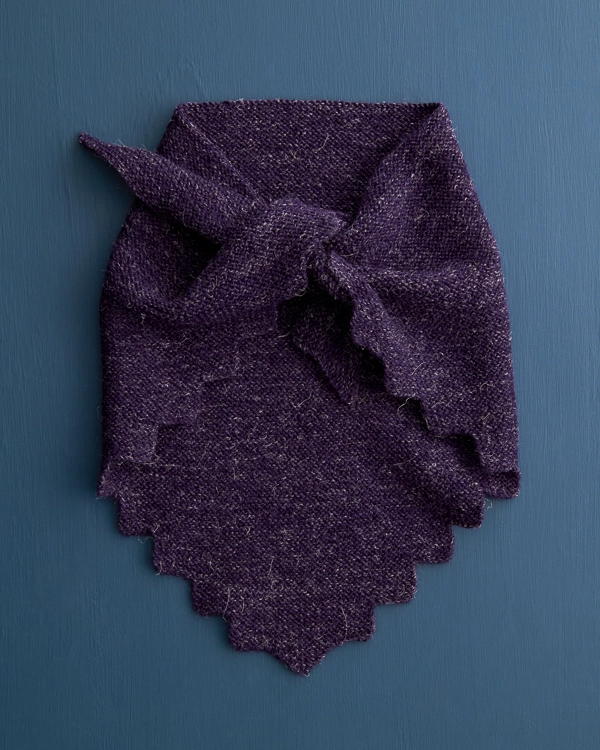
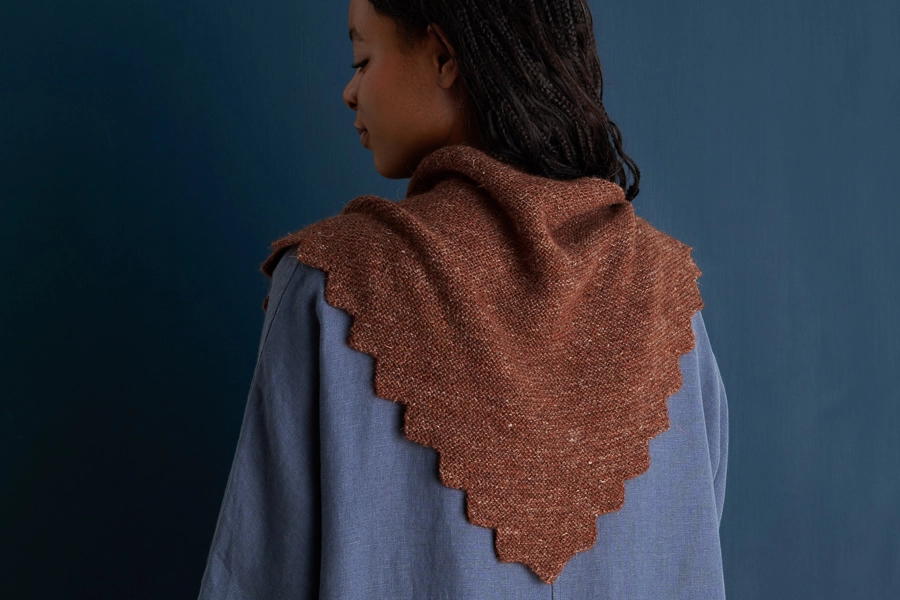
Our Larkspur Bandana pattern translates the delicate spurs of its namesake flower into a tiered triangle, while our Linen Quill yarn lends a hint of untamed charm—like tall spires of lush blossoms bursting from orderly beds.
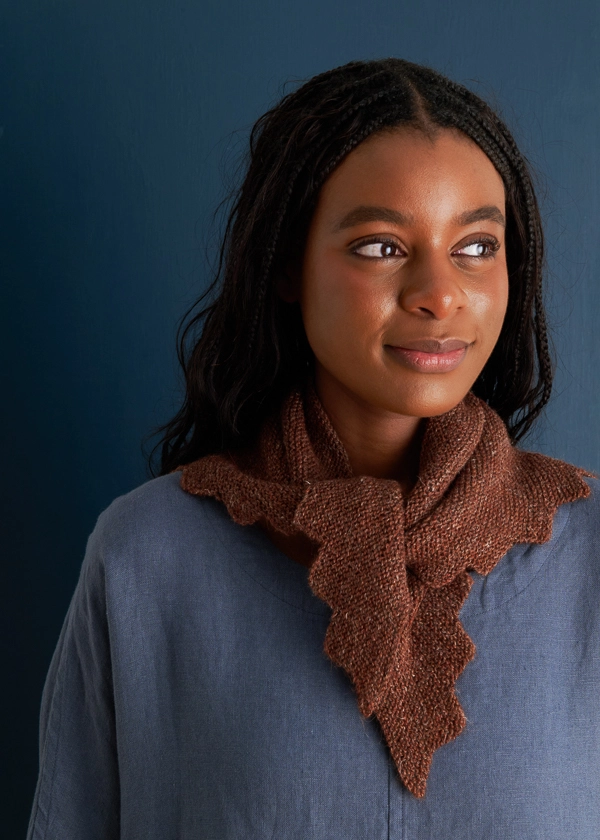
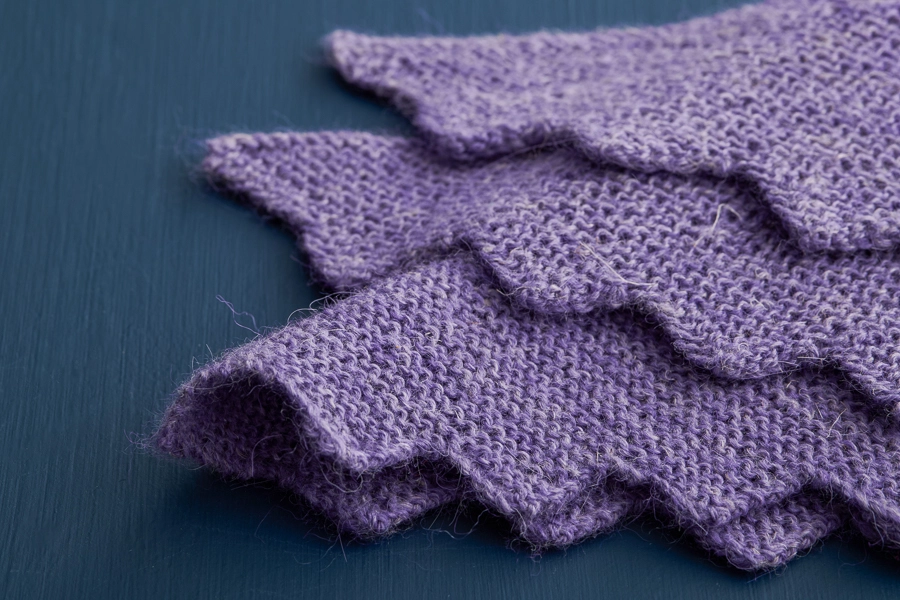
The bandana grows from the bottom point, ascending skyward in neat step-like terraces. You use the Cable Cast On method to shape each new tier, casting on loosely for a relaxed and fluid edge.
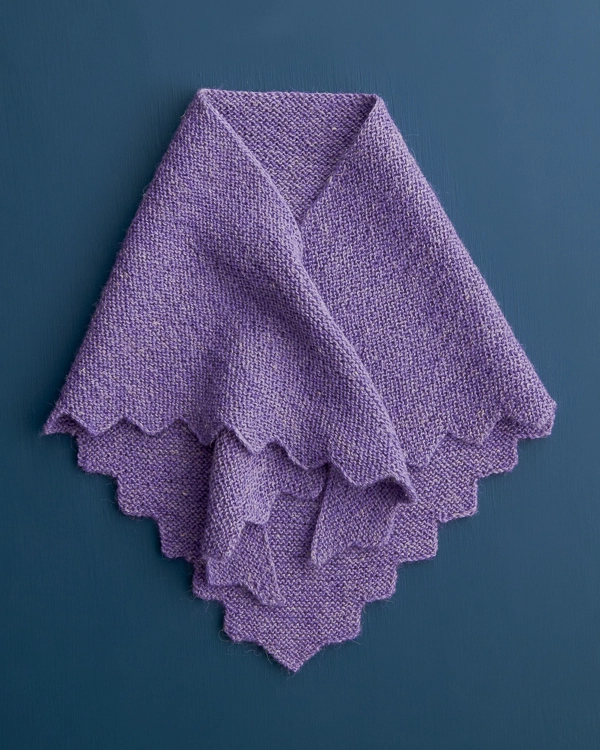
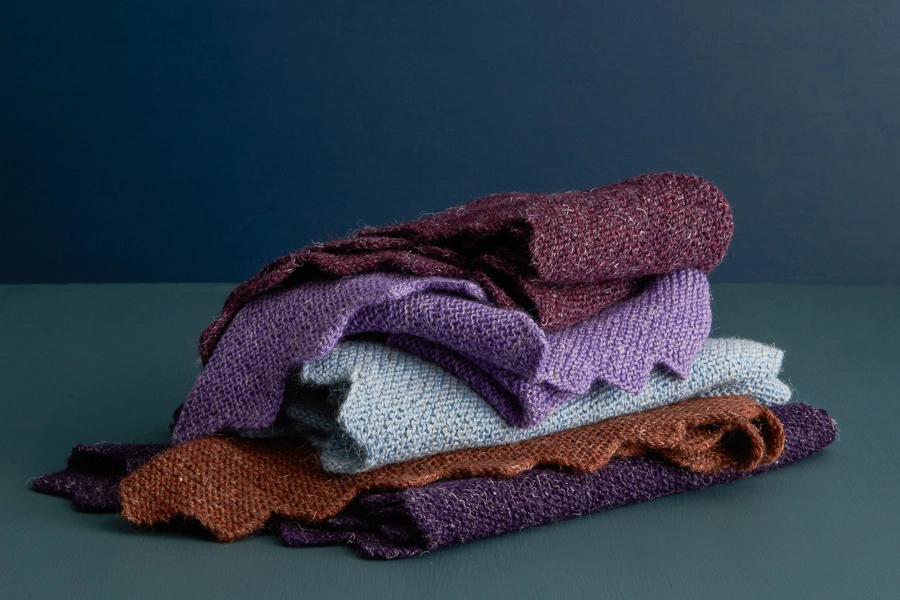
Worked in rhythmic garter stitch, it’s an easy, meditative knit, the structure drawing you gently from one rise to the next. For the tidy Bandana size shown here, you’ll need just one skein of Linen Quill, while three skeins are enough for the generous span of the scaled-up Shawl size.
Cast on with Linen Quill and you’ll see why it’s our most popular yarn of all time. A fingering-weight mix of fine highland wool, alpaca, and linen, it pairs the springiness and durability of wool with alpaca’s long-fiber softness, while the linen gives the yarn its rustic elegance and remarkable depth of color. Spun in Peru and inspired by traditional yarns of the Andean highlands, it brings character and complexity to even the simplest stitches.
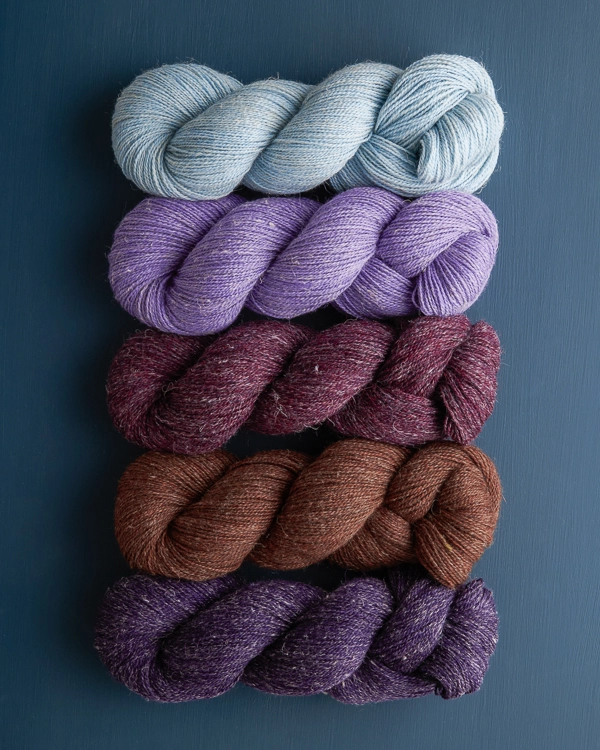
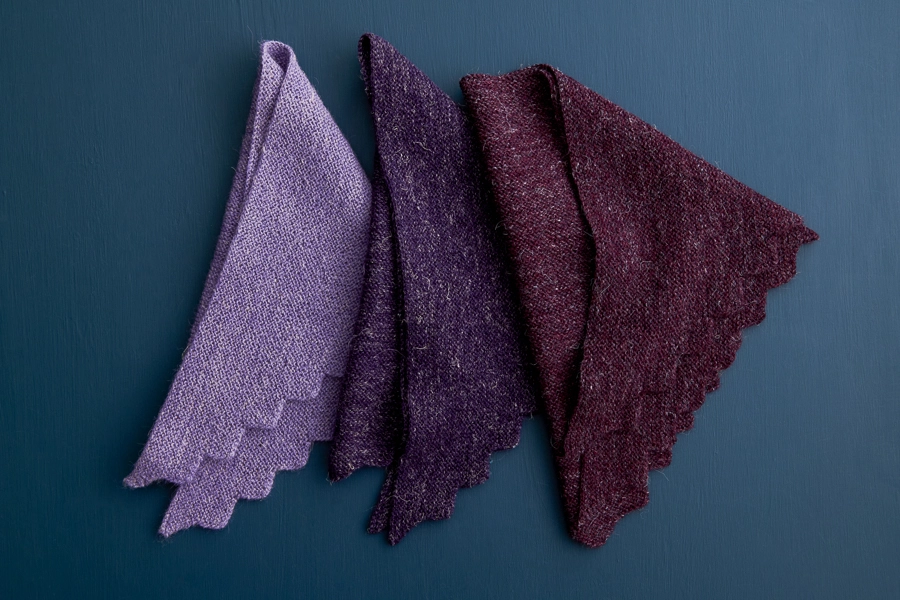
For our Larkspur Bandanas, we chose blues and purples that echo columns of layered petals—Deep Petunia, Dark Iris, Sugar Plum, and Light Cerulean—grounded by rich, sun-warmed Hazelnut Brown. With 75 nature-inspired shades to explore, Linen Quill offers a whole garden of possibility.

Balancing orderly shaping with nuanced color and the quiet wildness of linen, the Larkspur Bandana is ready to bloom on your needles—a modern heirloom to knit, wear, and treasure.
Yarn lovers, if you adore the yarn used in this project, you’ll love exploring all of our other yarn collections! Discover over 55 thoughtfully designed yarns in nearly every natural fiber and in every spectacular color you can imagine. Only available here at Purl Soho’s online yarn store, where every skein is created with care and your creativity in mind!
Pattern designed and written by Purl Soho founder and co-owner, Joelle Hoverson.
Story written by Andrea Lotz for Purl Soho.
Want to print this pattern? On desktop, find the “print” icon in the right margin, and on mobile, scroll to the end of the pattern for it. Use the on-screen instructions to remove anything you don’t want to print!
Materials
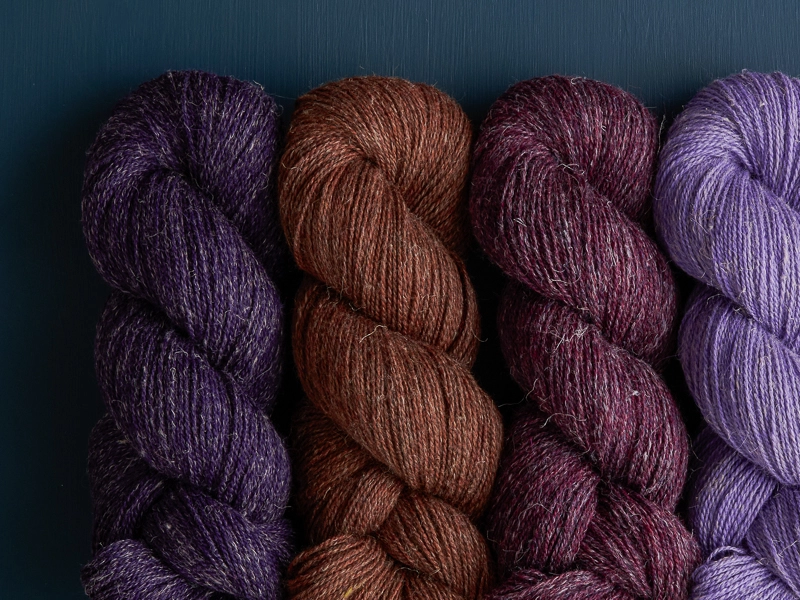
- 1 (3) skein(s) of Purl Soho’s Linen Quill, 50% fine highland wool, 35% alpaca, and 15% linen. Each skein of this fingering-weight yarn is 439 yards/ 100 grams; approximately 439 (1185) yards required. We used the colors Deep Petunia, Hazelnut Brown, Dark Iris, Sugar Plum, and Light Cerulean.
- US 3 (3.25 mm), 16- and 32- or 47-inch circular knitting needles (NOTE: You can use just the 32- or 47-inch needles, but they may be a bit unruly at the beginning of the project when you’re working only a few stitches!)
- A removable stitch marker
GAUGE
24½ stitches and 56 rows (28 ridges) = 4 inches in garter stitch
NOTE: To check your gauge (and save yarn!), we recommend casting on and knitting the pattern for a few inches, then place your work on scrap yarn without cutting the main yarn and block your piece. If necessary, frog and re-knit on different needles.
SIZES
Bandana (Shawl)
- Finished Length of Wingspan: 36 (58¾) inches
- Finished Length of Each Short Side: 23¾ (39) inches
- Finished Length from Cast-On Point to Middle of Bind-Off Edge: 15¾ (25¾) inches
Samples: We knit the Bandana size.
NOTES
GARTER RIDGE
A “garter ridge” equals two rows of garter stitch. It looks like a prominent horizontal ridge and is an easy way to count rows!
CABLE CAST ON SET-UP STITCH
This is a preparatory step before you begin your regular cable cast on. It helps keep your cast on tidy and ensure there are no gaps between your stitches.
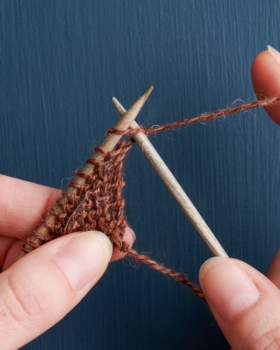
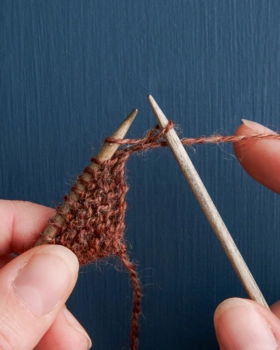
Knit the next stitch, but do not let it drop off the left needle. Here’s how…
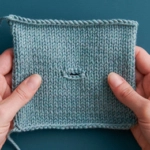
Insert right needle into next stitch as if to knit and wrap working yarn like you would for a normal knit stitch (above, left). Pull the stitch through onto your right needle, but don’t let any stitches drop off left needle (above, right).
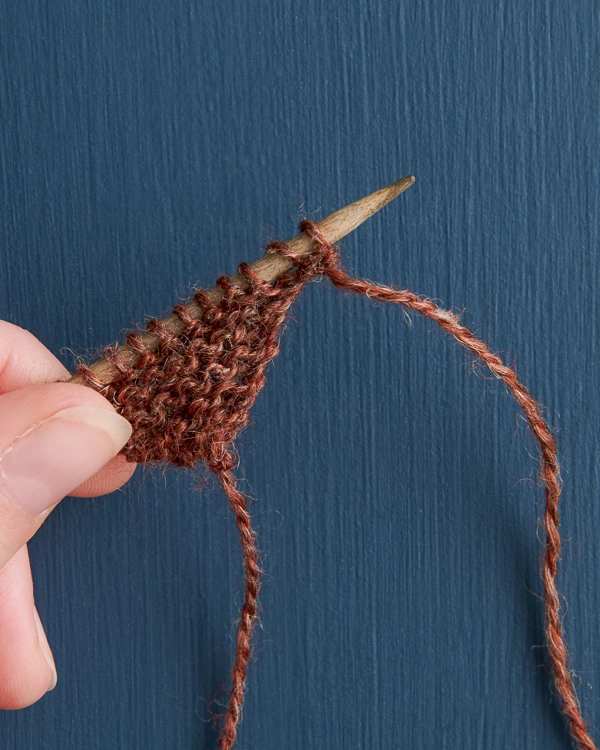
Then, without twisting it, slip the stitch from your right needle to the left needle, as you would for a normal cable cast on stitch. That’s all there is to it… you’re ready to complete your cable cast on!
CABLE CAST ON
For a video of how to do a Cable Cast On, visit our Cable Cast On Tutorial. Make sure you work this technique extremely loosely in this pattern!
PATTERN
CAST ON + SET UP
Place a slip knot on your needle. Our basic Long Tail Cast On Tutorial shows you how!
Set-Up Row (wrong side): Knit front and back (kfb). [2 stitches]
Row 1 (right side): Kfb, k1. [3 stitches]
NOTE: To help you stay oriented, place a marker on previous row to indicate the right side.
Next Row: Kfb, knit to end of row. [1 stitch increased]
Repeat last row 8 (20) more times, ending with a wrong-side row. [12 (24) stitches; 6 (12) garter ridges (see Notes)]
INCREASE
Increase Row 1 (right side): Without turning the work, make a cable cast on set-up stitch (see Notes), then cable cast on 6 (12) stitches (see Notes), knit across all cable-cast-on stitches and then knit to end of row. [7 (13) stitches increased]
Increase Row 2 (wrong side): Repeat Increase Row 1. [7 (13) stitches increased]
Knit 12 (24) rows even, ending with a wrong-side row.
In this section, 14 (26) stitches increased and 7 (13) ridges added.
CONTINUE
Repeat Increase section 13 (11) more times, switching to longer circular needles when necessary. [208 (336) stitches]
FINAL INCREASE
Beginning with a right-side row…
Next Row: Kfb, knit to end of row. [1 stitch increased]
Repeat last row 11 (23) more times, ending with a wrong-side row. [220 (360) stitches]
With right side facing you, bind off loosely to end of row.
FINISHING
Weave in ends and gently wet block.
Share your progress and connect with the community by tagging your pics with #PurlSoho. We can’t wait to see what you make!
Learn About Linen Quill + All Our Beautiful Yarns
We designed this project to highlight the uniquely beautiful qualities of our Linen Quill, a wonderful fingering-weight yarn that is a blend of 50% wool, 35% alpaca, and 15% linen. It feels amazing in your hands, and in 70 jaw-droppingly gorgeous colors, Linen Quill is the candy store of yarn! Want to play with lots of those amazing colors? Check out our Linen Quill Minis, available in 40- and 20- color bundles, and be sure to read our article, Linen Quill: A Closer Look At Our Most-Loved Yarn, to learn all about what makes it so special.
More Knitting Patterns
- Be sure to explore our vast collection of (mostly free!) Linen Quill knitting patterns and cast on!
More Fingering-Weight Yarns
- Shop our entire collection of fingering-weight yarns (What does fingering-weight yarn mean, really? Our guide to fingering-weight yarn will answer your questions and more!)
- If you want to use a different yarn, be sure to take the time to get the correct gauge. Need help? Check our All About Gauge Tutorial, our Yarn Substitution article, and our Complete Guide To Yarn for lots of helpful information.
More Yarns With Similar Fibers
- Shop wool yarn
- Shop alpaca yarn
- Shop linen yarn
Looking for more inspiration? Explore all of our knitting patterns (including tons of free knitting patterns) and knitting tutorials, buy one of our many knitting kits and yarn bundles, and shop for beautiful yarn. We have over 55 gorgeous natural fiber yarns in 1,000s of magnificent colors, designed to bring integrity, beauty, and joy to your next knitting project and only available at Purl Soho!
Similar Posts You Might Enjoy:



Can I use the line weight as a substitute for the linen quill since they’re both fingering weight?
Hi Olimpia,
Thanks for writing in about this! You can absolutely substitute Line Weight, and I think it will make a beautiful bandana! Line Weight is just a bit lighter than Linen Quill, so you may want to size up your needles to get the same gauge (or you could just knit the pattern as is and you may end up with a slightly smaller bandana).
We hope this helps! Let us know if you have any questions.
Kindly,
Allison
hello! this pattern is so cute and so simple! thank you for providing it for free. Is there a typo with the cable cast on setup?
original instruction:
“Then, without twisting it, slip the stitch from your right needle to the left needle, as you would for a normal cable cast on stitch”
suggestion:
“Then, without twisting it, slip the stitch from your left needle to the right needle?”
Hi there,
Thanks for reaching out about this! We checked on this, and the pattern instruction is correct!
For the cable cast-on, you’ll form the new stitch with your right needle, but then you’ll place it on your left needle to work as a usual stitch. The Cable Cast-On Setup Stitch shows the newly cast on stitch on the right needle (in the second photo), which then has been placed on the left needle (in the third photo).
We hope this helps clarify! Let us know if you have any questions.
Kindly,
Allison
Where are your lace patterns? I hate straight garter/stockinette stitch; it’s so boring! For me, the harder, the better!
Hi Hollis,
Thanks for reaching out about this! If you love lace, I recommend checking out the Botanical Lace Wrap, the Laurel Wrap, and the Garland Shawl. The Aperture Pullover is also lace-like and features lots of interesting techniques!
We appreciate your feedback. We hope this helps!
Kindly,
Allison
Suggest having fun with this and add your own lacy pattern, many can be turned into garter stitch patterns quite easily…I do this quite a bit with plain patterns and it makes it unique.
I am incredibly new so not sure the right length needles to acquire for this project, sounds like straight & circular are both required (I got the 4-5 size!)
Hi Deanna,
Thanks for reaching out about this! For the Larkspur Bandana, we used US 3 (3.25 mm) circular knitting needles in two different lengths: 16- and 32- or 47-inch. The pattern starts with a single stitch and gradually increases in stitch count, so we found it most comfortable to start this project with shorter needles (16″). As we continued knitting and had more stitches on our needles, we switched to longer needles (either 32″ or 47″ will work for this). You won’t need straight needles for this if you have circular needles!
I’m not sure exactly what you mean by 4-5 size needles, but we used US 3 (3.25 mm) throughout the entire project, so that’s what we’d recommend. If you use larger needles, your stitches will be larger and in turn your overall project will be larger, but for a bandana that may work out just fine!
We hope this helps! Let us know if you have any questions.
Kindly,
Allison
Can this be knitted in DK yarn? How much yarn would be needed?
Hi Sharlene!
I’m so glad you wrote in with this question. The Larkspur can absolutely be knit in a DK weight yarn… I’d suggest something with a bit of drape, like Plein Air. Since it is a thicker gauge, you will need more yarn, and to go up a needle size. If you plan to make the bandana size, you will need at least 602 yards, and for the shawl size, at least 1623 yards. That would be 3 or 8 skeins of Plein Air, respectively. (For an alternative yarn suggestion, I would recommend Cashmere Merino Bloom…the yardage is the same, so the skein recommendation remains the same).
I hope this works out nicely for you, and please let me know if you have any other questions!
Happy knitting!
Hillary
The instructions note that you knit the bandana size–but is the brown one in the photo also the bandana size? Seems like it might be larger than the others?
Hi,
Thanks for reaching out about this! We knit the Bandana size for all our samples.
We hope this helps! Let us know if you have any questions.
Kindly,
Allison
The cable cast on set-up stitch leaves a noticeable hole even though I am pulling the yarn tight. Any suggestions to avoid this?
Thank you,
Theresa
Hi Theresa!
Thanks a bunch for reaching out today. I’d love to help you steer clear of any holes. One idea is to try using a smaller needle for your cast-on sections.
Feel free to ask if you have any other questions; I’m here to help!
Hope this helps you avoid holes and that you have a wonderful time knitting your Larkspur Bandana.
Happy knitting!
Hills
I find that the cable cast on set-up stitch is pointless after the very first section (the triangle at the start). Am I missing something? With >3 stitches on the needle can’t I simply use the cable cast on from there on?
Hi Mike,
Thanks so much for reaching out. I’m really glad to hear you’re working on the Larkspur Bandana!
We recommend the set-up stitch to help minimize the possibility of holes forming as you work the cable cast-on. If you’d like to work without this set-up stitch, the pattern should still work well and may just form gaps.
I hope this help, and happy knitting!
Hills
This is a beautiful pattern and I love the look of the linen quill yarn, but I can’t manage the smaller needle sizes well. Would this yarn lend itself to being held double and worked with a size 5 or 6 needle? And do you think that would translate ok for this pattern? Thank you!
Hi Anne!
Thanks so much for reaching out. I would recommend swatching and seeing if you like the feel and look of the resulting fabric. If so, knit away! You might end up with a slightly larger finished bandana (as a heads-up). I would recommend picking up two skeins, instead of one, for the smaller size since you’ll use up more yarn faster (and its way easier to hold two skeins separately!).
I hope this helps!
Happy knitting!
Hills
Hi how much yardage is needed to knit your larkspur bandana?
Hi Carolyn!
Thank you so much for reaching out with your question!
We used close to the entirety of the skein of Linen Quill on average in our samples, so just to be safe we’d recommend 439 yards of Linen Quill. Please keep in mind, if you would like to substitute a thinner yarn, your project may use more yards.
I hope this helps! Please feel free to reach out with any other questions you have.
Happy knitting!
Hills
Hi! Could I knit this with linen quill worsted for a larger wrap? If so, can you recommend a needle size?
My other option is good wool. Would that work? Can you recommend a needle size for that yarn?
Hi Renee!
Thanks so much for reaching out! I think this would be a lovely project and I’m so glad the Larkspur project caught your eye!
You’d need about 137% more yarn, or 1630 yards. That’s about 10 skeins of Linen Quill Worsted. I’d recommend trying a size 6 needle first, and see if you can reach 5 sts/in in your gauge swatch. If you fall somewhere else in the gauge range, then you’d just need to divide the original gauge (6.875 sts/in) by your new gauge to get the ratio between them. You can multiply that number by the original yardage estimate and divide by 164 yards per skein of Linen Quill Worsted. You could do the same kind of math for Good Wool! We’d love to see the final result!
I hope this helps and you love your Larkspur project!
Happy knitting!
Hills
Hello
Just checking. Do you knit 12 rows even after 2 rows of inc each time or just after 2st set?
Hi Lisa,
Thanks so much for writing in with your question. I’m so glad to hear you’re working on the Larkspur Bandana!
Your instinct is spot-on here. Each time you work Increase Row 2, you will follow-up with 12 rows knit even. You don’t need to knit 12 rows even after Increase Row 1, though!
It’s written:
It will look like:
I hope this helps, and please feel free to reach out with any other questions you might have!
Happy knitting!
Hills
Hello, for Increase Row 2 where it says “repeat”, does that mean to repeat the cable cast on stitches on the wrong side? And then knit 12 rows even? Thanks!
Hi Reese,
Thanks so much for your question. I’m so glad to hear considering the Larkspur Bandana!
Your instinct is spot-on here. Each time you work Increase Row 2 you’ll repeat increase Row 1, but on the wrong side (including the cable cast on), and then follow-up with 12 rows knit even. Then you’ll repeat that entire increase section 13 times. This should create symmetry for the project.
I hope this helps, and please feel free to reach out with any other questions you might have!
Happy knitting,
Hills
Hola Hola
Can i keep knitting and make it as a shawl/wrap such as double the length?
Can you please guide me with the info
Thank You so much
Hi Carellano!
Thank you so much for your question. I’m really glad to see the Larkspur Bandana caught your eye!
To double the length, you would also need to double the height for this pattern to keep the shawl proportional. The original area of the triangle is 756.4 inches squared and uses 1,185 yards. If the height were 51.5 (double the original height), the resulting length of the wingspan would be 117.5 inches…bringing our new area to 3,026 inches squared. In proportion with the original shawl, the new yardage required would be 4,740 yards (11 skeins of Linen Quill).
I hope this helps, and please feel free to reach out with any other questions you might have!
Happy knitting,
Hills
Is it possible to increase the bandanna size by a few inches? If so, could I do so with the one skein?
Hi Rebecca,
Thanks so much for reaching out. I’m really glad the Larkspur Bandana is on your radar, and I’m happy to help!
If we were to increase the size of the bandana, we would want to do so proportionally to maintain the garment shape. The original width is 58.75 inches and the original height is 25.75, bringing the original area to 756.4 inches squared, using 1,185 yards.
Let’s say we increase the original width to 61.75 inches, our new height would need to be 27 inches, for a total area of 833.625 inches squared. You would need 1,306 yards of Linen Quill, which is still technically 3 skeins of Linen Quill. I would recommend picking up an extra skein though, as there isn’t much wiggle room here. You could also scale up further and continue your repeats until you’ve reached the size for which you’re aiming.
I hope this helps, and please feel free to reach out with any other questions you might have!
Happy knitting,
Hills
I wanted to make this as a head kerchief. I did a total of 5 regular increases and then the final 12 rows of increases. After binding off I chained with a 3.25mm crochet hook to the desired length for ties and then slip stitched back over the chain to make the ties more strong.
Hi Emilia,
This sounds like a fantastic modification! We would love to see your work. Please feel free to upload a photo at the bottom of our homepage or to the Ravelry project page! We can also receive photos at [email protected]. This sounds like it could really inspire other makers!
All the best,
Hills
I just finished blocking my Larkspur Bandana scarf. While knitting this project, I kept thinking: wouldn’t it look beautiful with a picot bind off.
So, that’s what I did. I took a picture but I don’t know how to send it to you.
I’m really enjoying your yarn…have the Cocoon Cardigan going now!
Hi Linda,
What a lovely idea for a finishing touch, we would love to see your finished Bandana! I highly encourage you to upload your photo to our website since we have a wonderful feature that shows off some of the wonderful things our community of makers has created! You can do that by going to this link (https://www.purlsoho.com/), scrolling down to “Get Inspired By What Our Community Is Creating!”, and clicking on “UPLOAD YOUR PHOTOS”.
We can’t wait to see how your Cocoon Cardigan works up!
Happy knitting!
Mia
Hello All,
I only have the Linen Quill minis in a variety of colors. How would this look using 4 different colors?
Many thanks,
Jenny
Hi Jenny,
I think the Larkspur Bandana would look lovely in 4 different colors using Linen Quill Minis! You would simply cast on with the color you want to be at the bottom tip of the bandana and knit through each mini until you’ve run out of yarn before moving onto the next one (always ending at the beginning of a row).
Since I see that you have purchased our 40-color bundle, the possibilities are endless allowing you to make up to 10 of the bandana sized Larkspur using 4 different colors each.
Happy knitting!
Mia
Hi, I have 70 grams, or 307 yards left of linen quill from another project. Would that be enough to make the bandana size? Or does use all of one skein? Thanks!
Hi Kim!
Thanks so much for reaching out with your question! I’m really glad the Larkspur Bandana caught your eye. This sounds like a fun way to use your leftover Linen Quill, and I’m happy to help you consider this.
We used the entire skein for the Bandana size, or 439 yards/100g. The bandana is worked from the bottom point upwards, though, so you could work the project until you run out of yarn.
With your yardage constraints, this would put you at about 11 inches from the tip of the point to the wingspan at the longest point, rather than 15.75 inches in the sample (you would lose about 4-5 inches in the “depth” of the bandana). Each INCREASE section is 7 garter ridges, or 1 inch. Instead of repeating the increase section 13 times, I would suggest repeating it 9 times (to account for the 7 ridges from the setup and 6 ridges from the final increase, or around 2 inches).
If that sounds alright to you, then I would definitely encourage you to give it a try! We would love to see the finished project. I so hope this helps point you in the right direction, and please feel free to reach back out.
Happy knitting,
Hills
Hi!
Can you tell me how many stitches I should have on my needle after I have added the cable cast-ons on both sides of my original “12- stitches-triangle?”
It would help me to know I have the correct number of stitches as I begin the 12 knit rows.
Thanks!
Hi Melanie,
Thank you so much for reaching out! I’m happy to help with your stitch count before you get too far into the project.
It looks like your first triangle should be 12 stitches for the small size or 24 stitches for the larger size. After increasing on either side of the first triangle, you should have increased by 14 or 26 stitches respectively. You’re adding either 7 or 13 stitches on either side (including your cable cast-on set-up stitch).
I hope this helps! If you’re still running into trouble, please feel free to email us at [email protected].
All the best,
Hills