Your basket is empty.
Continue Shopping
Knitting With Mohair Yarn: Texture, Color + Light
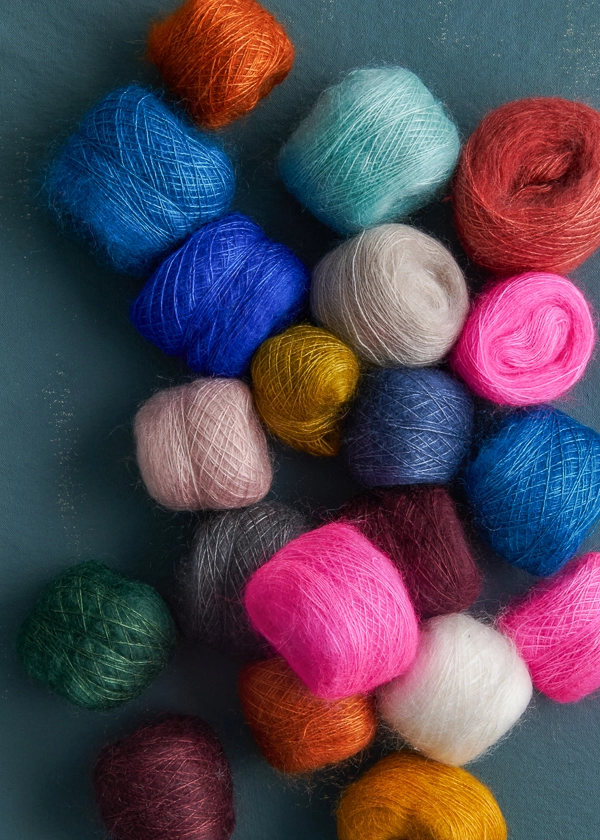
Soft and radiant as a fluffy cloud struck by the setting sun, mohair is one of the most enchanting natural fibers to knit with—an extraordinary medium for exploring color, texture, and light. In this guide to knitting with mohair yarn, we’ll explore what mohair fiber is and where it comes from, how mohair yarn behaves when you knit with it, and how to use it on its own or held with other yarns to create airy, luminous fabric and rich, layered color. Read on to discover the creative depths of knitting with mohair, meet our mohair yarns and mohair knitting patterns, and explore the possibilities for yourself!
What Is Mohair?
Mohair is a natural animal fiber that comes from the long-haired Angora goat, a small goat covered in ringlets of soft, lustrous fiber. While the Angora goat breed originated in the region of modern-day Turkey thousands of years ago, most of the world’s angora goats are now raised in South Africa.

A young Angora goat kid, covered with wavy locks of mohair | Stock Photo
The most common grades of mohair fiber used for hand-knitting yarn are “kid mohair,” from the first shearing of young goats and prized for its exceptional softness and fineness, and “super fine kid mohair,” spun from only the very finest of those fibers and considered the highest quality available.
All the mohair we source for our mohair yarns comes from South Africa and adheres to the Responsible Mohair Standard, a rigorous certification recognizing progressive land management and a commitment to treating goats ethically and responsibly.
Properties Of Mohair
While the coats of mohair goats grow in distinctive ringlets, the fibers themselves are long, straight, and smooth, lacking the pronounced scales found on the surface of many other animal fibers. Exceptionally fine and lightweight, these fibers have a unique structure that shapes everything about mohair, from its signature halo and radiant sheen to its silky feel and remarkable warmth.

From top: Raw mohair fiber sheared from angora goats, washed mohair fiber, and carded mohair fiber ready for spinning.
Halo + Bloom
The first thing you notice when you look at a mohair yarn is its glorious halo, rising above the surface in a cloud-like nimbus. Because mohair fibers are so long, fine, and smooth, they don’t twist tightly into the yarn but instead lift and bloom outward from the strand. This airy structure contributes to mohair’s warmth and, of course, its beauty, softening stitch definition, diffusing light, and allowing colors to blend.
Dye Uptake + Luster
Mohair fibers are porous and lack pronounced surface scales, allowing dye to penetrate deeply and evenly for incredibly rich, saturated color. At the same time, their smooth surface reflects light beautifully, giving mohair its striking luster and making colors appear especially vibrant. Together, this depth of color and luminosity create the glowing, almost iridescent quality mohair is known and loved for.
Lightweight Warmth
Despite its weightless appearance, mohair is remarkably warm. Its fine fibers trap air, creating natural insulation without adding weight or bulk. The result is an impressive warmth-to-weight ratio that keeps mohair featherlight, breathable, and surprisingly cozy.
Strength + Elasticity
Mohair may look delicate, but its individual fibers—though fine and floaty—are exceptionally strong and resilient. Its strength comes from a long staple length and smooth structure, which allow the fibers to withstand tension. The same properties give mohair its elasticity. While wool relies on crimp for stretch, mohair achieves its elasticity with long, smooth strands that are able to extend and recover without breaking. The result is a durable fiber with a wonderful ability to keep and recover its shape.
How Does Mohair Compare?
| Fiber | Softness | Density | Insulation | Luster | Color Vibrancy | Halo |
|---|---|---|---|---|---|---|
| Mohair | Soft | Very Low | Very High | Very High | Exceptional | Long + Fine |
| Suri Alpaca | Very Soft | Low | Highest | High | Low | Dense + Fuzzy |
| Cashmere | Exceptional | Lowest | Very High | Moderate | Moderate | Delicate |
| Fine Merino | Very Soft | Low | High | Moderate | High | Minimal |
Mohair Yarn
Mohair’s natural qualities—its long staple length, smooth surface, strength, and halo—shape the way it is spun and constructed into yarn. Because the fibers have relatively little surface friction, mohair is rarely spun on its own. Instead, it is most often blended with wool or other fibers, or spun around a core of silk or cotton, which provides structure while allowing the mohair to bloom outward from the strand. Many mohair yarns are also brushed after spinning, lifting the fine fibers into a soft, downy surface.
These construction choices influence everything from the density of the halo to the clarity of stitches in the finished fabric. For a deeper look at how fiber properties, yarn construction, and yarn weight affect your knitting, explore our Complete Guide To Yarn article.
Meet Our Mohair Yarns
We currently offer two very different mohair yarns, both incredibly beautiful ways to dive into the joy of knitting with mohair.
Tussock
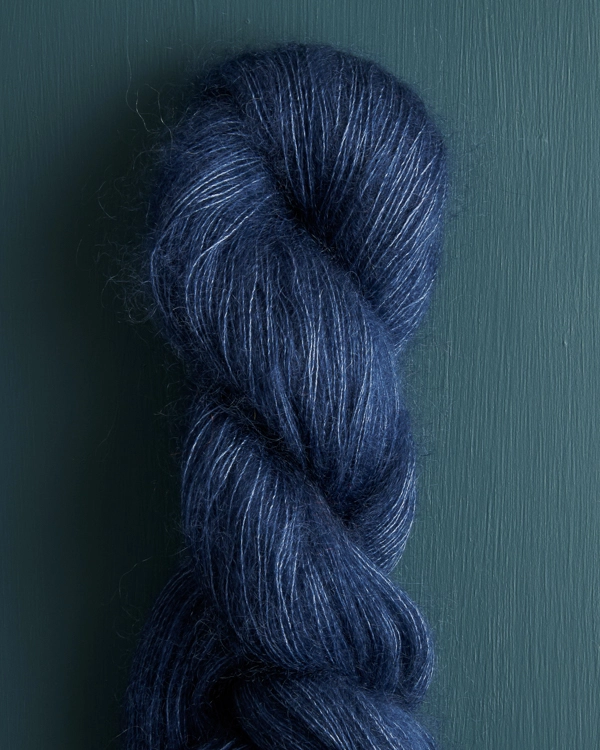
60% Fine Kid Mohair, 40% Mulberry Silk | Lace-Weight Yarn
Our classic mohair yarn, Tussock, is a fine lace-weight yarn made with 60% super fine kid mohair and 40% mulberry silk. The high silk content—more than in many mohair-silk yarns—adds significant strength and luster. And because the kid mohair is super fine grade, Tussock is exceptionally soft and smooth, making it very comfortable for next-to-skin wear. Two strands of mulberry silk are spun together with the mohair, and then the yarn is lightly brushed to create a softly tousled halo.

Paintbrush Mohair
75% Kid Mohair, 25% Peruvian Pima Cotton | Worsted- to Chunky-Weight Yarn
We are also proud to offer a truly unique mohair yarn, our beautiful Paintbrush Mohair, available in a remarkable range of vibrant colors. This robust worsted-weight to chunky-weight kid mohair yarn has a Pima cotton core and a complex structure that adds body and helps prevent shedding. Two fine strands of warm white 2-ply Pima cotton are twisted with soft kid mohair, and then another cotton strand gets wrapped around in the opposite direction. After brushing, the yarn develops impressive loft and dimension—a radiant haze of color that seems to hold light within the strand itself.
Knitting With Mohair Yarn
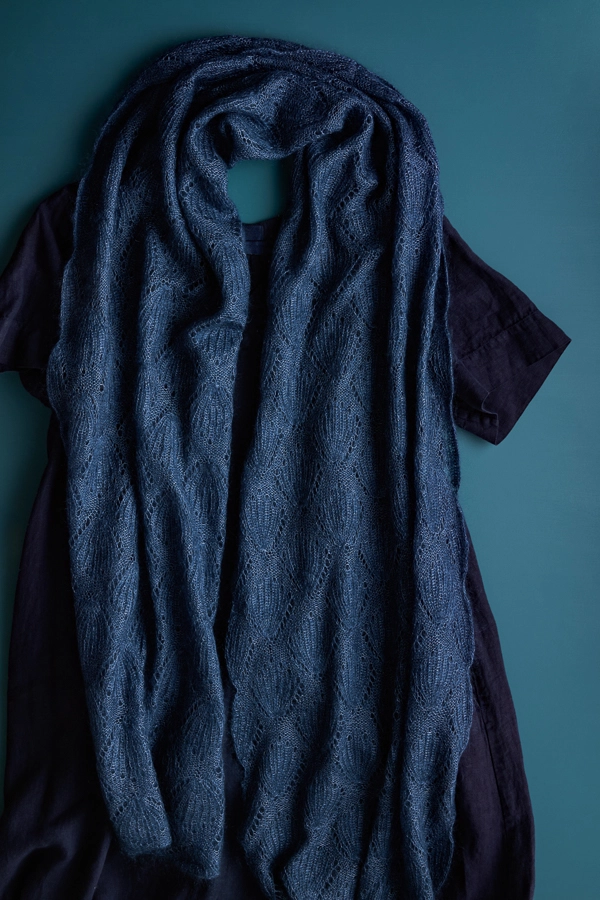
Our free Seashell Lace Wrap pattern in Tussock is a classic lace mohair wrap.
Once you have mohair yarn on your needles, the possibilities begin to unfold. Whether knit on its own or held with other yarns to add softness and depth, mohair invites experimentation and transforms whatever it touches. A few simple techniques will help you work confidently with its unique character—then the real fun begins.
Tips For Knitting With Mohair Yarn
Some knitters find knitting with mohair a little intimidating, and it’s true that the yarn can cling to itself, and its beautiful halo makes individual stitches harder to see. If you’re new to knitting with mohair yarn, a gentle touch and a few simple adjustments can make all the difference.
- Pull the yarn from the outside of the ball to minimize extra friction and tangling.
- Try out different needles. Some knitters prefer wood or bamboo so stitches don’t slip off as easily, while others love knitting mohair on metal needles so the yarn glides smoothly.
- Start out at a loose gauge, with larger needles which open up the fabric and make the stitches easier to see and count.
- Catch the full strand with your needle as you knit, rather than dipping into the fluffy halo. This may be easier if you use a needle with a blunt rather than pointy tip.
- Consider holding mohair with another yarn when you’re starting out. This adds structure and makes the stitches more visible.
- If you need to rip back, go slowly. Avoid pulling sharply and instead, gently tease apart the fibers with your needle if they’ve adhered.
With some patience, mohair becomes far less intimidating—and its softness and glow more than reward the extra care.
What To Knit With Mohair Yarn
Mohair yarn adapts beautifully to whatever you want to create—it can drift lightly across the shoulders in an airy wrap, knit up into the fluffiest hat a head could want, or become a beautiful garment, whether on its own or held with another yarn. You might even use it as a textural contrast within a project—soft, downy stripes against hardy wool ones, for example.
The creative possibilities are vast, and you could spend your entire knitting life exploring them. You’ll find plenty of inspiration in our collection of mohair knitting patterns—including our Tussock knitting patterns and Paintbrush Mohair knitting patterns—featuring these yarns knit singly, held double, and paired with other fibers.
Mohair Held Single
Knitting with a single strand of mohair yarn on its own reveals how shifts in gauge can dramatically change the character of the finished fabric—from light and diaphanous to dense and plush.
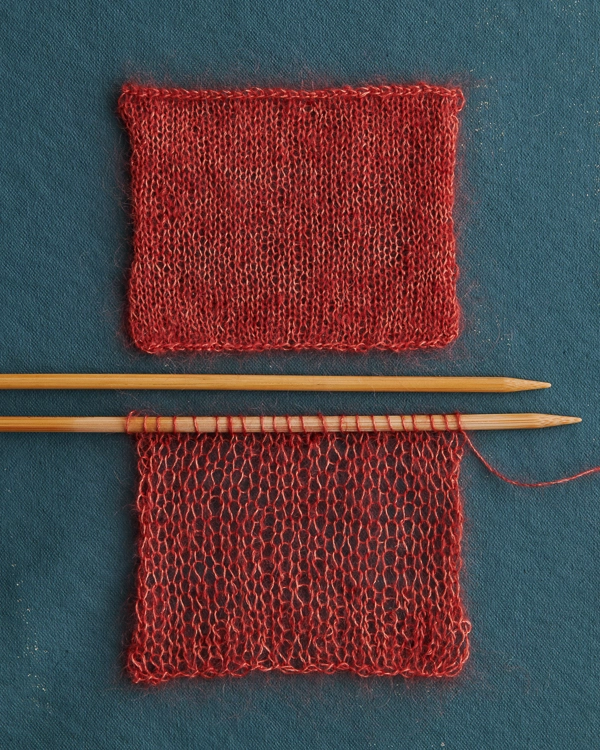
Tussock knit on US 3 and US 10 needles
Tussock, our mix of super fine kid mohair and silk, is technically classified as lace-weight, but we most often knit it at a fingering-, sport-, or even light worsted-weight gauge—typically around 3–8 stitches per inch on US 3–8 needles—to give the mohair room to bloom. As shown above, on US 3 needles it knits into a denser fabric that still retains its airiness, while on US 10 needles it opens into a lacy texture that allows the fibers to fully expand.
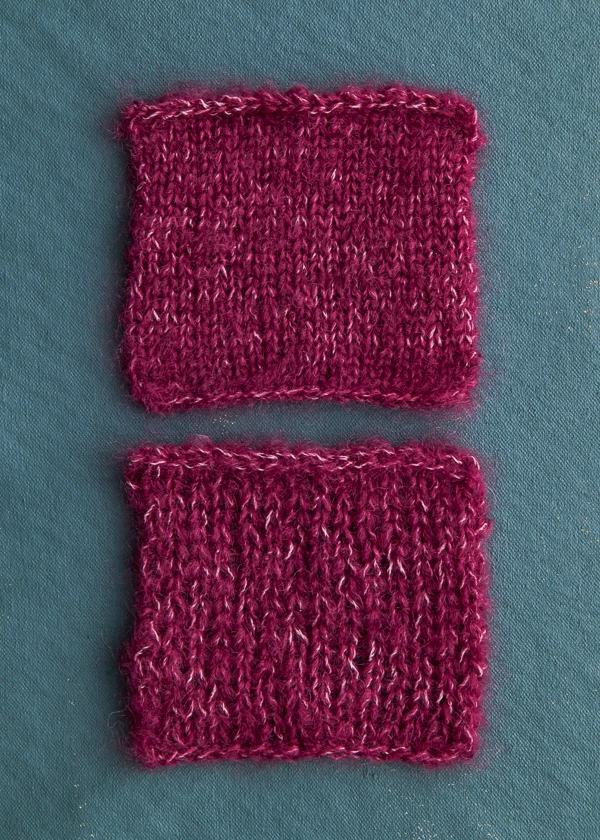
Paintbrush Mohair knit on US 6 and US 11 needles
Our worsted- to chunky-weight Paintbrush Mohair is similarly flexible. We recommend US 7-10.5 needles but, as you can see above, it knits up beautifully on US 6 and US 11 needles. At any gauge from dense and plush to lofty and light, its cotton core adds body and stability that grounds the floaty mohair strand.

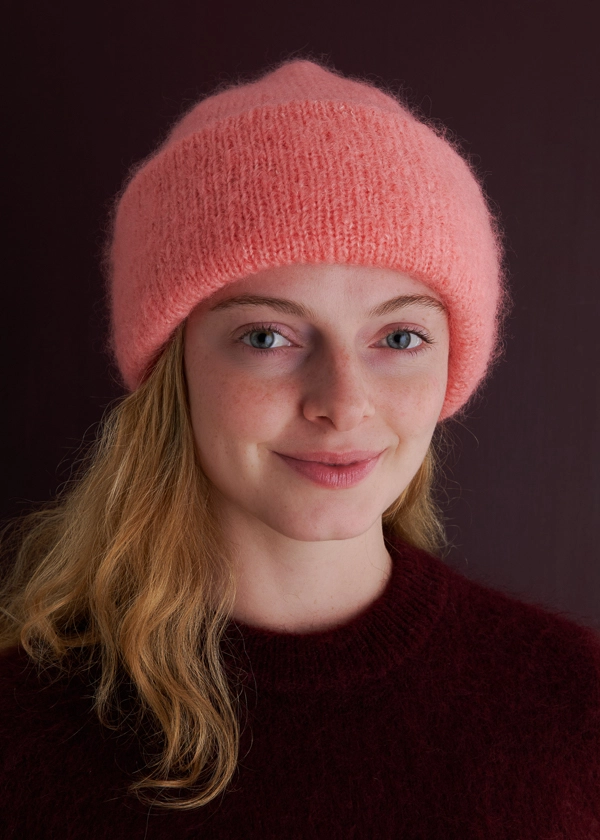
Our free Open Air Wrap pattern in Tussock and our free Big Cuff Hat pattern in Paintbrush Mohair are both knit with a single strand of mohair yarn, but the two projects are as different as can be!
The two free patterns above show some of these possibilities in action. The Open Air Wrap (above left) highlights Tussock at the more open, lacy end of its gauge range, while the Big Cuff Hat (above right), knit in Paintbrush Mohair, is worked more densely than its usual gauge range for a thick, structured, and very cozy fabric. Though both are knit with mohair held single, differences in yarn weight and gauge produce strikingly different results.
Mohair beautifully illustrates that yarn weight is less about the thickness of the strand and more about the fabric you want to create. Ultimately, gauge is personal, and knitting a gauge swatch will help you understand how a yarn on a given needle will knit up in your hands. For a deeper dive into measuring and adjusting gauge, explore our All About Gauge guide.
Mohair Held Double
Knitting with two strands (or more!) of mohair yarn more than doubles your options, giving you even more gauge possibilities and introducing color as a new variable in your experimentation.

Our free Elementary Wrap pattern in Tussock, knit with two strands of lace-weight mohair yarn held together on US 6 needles.
Holding two strands of a lace-weight mohair yarn like Tussock creates a fingering- to sport-weight. On US 6 needles, the fabric is fine and floaty yet substantial, with an incredibly lush halo and a fascinating marl. Our free Elementary Wrap in Tussock pattern is the perfect way to try this approach, knit all in stockinette stitch so you can focus on the beautifully mingling colors.

Paintbrush Mohair held double, knit on US 13 needles
Worsted- to chunky-weight Paintbrush Mohair held double creates an exceptionally thick and squishy fabric at a chunky- to super bulky-weight gauge. On US 13 needles, it knits up quickly into something thick and toasty, like a sweater, hat, or scarf.
Mohair Held With Other Yarns
Holding mohair together with a companion yarn adds warmth, bloom, luster, and depth of color. It also changes your gauge, though how much depends on the weight of both the mohair yarn and companion yarn.


In our free Classic Knit Beret pattern, Tussock is held together with lace-weight Spindle.
In general, our lace-weight Tussock yarn increases the relative weight of a companion yarn by about one category. For example, holding Tussock together with a fine yarn like our lace-weight Spindle produces an approximately fingering-weight gauge. We use this approach in our free Classic Knit Beret pattern, where the two yarns are knit together on small needles to create a firm, cohesive fabric with a soft surface bloom and gorgeous luminosity.

In our free Powder Puff Scarf pattern, Paintbrush Mohair is held together with bulky- to super bulky-weight Super Soft Merino.
However, pairing a mohair yarn with a bulky- to super bulky-weight yarn like Super Soft Merino—as in our free Powder Puff Scarf pattern—creates a more modest gauge shift. Even when using Paintbrush Mohair, which is a significantly thicker yarn than Tussock, its impact on the gauge is proportionally smaller when added to an already substantial yarn, requiring only a slight adjustment in needle size. The result is a fabric with the addition of a beautiful halo and rich depth of color, without dramatically changing the overall structure.

Left to right: Yonder, Yonder + Tussock, and Yonder + Paintbrush Mohair
In the swatches above, worsted-weight Yonder is knit alone on the left. In the middle swatch, adding lace-weight Tussock slightly increases stitch size, but the most noticeable change is in texture and depth of color. In the right swatch, adding Paintbrush Mohair—similar in thickness to Yonder—significantly increases the stitch size, shifts the balance of colors, and softens the surface texture.
Swatching is essential when you’re adding mohair to another yarn, especially if you’re substituting a mohair yarn plus a companion yarn in a pattern that doesn’t call for it. Be mindful of your gauge, drape, and hand—especially after blocking—and be sure you have enough yardage. For more guidance, check out our Yarn Substitution Made Easy guide.
Color Effects With Mohair
Few fibers influence color as dramatically as mohair. Because its smooth surface reflects light and its halo diffuses it, mohair softens edges, deepens saturation, and creates a gentle glow that can subtly shift the way a color reads. When layered with another yarn, it doesn’t simply sit on top—it interacts with the underlying color, altering its depth and tone.
When experimenting with color, it helps to think first about value—how light or dark a color is—before hue. Pairing a light mohair with a dark companion yarn or vice versa creates a more dramatic effect, while combining colors that are close in value produces a more blended, atmospheric look.
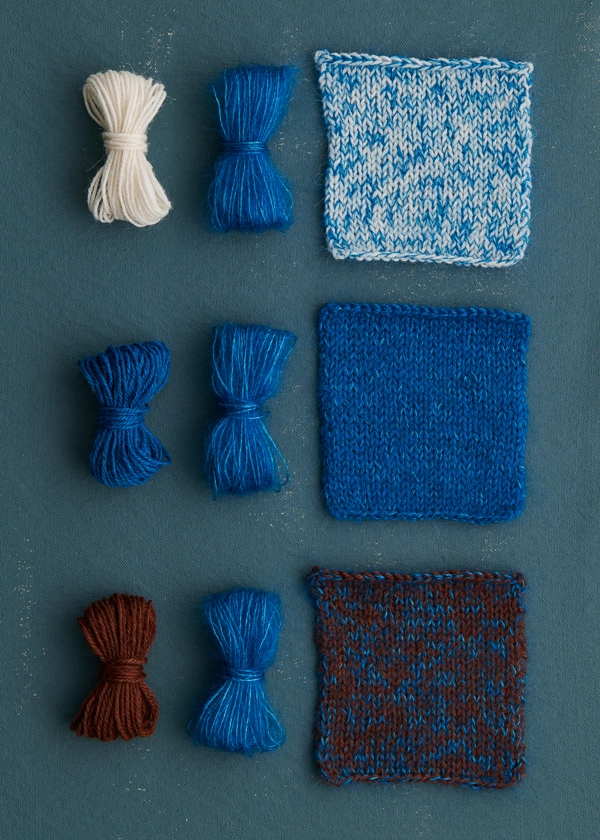
Tussock in Cerulean Sea knit with different colors of Quartz. From top: Quartz in Heirloom White, Quartz in Aquamarine Blue, and Quartz in Red Panda.
In the example above, the same color of Tussock (Cerulean Sea) is held together with three different colors of fingering-weight Quartz. When paired with a high-contrast light color like Heirloom White, the mohair’s vivid blue stands out clearly. Combined with a closely related blue like Aquamarine Blue, the two colors blend into a unified, luminous surface. And when matched with a similar value but contrasting hue like Red Panda, the result is a vibrant marl—distinct, yet softened by the mohair’s halo.
The proportion of mohair in the fabric also matters. A fine strand like lace-weight Tussock will tint a companion yarn without completely overpowering it, even when held with fine fingering- or sport-weight yarns. A thicker strand like Paintbrush Mohair, on the other hand, has a stronger visual presence—particularly when paired with lighter-weight yarns.
If you’re just beginning to add mohair to other yarns, experiment by swatching two colors that are close in value for subtle depth, then choose a higher-contrast pairing to experience the difference. Most importantly, approach knitting with mohair with a sense of play and curiosity!
Caring For Mohair Knits
The beautiful pieces you knit with mohair yarns deserve thoughtful care to keep their halo soft and lofty—but there’s nothing complicated to it. Hand-wash your mohair knits in lukewarm water (never hot) with a mild wool wash, and handle them gently, especially when wet. Avoid wringing or twisting; instead, press excess water out with a towel.
When blocking, resist the urge to overstretch. Mohair responds best to a light touch—simply pat your project into shape and let it dry flat. Once dry, you can gently fluff the halo with your fingers or a soft comb to restore its bloom.
In between washes, store your mohair knits folded rather than hung to help them retain their shape. If your knit just needs refreshing, a light steam will revive the fibers and extend the time between washes.

Cast On With Mohair Yarn!
Soft, glowing, and endlessly versatile, mohair opens up a world of texture and color. Whether you’re crafting an ethereal shawl, a cozy hat, or a statement sweater, this remarkable fiber brings warmth and dimension to every stitch. Few fibers offer the creative range of mohair! Explore our full collection of mohair knitting patterns, discover the beauty of our mohair yarns, and bring your next beautiful project to life.
Article written by Andrea Lotz for Purl Soho.
Looking for more inspiration? Explore all of our knitting patterns (including tons of free knitting patterns) and knitting tutorials, buy one of our many knitting kits and yarn bundles, and shop for beautiful yarn. We have over 55 gorgeous natural fiber yarns in 1,000s of magnificent colors, designed to bring integrity, beauty, and joy to your next knitting project and only available at Purl Soho!







Really interesting and informative, and I’ve been knitting with mohair on and off for about 30 years now. I adore the effect it makes when it’s combined, but hate that I tend to miss a loop of kidsilk every now and again :(.
I recently read that holding a strand of mohair with a roving type yarn can stop it pilling. Any thoughts or experiences with this?
I can’t help but wonder what happens to the goats after the first shearing, if that’s the only shearing that counts.
Hi Francesca!
So glad to hear you liked the article on Knitting with Mohair! We also love the combined effect! I totally relate to the concern of missing a kidsilk loop! Holding roving with your mohair would likely prevent this slippage as the mohair would grab onto the roving.
After shearing, the goats for kidsilk mohair will wait for next year’s shearing where their coats are used for non-kidsilk mohair, or adult mohair.
Please feel free to reach out with any other questions or concerns you may have!
Happy knitting!
Hills
I look forward to your emails every day. As a beginner knitter, I find them very interesting, informative, beautiful with color, and give me hope for future projects. I have saved a number of the free patterns. Keep them coming! Thank you!
Hi Eileen!
Thanks a bunch for your lovely words! We’re so happy to hear you enjoy our emails…we love sharing our passion for yarn, colors, and new patterns with you and everyone in the Purl Soho community. We’re excited to see what you create next!
Happy knitting, Eileen!
Hills
Just finished a cardigan in lovely Paintbrush mohair. While knitting I was leaving bits of yarn everywhere. Haven’t blocked it yet. My concern is, will I continue losing fibers? How do I stop this?
Hi Martha,
Thanks so much for reaching out. Congrats on finishing your cardigan!
This is a great question, and not at all an uncommon concern! Mohair does have a tendency to shed. However, with blocking this should decrease. You can also try a sweater comb or gleener before wearing to reduce any shed. I often find that knitting mohair while held with another yarn also reduces shedding down the line (for your future mohair projects!). Some folks also freeze their mohair projects before wearing them to reduce shedding, as well.
I so hope this helps, and if you’re still running into trouble, please feel free to email us at [email protected] for more troubleshooting!
Happy knitting,
Hills
I hope this isn’t a FAQ.
When carrying this with another yarn, do I include it in the ribbing?
Do I pick up the mohair after I complete the ribbing? Thx!
Hi Barb,
We’re happy to help, and this is a great question!
When carrying mohair with another yarn, you typically will hold both yarns for the entirety of the project. If you’re meant to change the yarns you’re carrying, the pattern will usually let you know to drop one strand or pick up another. While I’m not looking at the pattern with you, I would suggest holding the mohair for the ribbing (unless stated otherwise).
I hope this helps, and please reach back out anytime.
Happy knitting,
Hills