Your basket is empty.
Continue Shopping
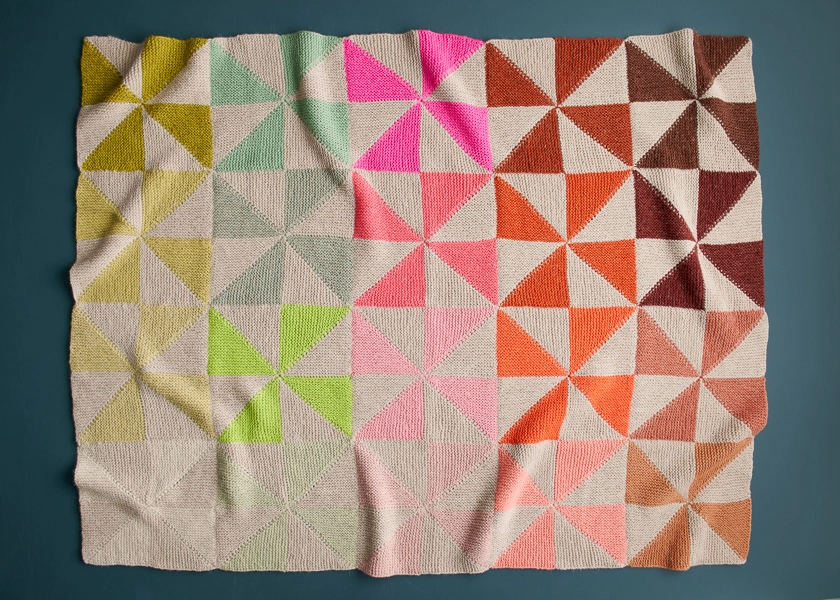
Pinwheel Blanket
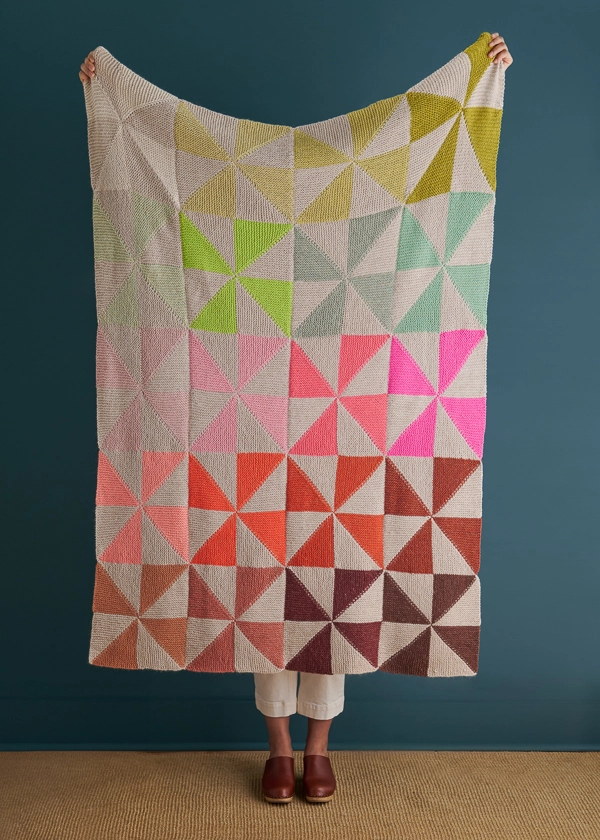
Set your imagination spinning with Ksenia Naidyon’s Pinwheel Blanket pattern, a fun and whimsical way to play with the vast palette of our most popular yarn, Linen Quill. Ksenia combined one 20-Color Bundle of Linen Quill Minis with full-size skeins to create a joyous field of swirling color!

You knit this blanket one pinwheel block at a time, each a burst of color that gives every Mini its time in the sun. Short rows shape the triangles, alternating between the Mini and your main color, and then you simply join the start to the finish to form a square. It’s easy, all in garter stitch, and we have lots of photos right in the pattern to help you out!

Held doubled, Linen Quill knits up quickly and gives your blanket a soft, springy texture that’s a pleasure to knit and to cuddle up with. It’s a perfect take-along project, too, because all you need in your knitting bag is one or two Minis and your main color. You weave in most of your ends as you go, so finishing is simple… Sew the blocks together and enjoy your irresistible new blanket!
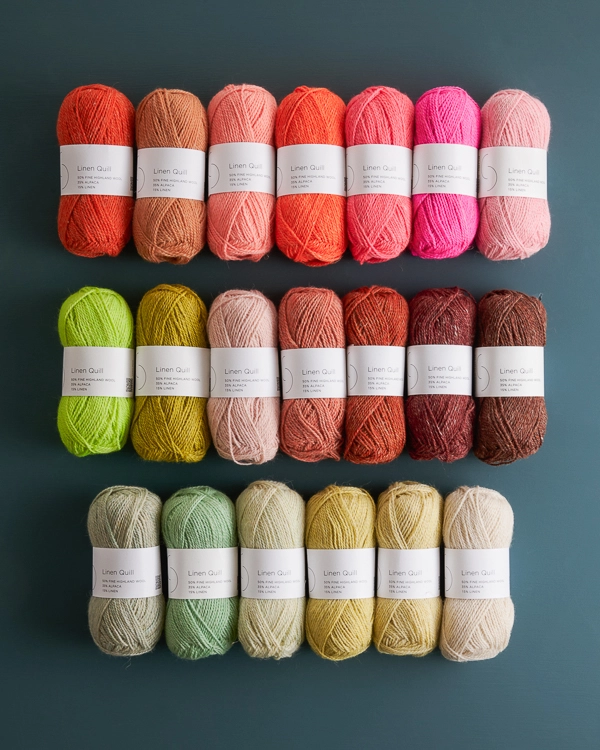
Our Linen Quill Minis are 25 grams each of the same fingering-weight Linen Quill yarn you know and love, a hearty mix of bouncy Andean highland wool, soft alpaca, and rustic linen. Each bundle of Minis is a whirlwind of gem-like colors, rich with the depth and texture that comes from linen’s natural character. You need one 20-Color Bundle for your Pinwheel Blanket… We picked dazzling Full Bloom!
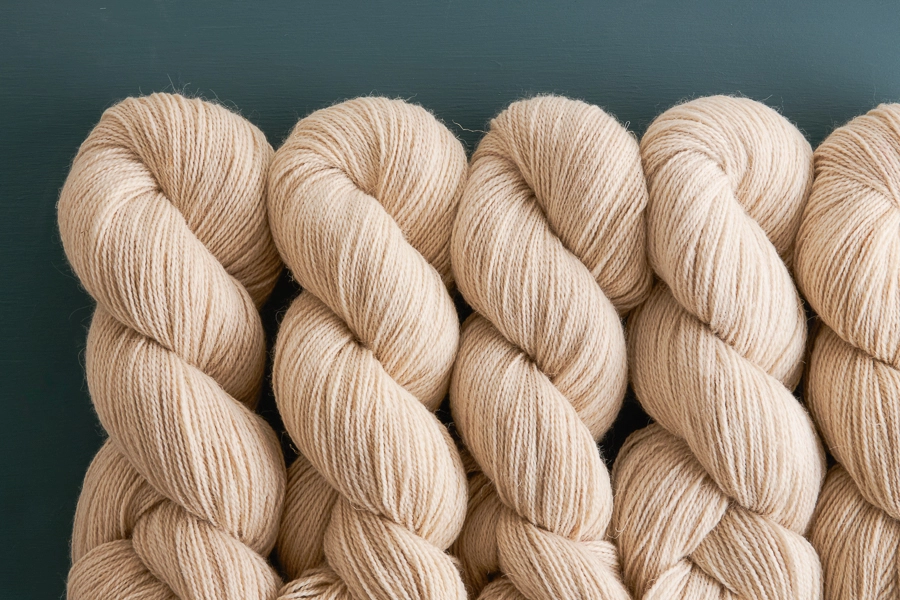
Set the stage for your Minis with 5 full-size skeins of Linen Quill. We chose Wheat Flour as a toasty warm backdrop, but of course, there are no wrong answers here and 70 colors to choose from!
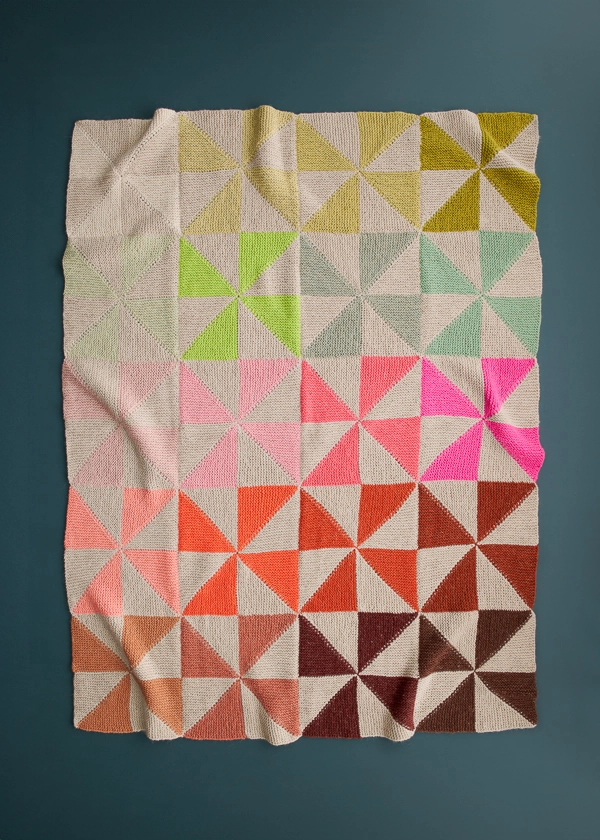
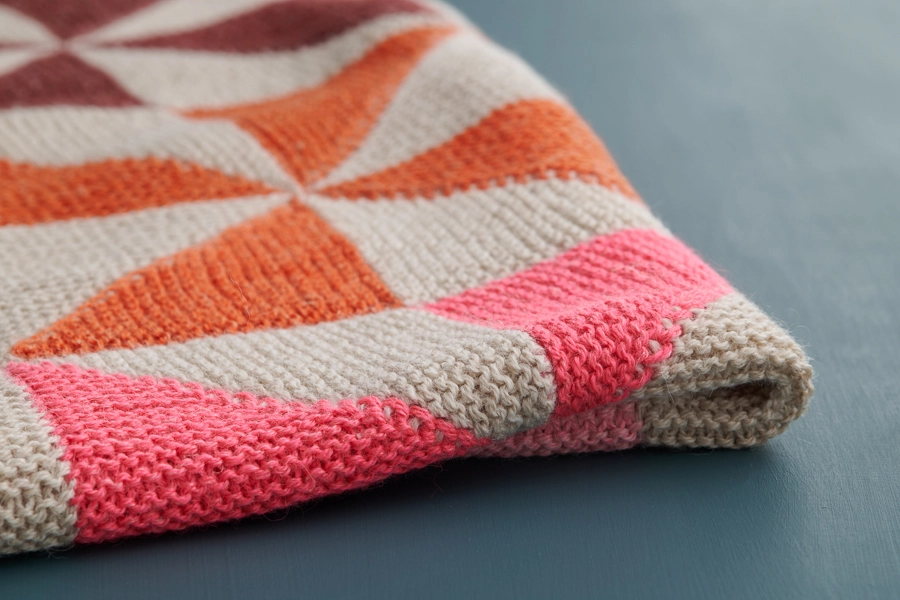
Let the Pinwheel Blanket be the breeze that sets your creativity in motion, one colorful block at a time… You’ll love how each pinwheel twirls and tumbles into place!
Yarn lovers, if you adore the yarn used in this project, you’ll love exploring all of our other yarn collections! Discover over 55 thoughtfully designed yarns in nearly every natural fiber and in every spectacular color you can imagine. Only available here at Purl Soho’s online yarn store, where every skein is created with care and your creativity in mind!
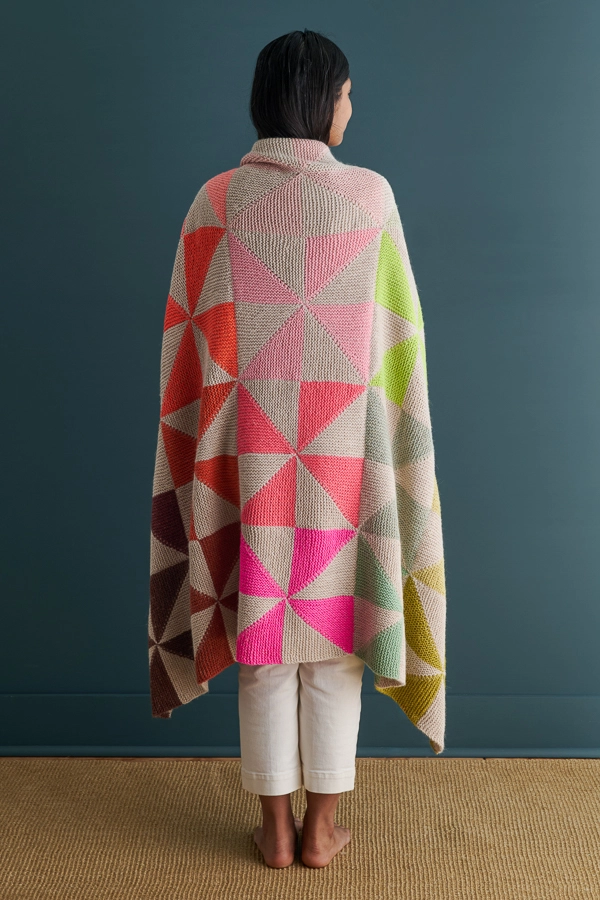
Designed for Purl Soho by Ksenia Naidyon, the talented designer behind Life Is Cozy, where she shares patterns for her beautiful hand knits, instructions for must-know stitch patterns, and reviews on needles, books, and notions… Everything we knitters love!
Story written by Andrea Lotz for Purl Soho.
Want to print this pattern? On desktop, find the “print” icon in the right margin, and on mobile, scroll to the end of the pattern for it. Use the on-screen instructions to remove anything you don’t want to print!
Materials
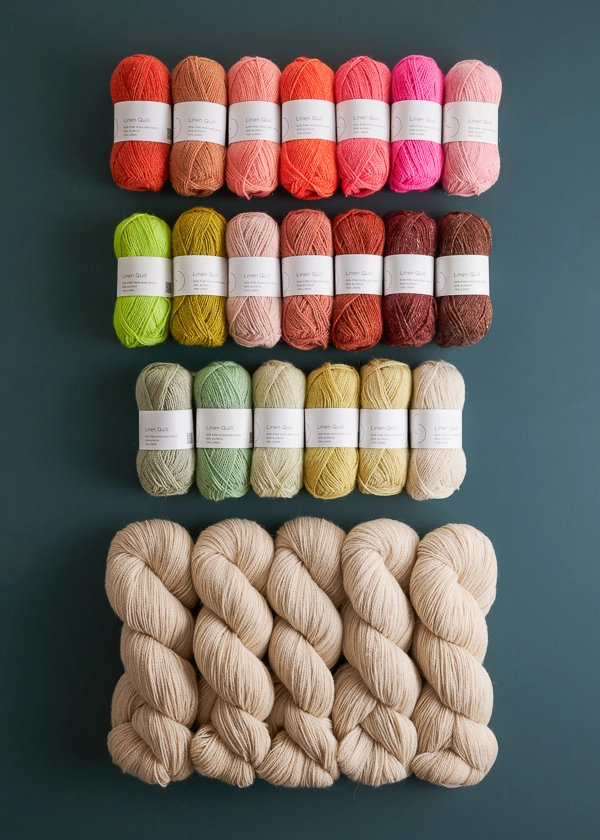
- Main Color (MC): 5 skeins of Purl Soho’s Linen Quill, 50% fine highland wool, 35% alpaca, and 15% linen. Each skein is 439 yards/ 100 grams; approximately 2,195 total yards required. We used the color Wheat Flour.
- Contrast Color (CC): A 20-color bundle of Linen Quill Minis, 50% fine highland wool, 35% alpaca, and 15% linen. Each ball is 109 yards/ 25 grams; approximately 2,180 total yards required. We used the Full Bloom palette (no longer available).
- US 6 (4 mm), straight or 24-inch circular knitting needles
- Spare needle, size US 6
- A crochet hook and scrap yarn for Provisional Cast On
Want to knit your blanket with Linen Quill Minis in Beach Walk as your CC? For a light and airy version, we love Linen Quill in Bird’s Egg Blue for the MC, or for a more grounded, earthy version, try the color Pale Mushroom!
GAUGE
18 stitches and 36 rows = 4 inches in garter stitch, with yarn held double
SIZE
Finished Dimensions: 44 inches wide x 55 inches long
Finished Pinwheel Block Dimensions: 11 inches square
NOTES
CONSTRUCTION
You will make 20 Pinwheel Blocks, each one knit in one piece, using short rows and alternating MC and CC Triangles. Each Block starts with a Provisional Cast On and ends with you joining the first Triangle to the last with a 3-Needle Bind Off. Once you’ve made all 20 Pinwheel Blocks, you will seam them together.
SPECIAL INSTRUCTIONS
YARN DOUBLED
You will hold two strands of yarn together throughout. If you only have one ball, pull one strand from the inside and one strand from the outside, or you can wind two evenly sized balls!
PROVISIONAL CAST ON
For assistance, including how to put live stitches back onto needles, please visit our Provisional Cast-On: One-Step Method Tutorial.
SHORT ROW SHAPING: TWISTED WRP-T (TWISTED WRAP + TURN)
On the right side, bring yarn between needles to front of work, slip next stitch purlwise from left needle to right needle, bring yarn to back of work, and return slipped stitch to left needle. Bring yarn between needles to front of work, and finally, turn work so wrong side is facing you, and working yarn is at the back of the work.
For step-by-step photos of this technique, visit our Striped Half + Half Triangles Wrap pattern (noting that this pattern works this technique on right sides, not wrong sides). Pick up wraps as instructed in Square 1.
Note that the only difference between a Twisted Wrap + Turn and a regular one is that, for a Twisted Wrap + Turn, you bring the yarn to the front of the work before you slip the next stitch. For a regular Wrap + Turn, you slip the stitch first, then bring the yarn forward. Details!
WEAVING IN TAILS AS YOU GO
To spare yourself weaving in lots of tails, we recommend knitting them in at certain points in the pattern when instructed. Here’s how…
Bring the tails over the working yarn at the wrong side of the work and knit the next stitch (“trapping” the tails with the working yarn), then drop the tails and knit the next stitch as normal. Continue knitting in tails every other stitch for an inch or two.
Our Weaving In Ends As You Go Tutorial shows you how!
PATTERN
PINWHEEL BLOCK
NOTE: The Pinwheel Block is made up of 8 Triangles. You will use short rows to knit the Triangles one after the other, without having to pick up stitches or sew anything together. It’s easier than it may sound… and fun, too!
MC TRIANGLE
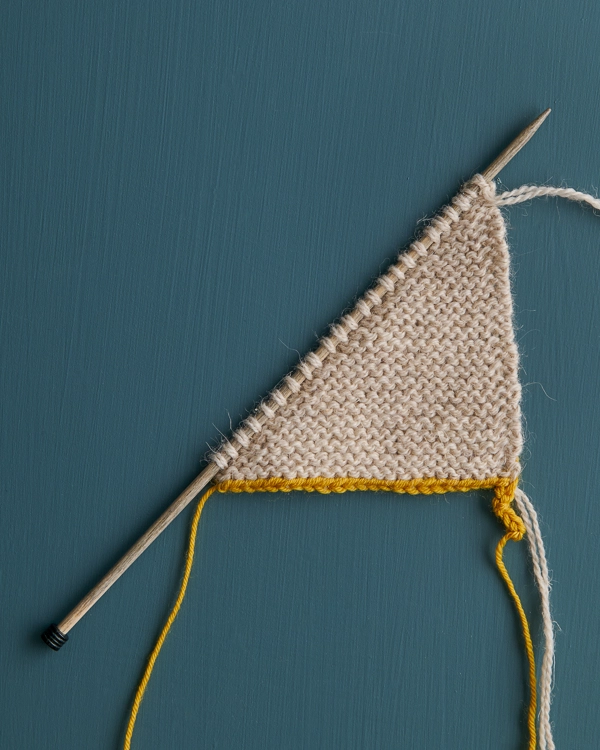
With scrap yarn, cast on 24 stitches using a Provisional Cast On (see Special Instructions).
With Main Color (MC) held double…
Row 1 (right side): Knit to end of row.
Row 2 (wrong side): Knit to end of row.
Short Row 3: Knit to last stitch, twisted wrp-t (see Special Instructions).
Short Row 4: Knit to end of row.
Short Row 5: Knit to 1 stitch before wrapped stitch, twisted wrp-t.
Short Row 6: Knit to end of row.
Repeat Short Rows 5 and 6 twenty-one more times until all stitches but one have been wrapped, ending with Short Row 6, which is a wrong-side row.
Cut MC, leaving a 3-inch tail.
CC TRIANGLE
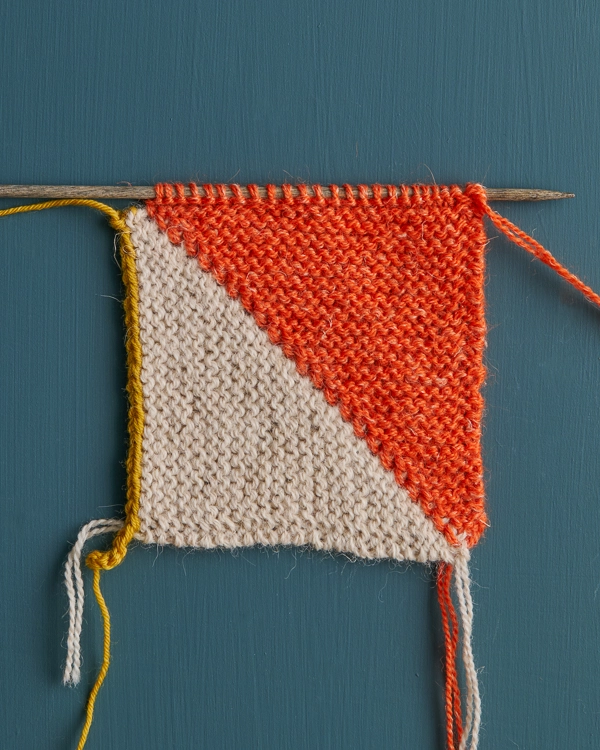
With right side of piece facing you and Contrast Color (CC) held double…
Short Row 1 (right side): K1, twisted wrp-t (this stitch will now have two wraps).
Short Row 2 (wrong side): Knit to end of row.
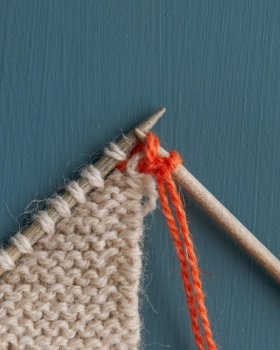

Short Row 3: Knit to double wrapped stitch, pick up CC wrap from back to front (above, left) and place it on left needle (above right), knit CC wrap together with its stitch, twisted wrp-t.
Short Row 4: Knit to end of row.
Repeat Short Rows 3 and 4 twenty-one more times or until all stitches have been double wrapped, ending with Short Row 4.
Next Row (right side): Knit to last double wrapped stitch, knit CC wrap together with its stitch.
Next Row (wrong side): Knit to end of row.
Do not bind off. Cut CC leaving a 3-inch tail.
REPEAT
Continuing with live stitches, work an MC Triangle, weaving in previous square’s CC tail on Row 1 and current square’s MC tail on Row 3 (see Special Instructions).
Next work a CC Triangle, followed by an MC Triangle, repeating until you have worked a total of 8 Triangles, ending with a CC Triangle.
Do not cut CC at end of the final Triangle.
BIND OFF

Carefully remove scrap yarn from Provisional Cast On, slipping stitches onto spare needle as you go. If necessary, rearrange stitches on needles so needle tips are at outer edge of Pinwheel Block.
With wrong side facing you, use attached CC yarn and other main needle to work a 3-needle bind off, working from the outer edge to the center of the Pinwheel and joining the first MC Triangle to the last CC one.
Cut CC leaving a 4-inch tail.
CLOSE CENTER
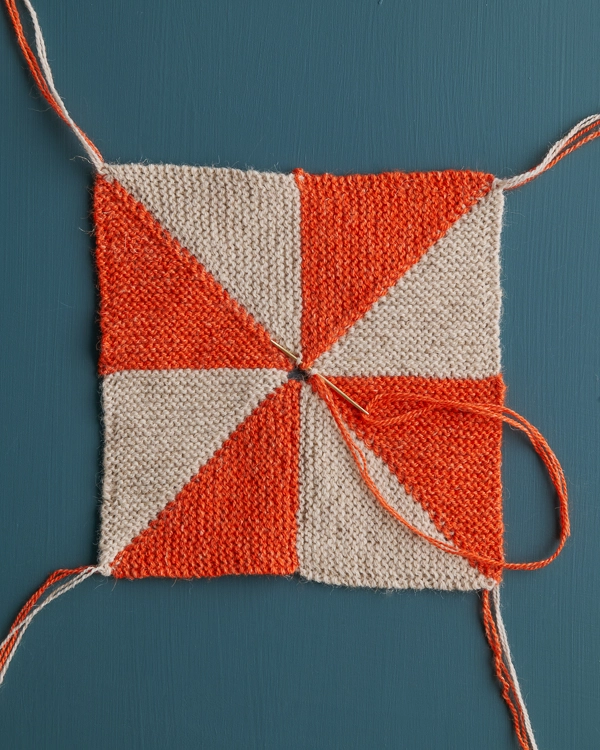
Thread CC tail from bind-off onto a tapestry needle. With right side facing you, weave needle through 8 stitches at center of Pinwheel (1 stitch from each Triangle), pulling tight to close the center.
Weave in all tails on wrong side.
CONTINUE
Make 19 more Basic Pinwheel Blocks, using a new CC for each one until you have one Pinwheel Block in each of the colors of the Linen Quill Minis 20-Color bundle.
FINISHING
BLOCK
Gently wet block Pinwheel Blocks to finished dimensions.
SEAM
NOTE: For help with seaming garter stitch, visit our Seaming Garter Stitch Tutorial.
Arrange Pinwheel Blocks in a rectangle 4 Blocks wide by 5 Blocks long, in any desired order or following along with our layouts, below.
With a new length of yarn, seam the Blocks together. If you have enough MC left over, that’s the easiest color to use, but the CC of the adjacent Triangle will work just as well. MC or CC – the seams are nearly invisible!
FULL BLOOM LAYOUT
Top Row: Pale Oats, Beach Grass, Sour Gooseberry, Golden Green
Second Row: Pale Celery, Lemon Lime, Celadon Green, Bright Mint
Third Row: Peony Pink, Cowrie Pink, Bright Flamingo, Pink Pop
Fourth Row: Peachy Pink, Super Orange, Sweet Potato, Kiln Red
Bottom Row: Baked Earth, Orange Cinnamon, Chestnut Red, Hazelnut Brown
BEACH WALK LAYOUT (not pictured)
Top Row: Pale Oats, Wheat Flour, Honey Pink, Fresh Nutmeg
Second Row: Golden Wheat, Turmeric Yellow, Butterscotch Yellow, Raw Sienna
Third Row: Light Cerulean, Weathered Blue, Gray Denim, Mountain Bluebird
Fourth Row: Oatmeal Gray, Stonewall Gray, Salt + Pepper, Stillwater Blue
Bottom Row: Peach Stone, Twig Brown, Ginger Brown, Pine Cone
Share your progress and connect with the community by tagging your pics with #PurlSoho. We can’t wait to see what you make!
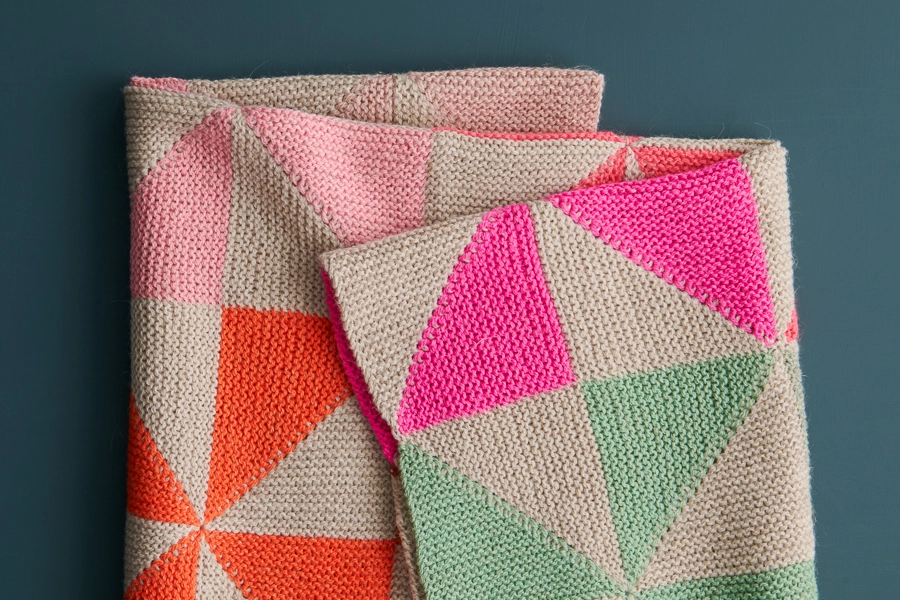
Learn About Linen Quill + All Our Beautiful Yarns
We designed this project to highlight the uniquely beautiful qualities of our Linen Quill, a wonderful fingering-weight yarn that is a blend of 50% wool, 35% alpaca, and 15% linen. It feels amazing in your hands, and in 70 jaw-droppingly gorgeous colors, Linen Quill is the candy store of yarn! Want to play with lots of those amazing colors? Check out our Linen Quill Minis, available in 40- and 20- color bundles, and be sure to read our article, Linen Quill: A Closer Look At Our Most-Loved Yarn, to learn all about what makes it so special.
More Knitting Patterns
- Be sure to explore our vast collection of (mostly free!) Linen Quill knitting patterns and cast on!
More Fingering-Weight Yarns
- Shop our entire collection of fingering-weight yarns (What does fingering-weight yarn mean, really? Our guide to fingering-weight yarn will answer your questions and more!)
- If you want to use a different yarn, be sure to take the time to get the correct gauge. Need help? Check our All About Gauge Tutorial, our Yarn Substitution article, and our Complete Guide To Yarn for lots of helpful information.
More Yarns With Similar Fibers
- Shop wool yarn
- Shop alpaca yarn
- Shop linen yarn
Looking for more inspiration? Explore all of our knitting patterns (including tons of free knitting patterns) and knitting tutorials, buy one of our many knitting kits and yarn bundles, and shop for beautiful yarn. We have over 55 gorgeous natural fiber yarns in 1,000s of magnificent colors, designed to bring integrity, beauty, and joy to your next knitting project and only available at Purl Soho!

Similar Posts You Might Enjoy:


Is there a way to make a baby blanket using this pattern?
Hi Eva,
Absolutely, this pattern would be lovely as a baby blanket, too! For a crib-size blanket, you’d just need to knit fewer Pinwheel Blocks; each block is 11 x 11″, so you could make a blanket that’s 4 blocks tall and 3 blocks wide, making the dimensions of the blanket 33″ wide x 44″ long. This blanket would be composed of 12 blocks in total and you’d need 3 skeins of Linen Quill for the Main Color and 1,317 yards in total of the contrast colors for this project! You could still get a 20-color Linen Quill Minis bundle for lots of fun contrast color options and just pick 12 colors for your blanket (with lots of yarn left for another project!) or you could choose 3 full skeins of Linen Quill for a blanket with 3 contrast colors. Both options would be beautiful!
I hope this helps, and please let us know if you have any other questions!
Kindly,
Cat
I absolutely LOVE the Pinwheel Blanket…
It’s gorgeous and the options for varying style usage blows the mind!
My query, l’d like to make two, but in strict colour pathways…
One with 2 colours in addition to the main, and the other with a main and one other colour… Could you confirm how much yarn that would take using the Linen Quills, full skeins & mini’s
Thank you…
Hi Beverley!
Thanks so much for writing in with your question! I’m so glad the Pinwheel Blanket caught your eyes, and I’m happy to help with yardage requirements!
For the main color you need 2,195 yards total (5 skeins of Linen Quill)
For the contrast color, you need 2,180 yards total. (20 balls of Linen Quill Mini or 5 Skeins of Linen Quill)
If you want to use 2 contrast colors, you can grab 1090 yards of each color (that’s 3 skeins of Linen Quill in each contrast color, or 10 Minis)
I hope this helps! Please feel free to reach out with any other questions you might have!
Happy knitting!
Hills
The two main colors suggested for the Beach Walk layout don’t seem to be in stock, or I might be missing where they are. If unavailable would you please suggest other colors that would work.
Thank you,
Christine
Hi Christine,
Thanks so much for checking in about that! I’m glad to share that it looks like Linen Quill in Bird’s Egg Blue and Pale Mushroom are available! I hope this helps, and please let us know if any other questions come to mind!
Kindly,
Cat
Thank you. On my phone the “see all” didn’t show up so I wasn’t seeing those two colors.
can this be done in good wool yarn
Hi Eileen,
While Good Wool is a bit thicker than Linen Quill, you could certainly use it for this pattern at a slightly larger gauge.
Happy knitting,
Gavriella
Could this pattern be made for a throw instead ?
Thank you,
Caroline
Hi Caroline,
Thanks for asking! You can definitely make this blanket larger by knitting more blocks! Since this construction is created with square blocks, you can knit as many as you’d like taking into account the 11 inch squares.
Happy knitting,
Gavriella
Could this be worked using a single strand of Cotton Chirp? I adore the pattern, but would like it in Cotton.
Hi Elisa,
What a great question! Cotton chirp is a bit too thick for this pattern but you could use Santolina or even Oleander instead for a cotton version of this pattern.
Happy making!
Gavriella
Hi, I’m working on the Pinwheel Blanket and had a question about block size. The gauge is listed as 18 sts + 36 rows = 4″ in garter with yarn held double, and the instructions say to cast on 24 sts and block each Pinwheel Block to 11″. By my math, that would make the unblocked square about 5″ across, which seems like a huge stretch. In my knitting, each square is coming out to about 8″ unblocked, and I don’t feel comfortable stretching it all the way to 11″. Could you clarify what you expect the unblocked square size to be before blocking? Thanks for another beautiful pattern!
Hi JC,
Thanks for writing in! You’re right that each individual square measures a little over 5″. The 11″ measurement is for each pinwheel block (4 squares seamed together), so each side is the length of 2 squares. We wish we had unblocked measurements to give you, but all the measurements given in the pattern are after blocking.
It sounds like your squares are knitting up at a larger gauge, which would make your overall blanket bigger (with 8″ squares, each pinwheel will be 16″, making the finished blanket 64″ x 80″, which would require a lot more yarn!). We’d recommend swatching on smaller needles or making fewer pinwheel blocks at your current gauge. Either way will make a beautiful blanket!
Hope this clears things up!
Andrea
I am really struggling with starting the CC triangle –
so row 1 – knit 1 st in CC, then do twisted WRP-t — on next stitch -How does this st have double wrap – 1 wrap from row before??
ROW 2 — knit to end – is that just 1 stitch?(after turning the wrapped st is on the right needle and then you knit what was the 1st stitch?? )
So at the beginning, the rows are very short – (I am not good spatially )…Help! 🙂
Hi Bette,
So sorry you are running into trouble here but you are exactly right, on that first row you will just have the 1 other stitch to knit for the short row and the stitch you just wrapped will also have a double wrap, one being from the row below. I wouldn’t recommend weaving in your ends while completing the wrap and turns but instead on row 1 that doesn’t include and short rows. I hope this helps and happy knitting!
All the best,
Gavriella
Hi Gavriella
I am also confused with the CC triangle. After row 4 it says repeat 3-4. Row 3 is picking up the wrap. So when do I do the next wrp-t? I’m sure it’s simple I just can’t see it.
Hi Lorraine!
Thank you for writing in! Short rows can definitely feel a bit confusing until the rhythm clicks, so you’re not alone. After Row 4, when the pattern says to repeat Rows 3–4, you’ll work Row 3 exactly the same way — when you knit back to the end of the row, that’s where your next wrap-and-turn happens. So you’ll work your twisted wrp-t right at the end before turning.
Once you see it happen a couple of times, the repeat becomes much clearer — you’re doing great!
Warmly,
Megan
Reread it again and worked it out!
Hi Lorraine!
So glad to hear you got it worked out!
Warmly,
Megan
Hi Purl Soho — really enjoy your patterns — doing a test square for the Pinwheel Blanket, I’m wondering how you were able to hide the contrast color along the seams of each of the triangles making up the square. I don’t see a way to attach a photo, but looking at this on Ravelry, there’s another knitter who’s put up some photos that also show this issue. There, and on my test square, what looks like a wrap is extremely obvious but not on the photos included here. Any thoughts? Thanks!
Hi Jim,
Thank you for reaching out. You will indeed see some of the contract color of the wraps show through depending on how high of a contrast the two colors you are using are. You can see our wraps as well a little more in the 2nd and 6th photos from the top in the more pink colors. If it works better for you though, you can also email our team at [email protected] and we will keep an eye out for your reply!
All the best,
Gavriella
Do you have any tutorials on the picking up the wraps for the CC triangle? I am new to knitting and I am afraid you can see a line of MC in the CC side (which I dont see in the pictures)
Hi Lara,
Thanks for asking! You will be able to see a peek of the MC but that’s totally natural. I’m afraid we don’t have a video tutorial of this technique but you can can see a more in-depth look in our Half and Half pattern which uses the same technique. One thing I found helpful was practicing the squares over a VERY small swatch. I casted on only about 8 stitches with thicker yarn to really get the hang of the pattern before starting. I hope this helps but please let us know if you have any other questions!
All the best,
Gavriella
Hi! I’m a beginner knitter trying out this beautiful blanket pattern.
Could you please explain the difference between a “wrap and turn” and a “twisted wrap and turn”? I’m not sure what part is actually “twisted.”
Also, I’m a bit confused about how to pick up the wrapped stitch when working in garter stitch. Do I pick up the FRONT of the wrap, place it on the left needle, and then knit both together?
This will be my biggest knitting project so far, and I’m a bit nervous but very excited! Please cheer me on!
Hi Yuko,
Thank you for writing in! The main difference between a Twisted Wrap + Turn and a regular one is just the order of steps. For the Twisted version, you’ll bring the yarn to the front before slipping the next stitch. For the regular Wrap + Turn, you’ll slip the stitch first and then bring the yarn forward. That small change is what gives the “twisted” look! When you’re ready to work the wraps, use the tip of your right needle to scoop up the wrap from front to back, then pop it onto your left needle so it sits in front of the stitch it was wrapping. Now just knit those two together like you normally would. I hope this helps!
Happy knitting!
Gavriella
I wish there could be a step by step video with this one.
Hi Lisa,
Thanks for the recommendation and I will be sure to share this with our design team! In the meantime, we’d always be happy to review this pattern together through one of our free zoom help sessions!
Happy knitting,
Gavriella
Hi! I love this pattern! Can you recommend a superwash that I can use instead of linen quill?
Hi Romy,
So happy you love this pattern as much as we do! I’d recommend Oleander, Santolina or Stormy Superwash as some great machine wash alternatives!
Happy knitting,
Gavriella
Hi! Love this pattern – can you clarify on the MC triangle repeat if I’m supposed to do the twisted wrp-t on the right side or the wrong side? it seems like my triangle is slanted in the wrong direction, i.e. not making a pinwheel.
Hi Emily!
Thank you for your question, and I’m so glad you’re enjoying the pattern! The twisted wrp-t should be worked only on the right-side rows. If it sneaks into a wrong-side row, it can definitely cause the triangle to lean in the opposite direction, which would throw off the pinwheel effect. Double checking that each twisted wrp-t happens on a right-side row should get your triangles turning the way they’re meant to.
If you’d like to send a photo to [email protected] for us to take a look, please do!
Warmly,
Megan
I am so confused about the wrapped stitch – and what happens. I understand that I start with 24 stitches and end up with one so I’m decreasing the rows by “wrapping a stitch” – but after following (I think!) the directions and watching the video I still don’t understand where two stitches (which two?!) get stitched together…I’m a new knitter but I’m not new to following directions and this has me completely stumped!
Hi Amy,
Thanks for asking a great question!
This pattern uses twisted Wrap + Turns. These are not decrease stitches, so you won’t work two together. For this technique you are only working some of the stitches in each row, so some columns of stitches will have more stitches while other columns will have fewer stitches. Instead of decreasing any stitches, you just have stitches left unworked on your left needle at the end of each row.
I hope that makes sense! Please let us know if you have any other questions, and feel free to reach out to [email protected] for more specific help with wrap + turns!
Warmly,
Andrea
Should the seam also be yarn doubled?
Hi Isa!
Thanks so much for writing in with your thoughtful question! I’m so glad the Pinwheel Blanket caught your eye!
Yes, the seam should also be held double… you may even be able to use your ends to seam and weave your ends in that way! The yarn held double should provide extra strength at the seams for the blanket.
I hope this helps! Please feel free to reach out with any other questions you might have!
Happy knitting!
Hills
This pattern is *killing* me! I cannot figure out what I am doing wrong! I successfully knitted the MC half of the triangle but the CC half has me confused. My issue, I think, is that I can’t correctly identify the wraps that I am supposed to be picking up. I can’t find good visuals of what this is supposed to look like. I have been trying different threads that I *think* might be the wrap, but my work is coming out with a gappy seam between the two sides of the triangle. Any advice on spotting the wrap (esp. with this fuzzy linen quill yarn) would be great! Thank you!
Hi Stephanie,
Thank you so much for reaching out. I am so sorry to hear that that this project is causing frustration for you, and I’m happy to help.
We offer this tutorial on wrap-and-turn short rows I hope that this will be helpful for you. If you’re still running into trouble, I would suggest scheduling a 1-on-1 Help session…we would so love to get you back on track!
I hope this helps, and happy knitting!
Hills
I purchased the 40-bundle linen quill mini bundle. I would like to make this blanket in the Full Bloom palette but I understand this palette is not available. Can you please provide the colors from the 40-bundle linen quill mini bundle I can substitute for the unavailable colors in the Full Bloom palette? Many of the colors in the Full Bloom palette are in the 40-bundle but a few are not and for those missing colors I’d like to get your suggestions for substitute colors. Thank you!
Hi Dawn,
Thank you so much for reaching out! I’m happy to help with your color substitutions.
It looks like the colors missing from your 40-bundle that were in the Full Bloom Palette include: Sweet Potato, Super Orange, Pink Pop, Cowrie Pink, Orange Cinnamon, Hazlenut Brown, Celadon Green, Bright Mint, Sour Gooseberry, and Beach Grass. There ought to be full skein versions of all of these skeins, excluding Orange Cinnamon, Bright Mint, Sour Gooseberry, and Beach Grass.
I’d suggest considering: Ginger Brown, Vintage Celadon, Raw Sienna, and Turmeric Yellow. Please feel free to reach out to us at [email protected] if you would like to see color cards for these colors.
I hope this helps!
All the best,
Hills