Your basket is empty.
Continue Shopping
Océane LM For Purl Soho: Tidemark Pullover
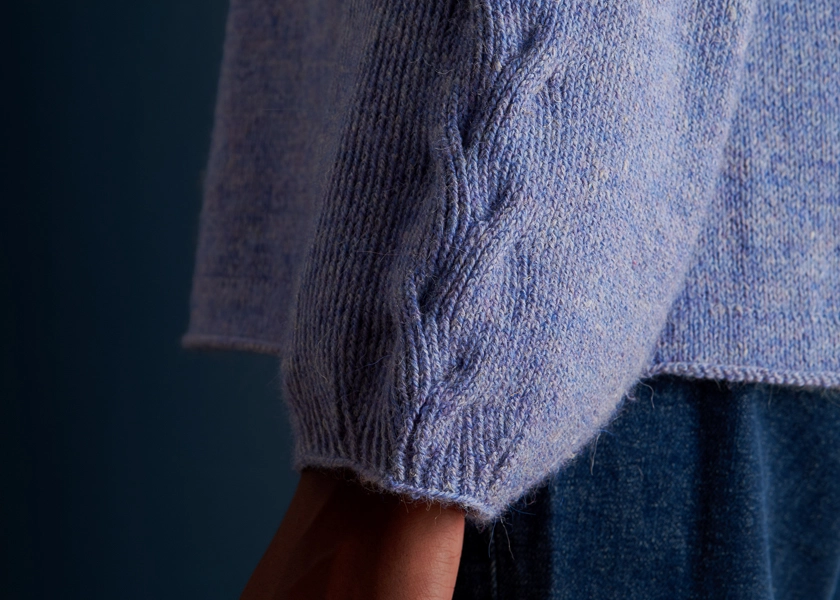
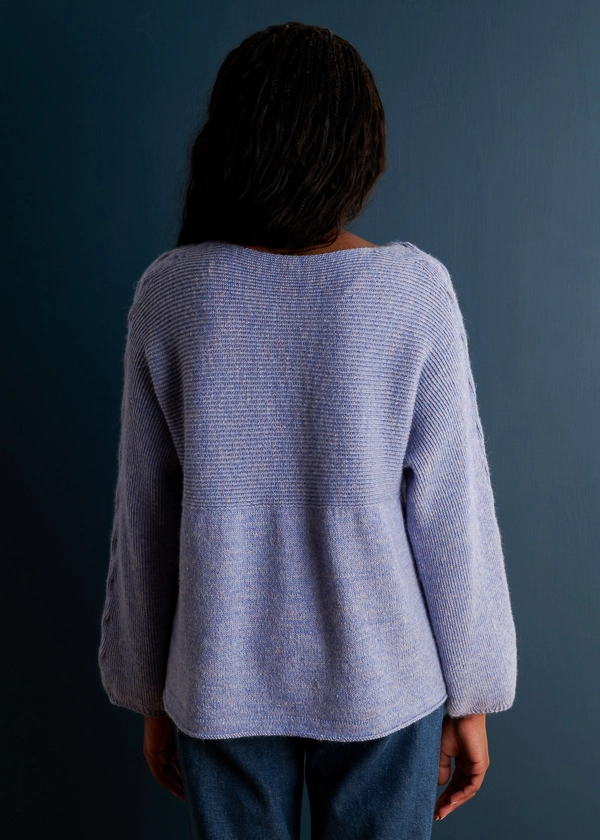
Blending furrowed ribbing, flowing cables, and smooth stockinette, our Tidemark Pullover pattern—designed by Océane LM—captures waves curling to the shore and rushing back again, leaving polished sand in their wake. With its subtle texture and heathered depth, Linen Quill lends a beautifully nuanced quality that feels as effortless as the tide itself.
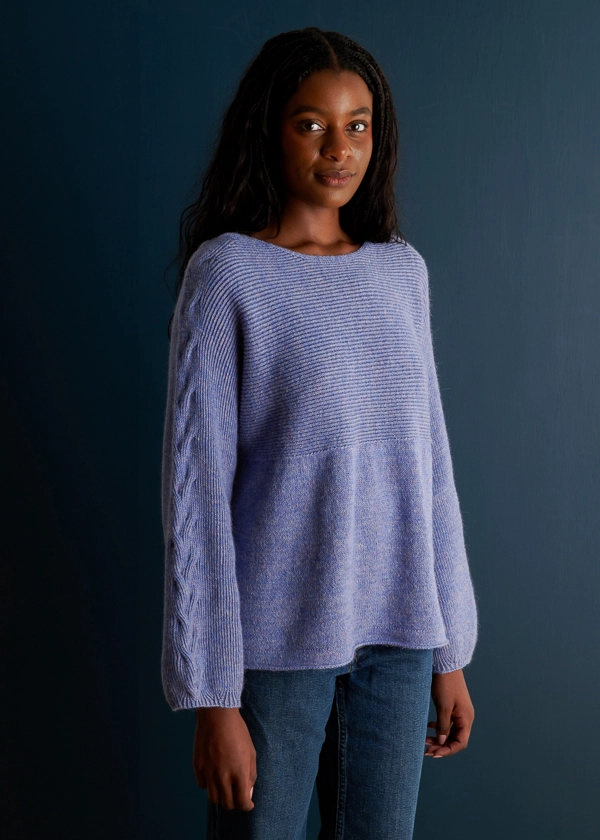
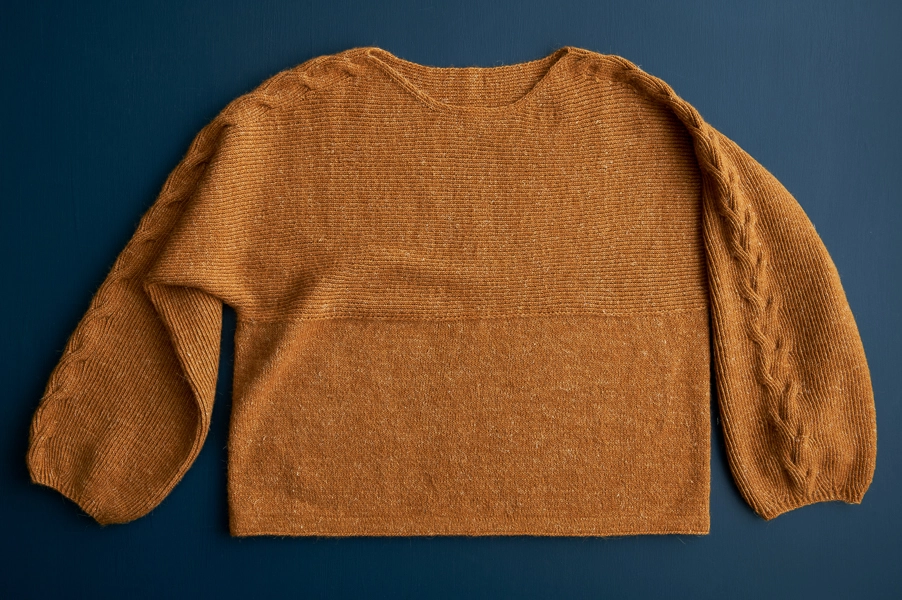
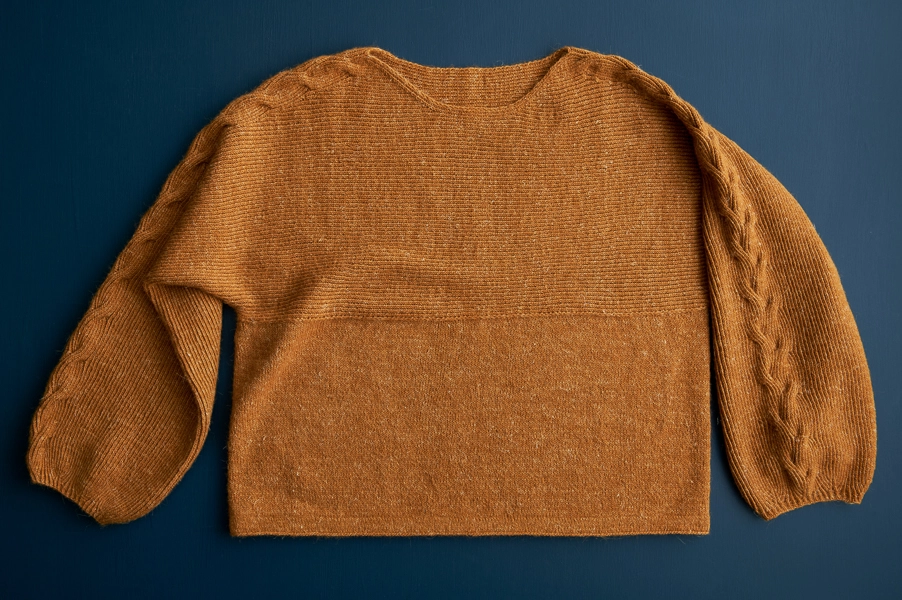
A creative (and reversible!) seamless design with sleeves and yoke knit from cuff to cuff, Océane designed the Tidemark Pullover to flow easily from your needles. You start at the right cuff, knitting the sleeve in the round, then you work flat to shape the shoulders and neckline before returning to the round for the left sleeve. To finish, you pick up stitches under the bust and knit the stockinette body in the round.
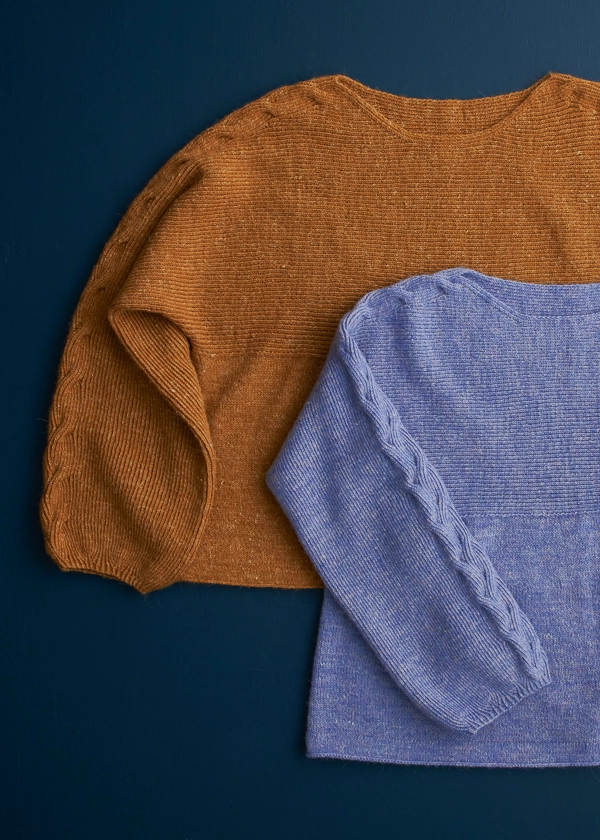
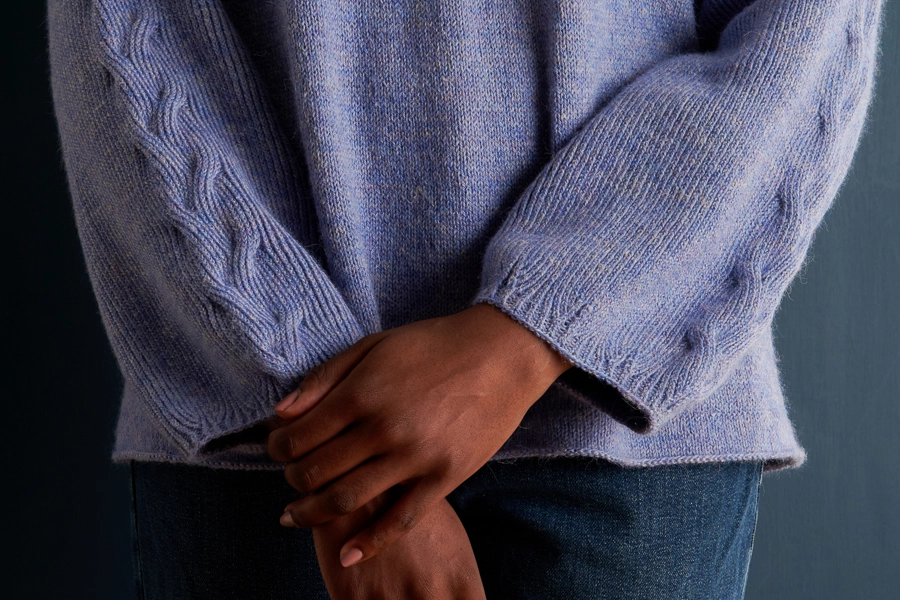
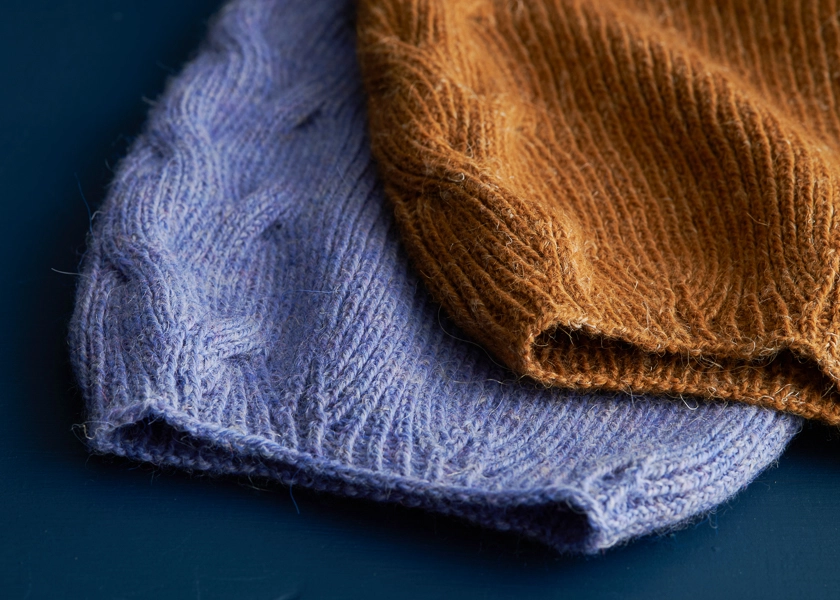
Elevated details truly make their mark: elegant sleeves shaped just so; a thoughtfully identical cast on and bind off at the cuffs; undulating cables that mirror each other across the arms; and a bit of double knitting at the bottom hem that makes the edge lie flat without ribbing. The Tidemark Pullover’s sweeping shape echoes the soft contours of the shoreline, a graceful, poetic design full of serene beauty.
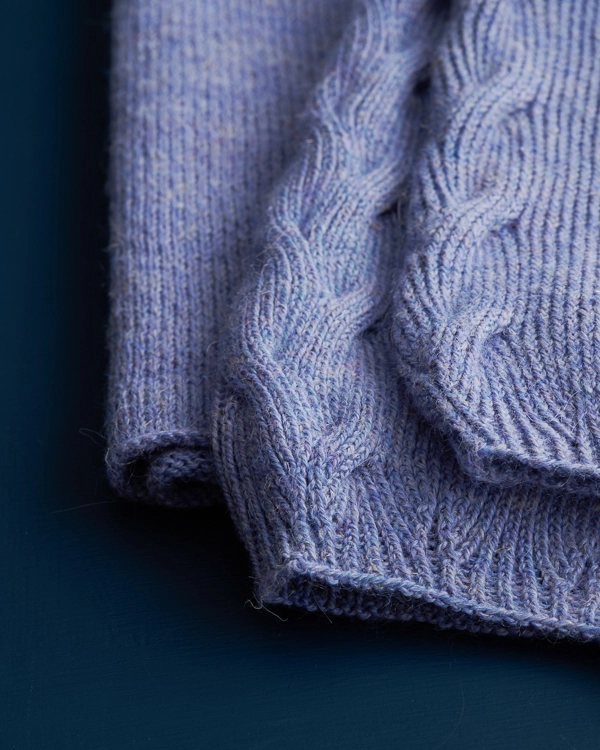
Our all-time customer favorite yarn, Linen Quill is a uniquely appealing fingering-weight yarn spun from three beloved fibers in perfect balance. Andean highland wool beautifully articulates every stitch; lustrous alpaca gives the fabric a soft drape; and a hint of linen adds a slight rustic texture and fascinating depth of color.

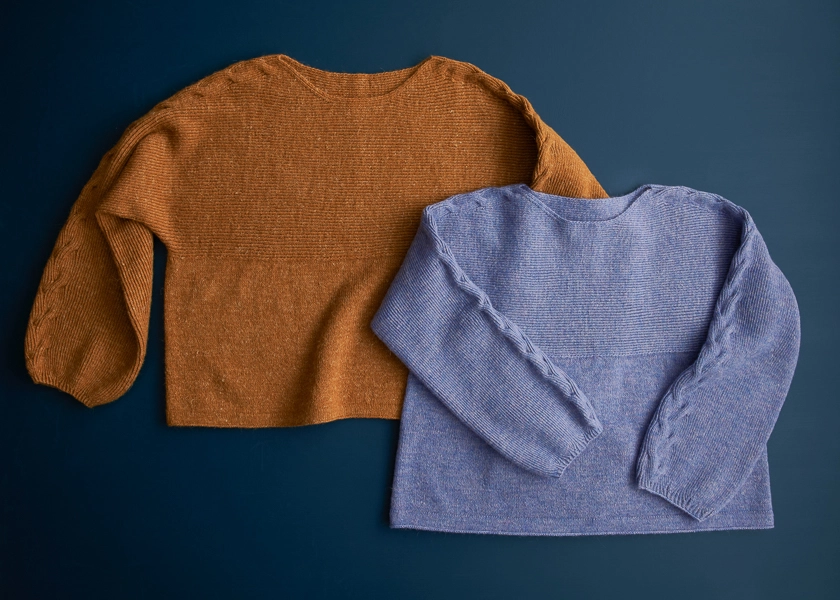
Pick from Linen Quill’s newly-expanded palette of 76 colors, drawing from nature’s endless variety and complexity. For our Tidemark Pullovers, we chose a bit of sea and a bit of shore with soft Hydrangea Blossom (a brand-new color!) and sun-warmed Raw Sienna.
Rich with quiet rhythm and pared-back elegance, Océane’s design is as timeless as the rolling tides… Cast on and feel the gentle pull of each new stitch as Linen Quill’s beauty carries you along!
Designed for Purl Soho by Océane LM. Based in France, Océane finds inspiration in peaceful landscapes shaped by nature’s forces. Her designs are filled with thoughtful details, creating timeless heirlooms that balance rustic elegance with modern simplicity. See more from Océane on her Instagram!
Story written by Andrea Lotz for Purl Soho.
Materials
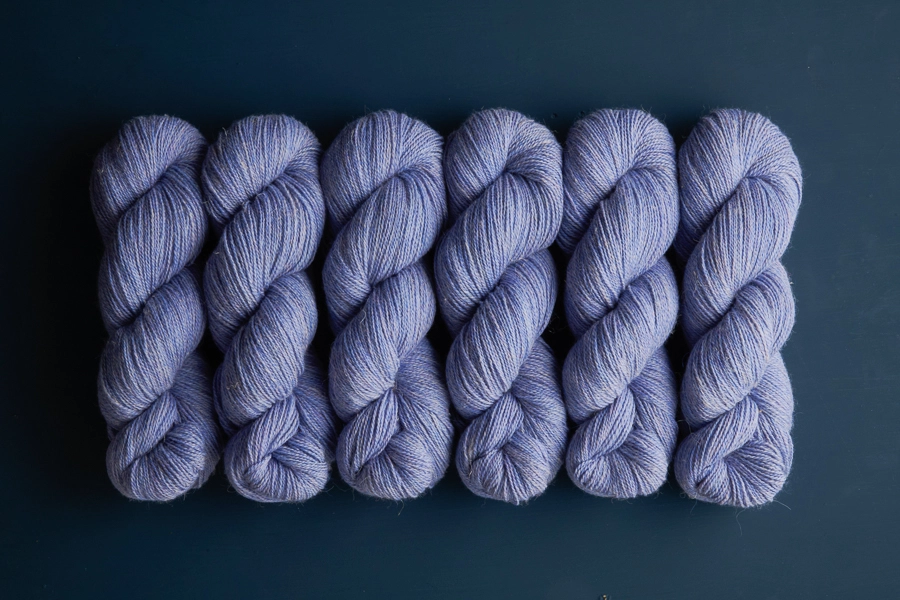
- 6 (6, 7, 7, 8) (8, 9, 9, 10) skeins of Purl Soho’s Linen Quill, 50% fine highland wool, 35% alpaca, and 15% linen. Each skein of this fingering-weight yarn is 439 yards/ 100 grams; approximately 2350 (2520, 2685, 3030, 3340) (3510, 3750, 3950, 4190) total yards required. We used the colors Raw Sienna and Hydrangea Blossom.
- US 1 (2.5 mm), 16- or 20-inch circular knitting needles, depending on size you are making
- US 1, 32- or 47-inch circular needles, depending on size you are making
- US 2 (3 mm), 32- or 47-inch circular needles, depending on size you are making
- A set of US 1 double pointed needles
- A cable stitch holder
- Stitch markers, including one unique
- Scrap yarn
- A Tidemark Pullover Pattern PDF
NOTE: If you want to use Magic Loop, you won’t need the 16- or 20-inch circular needles or double pointed needles listed above… Just stick with the 32- or 47-inch ones!
GAUGE
44 stitches and 39 rounds = 4 inches in Half Twisted Rib stitch on smaller needles, blocked and unstretched
31 stitches and 38 rounds = 4 inches in stockinette stitch on larger needles, blocked
SIZES
NOTE: For help picking a size, please check out our Understanding Ease + Selecting Your Size Tutorial!
40½ (44½, 48½, 52½, 56½) (60½, 64½, 68½, 72½)
To fit actual chest circumference of 30–34 (34–38, 38–42, 42–46, 46–50) (50–54, 54–58, 58–62, 62–66) inches, with 6–10 inches of ease
- Finished Chest Circumference: 40½ (44½, 48½, 52½, 56½) (60½, 64½, 68½, 72½) inches
- Finished Measurement from Wrist to Wrist: 58¼ (60, 62¼, 64¼, 66¼) (67¼, 69¼, 69¼, 69¼) inches
- Finished Length from Top of Shoulder to Bottom Edge: 22 (22½, 23, 23¼, 23¾) (24, 24¾, 25¼, 26) inches
Samples: The sweaters shown here are size 44½, worn with 11 inches of ease.
PATTERN
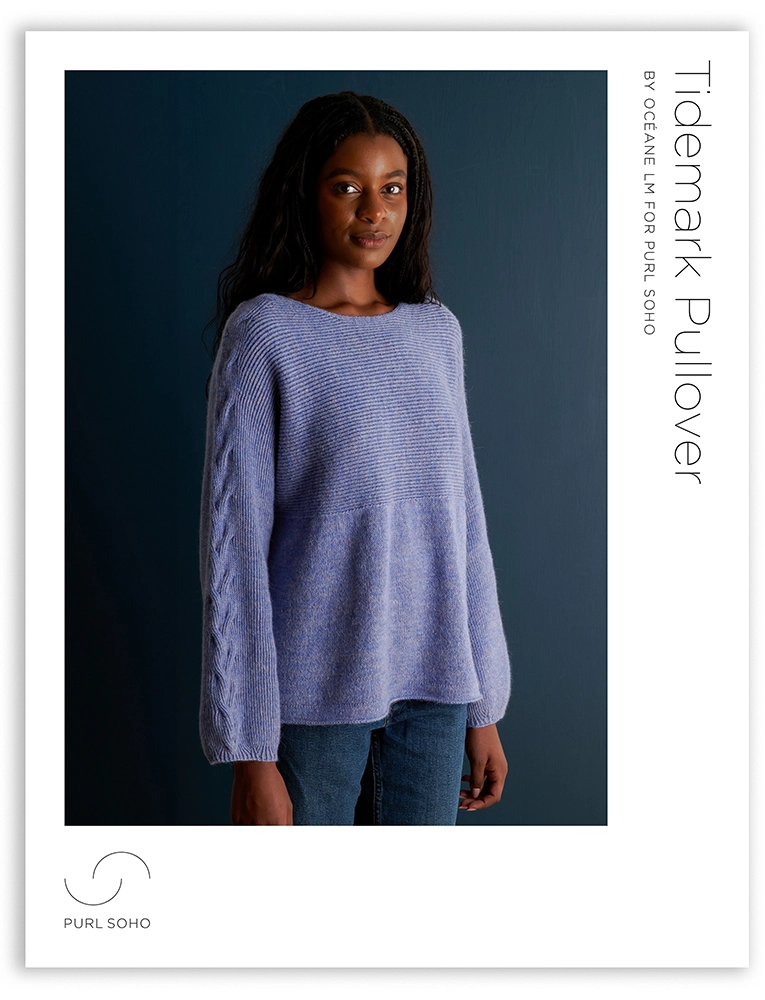
The Tidemark Pullover Pattern is available for purchase as a PDF download.
Share your progress and connect with the community by tagging your pics with #PurlSoho. We can’t wait to see what you make!
Learn About Linen Quill + All Our Beautiful Yarns
We designed this project to highlight the uniquely beautiful qualities of our Linen Quill, a wonderful fingering-weight yarn that is a blend of 50% wool, 35% alpaca, and 15% linen. It feels amazing in your hands, and in 70 jaw-droppingly gorgeous colors, Linen Quill is the candy store of yarn! Want to play with lots of those amazing colors? Check out our Linen Quill Minis, available in 40- and 20- color bundles, and be sure to read our article, Linen Quill: A Closer Look At Our Most-Loved Yarn, to learn all about what makes it so special.
More Knitting Patterns
- Be sure to explore our vast collection of (mostly free!) Linen Quill knitting patterns and cast on!
More Fingering-Weight Yarns
- Shop our entire collection of fingering-weight yarns (What does fingering-weight yarn mean, really? Our guide to fingering-weight yarn will answer your questions and more!)
- If you want to use a different yarn, be sure to take the time to get the correct gauge. Need help? Check our All About Gauge Tutorial, our Yarn Substitution article, and our Complete Guide To Yarn for lots of helpful information.
More Yarns With Similar Fibers
- Shop wool yarn
- Shop alpaca yarn
- Shop linen yarn
Looking for more inspiration? Explore all of our knitting patterns (including tons of free knitting patterns) and knitting tutorials, buy one of our many knitting kits and yarn bundles, and shop for beautiful yarn. We have over 55 gorgeous natural fiber yarns in 1,000s of magnificent colors, designed to bring integrity, beauty, and joy to your next knitting project and only available at Purl Soho!




I just eagerly purchased this pattern, but as I read it I grew a little apprehensive about the right double decreases. The explanation of how to do it is a little confusing, and I can’t find a video anywhere of RDDs being done in this way. Any chance you could make a video of RDDs done the way they are described in this pattern? Thank you very much!
Hi Judith!
Thank you for writing in! While we don’t currently have a video for this specific version of the right double decrease, I’m happy to walk you through it here as clearly as possible:
RIGHT DOUBLE DECREASE (RDD)
Slip 2 stitches knitwise, one at a time. Knit those two slipped stitches together (this is an SSK).
Slip the next stitch purlwise through the back loop with yarn in back (wyib).
Place the two stitches from the right needle back onto the left needle in their new orientation.
Pass the slipped stitch over the SSK stitch and off the needle.
Slip 1 stitch purlwise wyib. (2 stitches decreased)
LEFT DOUBLE DECREASE (LDD)
Slip 1 stitch knitwise with yarn in back.
Knit 2 stitches together.
Pass the slipped stitch over the k2tog stitch. (2 stitches decreased)
I completely understand how this can feel confusing without a visual! If you’d like, please email us at [email protected] and we’re happy to help with photos or sign up for one of our free 1-on-1 Help sessions for step-by-step guidance tailored to your work.
Warmly,
Megan
Thanks for the Tidewater Pullover. I am keen to make this, but without the cables; the shape is wonderful (cables are not in my wheelhouse at the moment…). 1) Would eliminating the cabling reduce the amount of yarn needed? And 2), my actual chest measurement is 40 inches, and I like plenty of ease (boxy, funky is good for me). What size would you recommend? Many thanks.
Hi Linda,
What a great idea! We think this sweater will look lovely without the cables as well. Cable stitches do use more yarn than stockinette, so eliminating the cables means you’ll use less yarn.
As for which size to choose, I recommend the 48½” size based on your measurements, which will give you plenty of ease. However, if you’d like a more oversized fit, you could also choose the 52½”. If you’re unsure which fit you’d prefer, we suggest measuring some of your favorite sweaters or sweatshirts that you already wear and love, and then choose the Tidemark Pullover size that aligns most closely with that.
We hope this helps! Let us know if you have any questions.
Kindly,
Allison
Hello!
Is there a way to know how much yardage would be needed just for the body of the sweater? I don’t have enough of the yard I want to use for the 44 1/2”size and wondered if I could use a complimentary shade for the lower section.
Thank you!
Hi Eileen,
Thanks so much for asking a great question! A two color Tidemark Pullover would be gorgeous! Some quick math says that you’ll need about 800 yards for the body and 1725 for the sleeves and yoke of the 44 1/2″ size.
I hope this helps! Please let us know if you have any other questions!
Warmly,
Andrea
I have a question about the right shoulder, shape shoulder. Do I go back and forth rather than knitting in the round? It says to do it on the 2nd row but does not say anything after that.
Hi Cheryl!
Thank you for your question! Yes, that section is worked flat, not in the round. Once you begin Shape Right Shoulder, you’ll work back and forth in rows. You’ll be shaping by increasing on either side of the cable pattern, and you’ll also work a yarn over at the end of right-side rows and drop it at the beginning of wrong-side rows to create ease along the left selvage (these yarn overs are not counted as increases). I hope this clears it up!
Happy Knitting!
Megan
I cast on my Tidemark Pullover yesterday and am having a lot of trouble with the increases shaping the right sleeve cuff, particularly the M1R and M1L purlwise. Can you suggest a different increase method that might be easier? Thanks!
Hi Eileen!
Thank you so much for writing in! Those purlwise increases can definitely feel fiddly, especially early on, so you’re not alone! You can absolutely substitute a different increase method if it helps you keep moving comfortably.
Two good options are knit front and back (kfb) or a yarn over. Both are much easier to execute than M1R/M1L purlwise. The main thing to know is that they’ll be a bit more visible in the fabric, whereas M1R/M1L are nearly invisible. That said, on a sleeve cuff this is usually not very noticeable, and many knitters happily trade a slightly more visible increase for a smoother knitting experience.
If you choose yarn overs, you may want to twist them on the following round to close up any holes, depending on the look you prefer. Whatever method helps you enjoy the process is the right choice here. Your sweater will still turn out beautifully!
Warmly,
Megan
I have been reading the pattern through and I am confused on where to use which needle size – where do I use size 1 and where do I use size 2??
Hi Marlene!
Thank you for your question! In this pattern, Size US 1 = the smaller needles; Size US 2 = the larger needles. As a general practice, you’ll always start sections that need more structure or elasticity (like ribbing, cuffs, hems, or twisted rib) on the smaller needles, and then switch to the larger needles when the pattern tells you to for things like the main fabric, cables, or body.
In this pattern, more specifically, you’ll use the smaller needles for the cuff and hem sections (anything labeled “smaller needles”). Switch to the larger needles when the instructions say “change to larger needles.”
If anything still feels unclear, you’re always welcome to email us at [email protected]. We’re happy to help you pinpoint exactly where you are and which needles you should be using.
Happy Knitting!
Megan
Hi! I’m checking in on this pattern, which says it uses two sizes of needles. I’m working on the first sleeve cuff and wondering if I will switch to the larger needle where it says “continue sleeve” or if the whole top of the sweater is in the smaller size needle and the bottom is the larger needle? Please advise.
Hi Laura,
Thank you so much for your question. I’m so glad to see you’re working the Tidemark Pullover, and I’m happy to help!
It looks like you’ll only switch to the larger needles after the sleeves, for the lower body.
I hope this helps, and please feel free to reach out with any other questions!
Happy knitting,
Hills
I would love to make this with a boat neck, which seems as if it would be possible by mirroring the back in the front. Would you be willing to advise?
Hi Gigi,
Thank you so much for reaching out. This would be really lovely with a boat neck, and I’m excited to help!
I took a look at the pattern, and it looks like this should work! I would just suggest keeping in mind your yardage estimate as you make changes. I’d recommend aiming for around a 10-15% buffer for making your modifications.
I hope this helps! We would love to see the final results. You can upload a photo of your project on the Ravelry project page or at the bottom of our homepage.
Happy knitting,
Hills
I was doing fine with this beautiful pattern until I reached Right Shoulder/Shape Shoulder. Following Half Twisted Rib Flat and other instructions leaves a gap at underarm. Is this right? If yes, how is gap filled? Are selvedge stitched picked up when knitting Lower Body? And how does this work when we get to Left Shoulder and Sleeve? Won’t it be lopsided?
Any advice would be appreciated.
Hi Lauren,
I’m so sorry to read that you’ve run into a bit of a hiccup here. We would love to get you back on track!
It’s a little tricky to picture what could be happening here through words alone, and I’m wondering if you might be able to send an image of your work to us? We can be reached at [email protected]. Thank you so much! If you could briefly explain your concern with your image, we would be grateful and are eager to help get to the bottom of this.
We’ll keep an eye out for your email!
All the best,
Hills
Hi, I’m still confused about when to switch to the larger needles. The two answers seem contradictory. The first says to start on smaller needles for cuff and then switch for main fabric, the second answer says the larger needles are for the body only. If the former, does the change happen before “shape cuff” or before “continue sleeve”? I don’t see the words “change to larger needles” anywhere.
Hi Laura,
I’m sorry to read that you’re running into some trouble here with your needle sizes, and I’m happy to help clarify.
The larger needles are used for the body, and you’ll switch back to the smaller needles for the hem.
This is the only part of this pattern calling for the larger needles. In other sections, you may be asked to switch to the longer, smaller circulars.
I believe the reply to which you’re referring was speaking a bit more generally about when and why you might use smaller vs. larger needles. I’ve gone ahead and edited for clarity!
If you’re still running into trouble, please feel free to email us at [email protected].
All the best,
Hills
I am confused about the instructions for increasing the cuff. If I am increasing every row, it looks to me like I have two strands between the two stitches (basically a loop) after the first row of increases. Which strand do I pick up then?
Hi Vanessa,
I’m so sorry you’ve run into some trouble with the cuff of your Tidemark Pullover, and we’re happy to help.
It can sometimes be a little tricky to visualize concerns through words alone, though. Could you kindly send a photo of your work to [email protected]? Thank you so much! We’re eager to take a look and get you back on track!
We’ll keep a keen eye out for your email!
All the best,
Hills