Your basket is empty.
Continue Shopping
Seaming Stockinette Stitch: Stitches To Rows
This Seaming Stockinette Stitch: Stitches To Rows Tutorial is for all those instances you have to sew a cast-on or bind-off edge to a selvage (i.e. a side edge)… In other words, seaming stitches to rows! This technique might come up when you’re setting sleeves into sweaters, or perhaps when you’re sewing together a patchwork blanket. It’s easy to do, and our how-to will show you every step.
We have other tutorials for other situations where you’re seaming stitches to stitches (as in, two bind-off edges) or rows to rows (as in, two selvages), so check those out as well to become a seaming pro!

Our Spring Top pattern in Morning has you seam the stitches of the front straps to the rows of the back shoulder.
Step-By-Step Instructions
Calculating Your Stitch Ratio
We use this technique in our Spring Top knitting pattern, where it’s used for just a short seam at the shoulder, and that’s what we’re demonstrating here. Because it’s such a short seam, we can simply sew the stitches to the rows at a 1:1 ratio, meaning we’ll sew every stitch to every row.
If you’re working a longer seam to join bigger pieces of fabric, you need to take into account the difference between the stitch gauge and the row gauge. Because knit stitches are shorter than they are wide, seaming at a 1:1 ratio would cause the seam to buckle. You can calculate your ratio by using your row gauge and your stitch gauge. So if you have 3 stitches per inch and 4 rows per inch, you would use a 3:4 ratio, joining three stitches to every four rows. In fact, in general, a 3:4 ratio is a good rule of thumb for medium-weight yarns!
We’ll get back to that, but to begin, we’re going to stick to the simpler 1:1 ratio so you can learn the basic technique!
Seaming Stitches To Rows
First, cut a piece of yarn for seaming that’s about three times the length of the seam. We’re using a contrast color yarn so that you can see what we’re doing, but you’ll usually use the same yarn you used to knit your project. Thread your yarn onto a tapestry needle and let’s get seaming!

Start in the right corner of the bind-off edge and locate the first knit stitch, which is a V shape, right under the bind-off edge. Insert your tapestry needle into the middle of that V, from front to back, and then up through the center of the very next V, to the front of your work. As you can see above, you’re passing your needle under an upside-down V.

Pull your yarn through, leaving a generous tail.
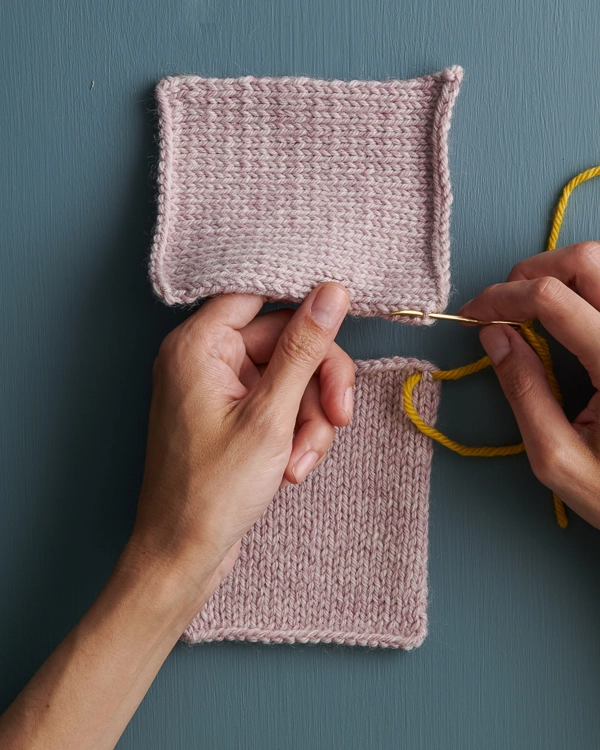
Now you’re going to pick up the first row of the other piece of knitting. To do that, look between the selvage and the first column of stitches, and pass your needle under the first horizontal bar of yarn. Note that if you are familiar with the Mattress Stitch, this is essentially the same technique!

Now go back to where you’re picking up stitches, and pass the needle down into the V of the stitch you came up through previously, and then up through the next V.

Now back to the other piece of knitting, pick up the next row by inserting your needle under the next horizontal bar.
Remember, here we’re joining every stitch to every row, working at a 1:1 ratio. If that’s the case for you, you’ll just keep repeating those steps all the way across. But if you are using a different ratio, you will skip some of the row bars. For a 3:4 ratio, for example, you would work into three bars, and skip the fourth completely.

Once you’ve worked a few stitches, you’ll see that you’re creating a row of knit stitches that seamlessly joins the two pieces of knitting.

Every inch or two, pull on the working yarn and the seam stitches will disappear, leaving you with a join that’s nearly invisible. Just pull tightly enough that your seaming stitches disappear but there is still some slack. You can also tug on the fabric along the seam to adjust the tension and make sure it has give. In the end, this seam is very strong and flexible and won’t stretch out over time… It’s a great seaming technique!
Give Seaming Stitches To Rows A Try
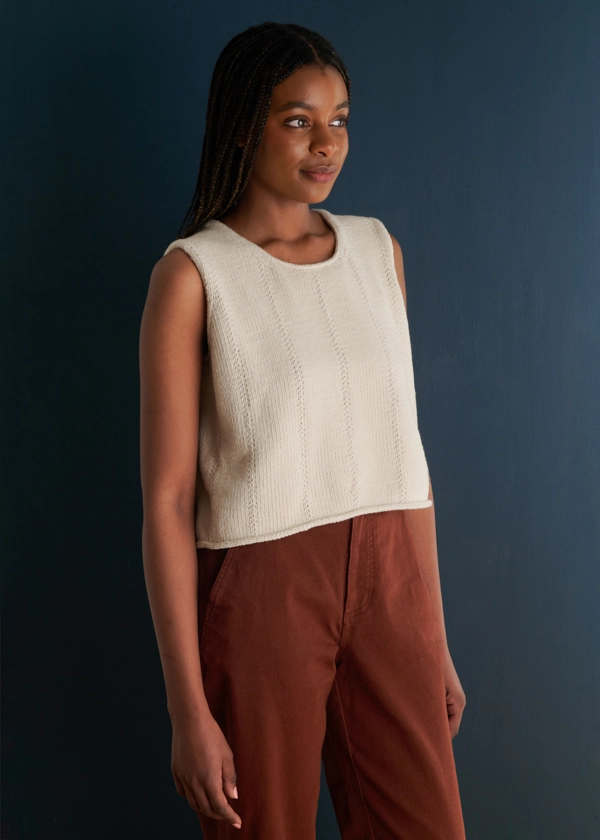
In our Spring Top knitting pattern, knit in our beautiful cotton and yak Morning yarn, you will join the long straps of the front to the sloped shoulders of the back. The stitches from the straps will be bound off, and the slope on the back is a selvage (although it looks like a sloped bind-off). The result is a sturdy seam that looks beautiful and won’t stretch out!

Tutorial written by Andrea Lotz for Purl Soho.
Looking for more inspiration? Explore all of our knitting patterns (including tons of free knitting patterns) and knitting tutorials, buy one of our many knitting kits and yarn bundles, and shop for beautiful yarn. We have over 55 gorgeous natural fiber yarns in 1,000s of magnificent colors, designed to bring integrity, beauty, and joy to your next knitting project and only available at Purl Soho!

Similar Posts You Might Enjoy:



Can’t find the price for the yarn for the windy day throw
Hi Valorie,
Thanks for reaching out. I’m sorry to say that we discontinued that yarn. We were big fans of Linen Quill Worsted ourselves, but I’m afraid not everyone else felt the same and are sad to see it go as well. We have a wonderful yarn substitution page that has some great suggestions for alternatives though!
I hope this helps but please let us know if you have any other questions!
All the best,
Gavriella
For the Spring Top shoulder seaming, there are live stitch left on the front straps. The pattern does not instruct to bind off. How do you seam with live stitches OR should I bind off the front straps? Thank you
Hi Linda,
Thank you so much for reaching out with this great question! I completely understand your hesitation, and I’m happy to clarify!
Seaming two edges with live stitches on both sides together is often called grafting (as referred to in the construction notes). You would want to use the Kitchener Stitch to use this technique. I hope this linked tutorial is helpful for you!
If you run into any trouble, please feel free to reach back out with follow-up questions.
Happy knitting,
Hills