Your basket is empty.
Continue Shopping
I-Cord Bind Off
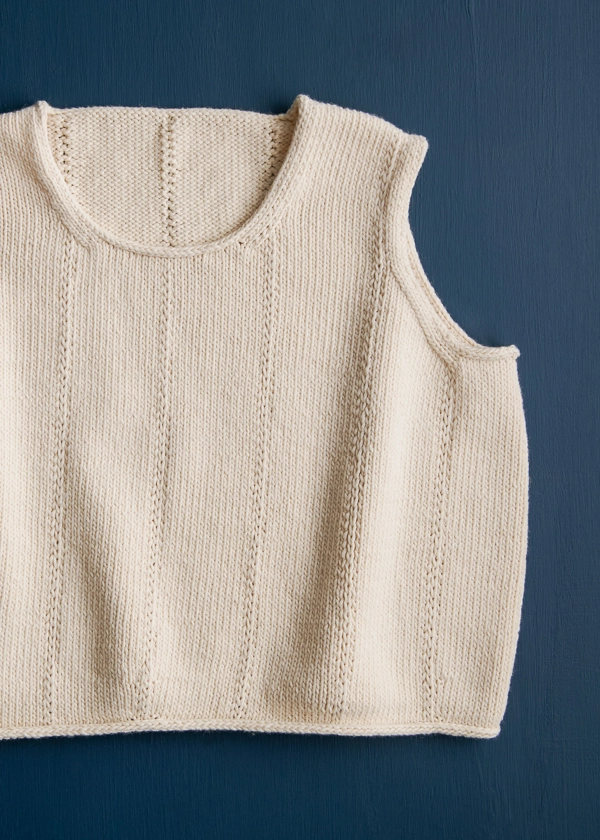
The I-Cord Bind Off creates a polished I-cord tube over any edge in your knitting, whether over live stitches or picked up stitches. It’s the perfect way to get a lovely matching finish across all the edges of a garment, as we did in our Spring Top knitting pattern, where this bind off is used at the hem, neckline, and armholes… Very beautiful, surprisingly easy, and it reduces rolling for stockinette stitch, as well! Find out how it’s done in our I-Cord Bind Off Tutorial.
Note: This bind off technique is similar but not identical to the Attached I-Cord, which has you pick up stitches and create the I-cord at the same time. In this tutorial, you’ll either pick up all your stitches at once or simply work from live stitches, which makes this method even easier!
I-Cord Bind Off: Video Tutorial
Click To See Video Transcript
Hi, this is Whitney from Purl Soho, and I’m going to show you an I-Cord Bind Off. This technique creates a beautiful rounded I-cord along any edge, including all the edges of our Spring Top pattern. It’s called an I-Cord Bind Off, but if you know how to make an I-cord, these steps are a bit different and actually even easier.
You can work an I-Cord Bind Off over live or picked up stitches. So here I’m going to demonstrate on this swatch how you pick up stitches around this cast on edge, which for the Spring Top is the bottom edge of the sweater. Okay, let’s get started! The first step is to cast two stitches onto my needles. In other cases, it may be three or maybe four stitches. The number depends on your pattern and how prominent an I-cord you want.
So here I’m using a basic Long Tail Cast On and I have two stitches on my needles, and next I need to pick up stitches all around this cast on edge so that I have stitches to bind off. I’m going to begin at the beginning of the round here, and just insert my needle under the cast on stitches and wrap the yarn around my needle like I’m knitting, and then pull a stitch through, and that’s how you pick up a stitch.
So I just continue around this whole edge into every single cast on stitch, picking up and knitting. If you are working this bind off over live stitches instead of picked up ones, instead of casting on two stitches the way I did here at the beginning, you would begin by keeping the right side facing you and then use a Cable Cast On to add the extra stitches you need, and then you would just move on to the next step. But for me here, I’m going to finish picking up these stitches and see you back here when I’m done.
Okay, I’ve picked up stitches around this whole edge and I’m back to my two cast on stitches here. The next step is to knit one. This is the first stitch that I cast on at the beginning, and so when I knit it, I’m actually joining to work in the round here. If your I-cord is more than two stitches, you’ll knit one stitch less than the number you cast on. So knit two if you cast on three, knit three if you cast on four.
Now you’re going to knit two together through the back loop. So that’s the last stitch you cast on, plus the first stitch you picked up. You insert your needle through the back leg of the first stitch, and then the back leg of the second stitch like that, and you wrap your working yarn around your needle and pull a stitch through. That’s knitting two together through the back loop.
Now you’re going to slip both of those stitches back over to the left needle, so you insert your left needle into the back leg of the first stitch and just pass it from the right needle to the left needle, and then do that again for the second stitch. And you’ll do that for all your stitches, whether you have two, three, or four.
That’s it. That’s all you do. So we’re going to do that again. You knit one, like that, knit the next two together through the back loop, like that, and then slip both those stitches from your right needle over to your left needle. It’s pretty simple. Knit, knit two together through the back loops, and slip those stitches back over to your left needle. If you take a look here at the back side, you can see that when you knit your first stitch, you’re bringing your yarn from the second stitch. So that’s what makes this an I-cord. And you can see on the right side here that we are starting to form this nice round I-cord tube along the edge.
So I’m just going to keep doing that, knit, knit two together through the back loop, slip both stitches back to the left needle, over and over until I have just two stitches remaining on my right needle. So, we’ll see each other back here when I’m at that point.
I’ve worked the I-Cord Bind Off all the way around and I have just two stitches remaining on my left needle. So now what you do is you cut your yarn, leaving a nice eight-inch tail or so, like that, and then you thread the tail onto a tapestry needle, like that. And now you’re going to thread your tapestry needle through your remaining stitches. Just each one, take it off the needle like that and just pull it through and give a little tug.
So now you can join the end of your I-cord to the beginning of your I-cord. I like to pass my needle under that first stitch there, like that, and then pass it under the top of the I-cord here, like that. And then you’re ready to weave your tail in to the back of your work.
And let’s look at this I-cord a little bit. You can see it has this nice tubular look along the whole edge. It helps keep your stockinette stitch from rolling and it was super simple to do and also very satisfying. So enjoy learning how to do an I-Cord Bind Off!
I-Cord Bind Off: Step-By-Step Instructions
Prefer still photos and text? Follow along here!
If You’re Picking Up Stitches
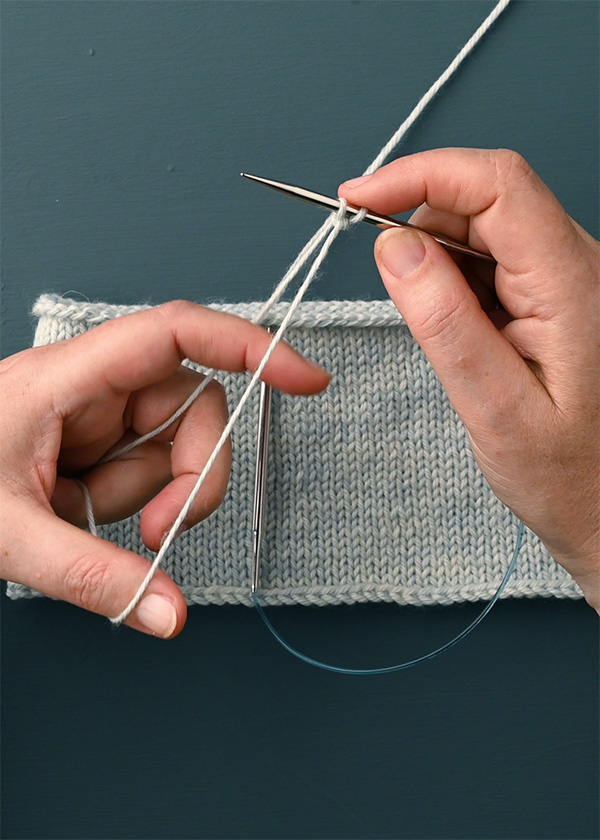
Start by casting two or more stitches onto your needles using a basic Long Tail Cast On. Our Spring Top pattern calls for two stitches, but other patterns may call for three or even four stitches, depending how prominent an I-cord you want.
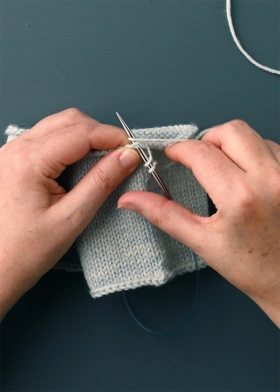
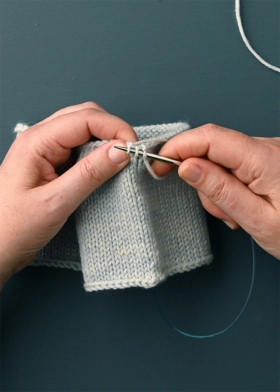
Now it’s time to pick up and knit stitches along whatever edge you’re working so that you have stitches to bind off. With the cast-on I-cord stitches on your right needle and starting at the beginning of the round (or row), insert your right needle under the first stitch, wrap the working yarn around your needle like you’re knitting, and then pull a stitch through. That’s one stitch picked up and knit! Check out our Picking Up Stitches Tutorial if you need more help.
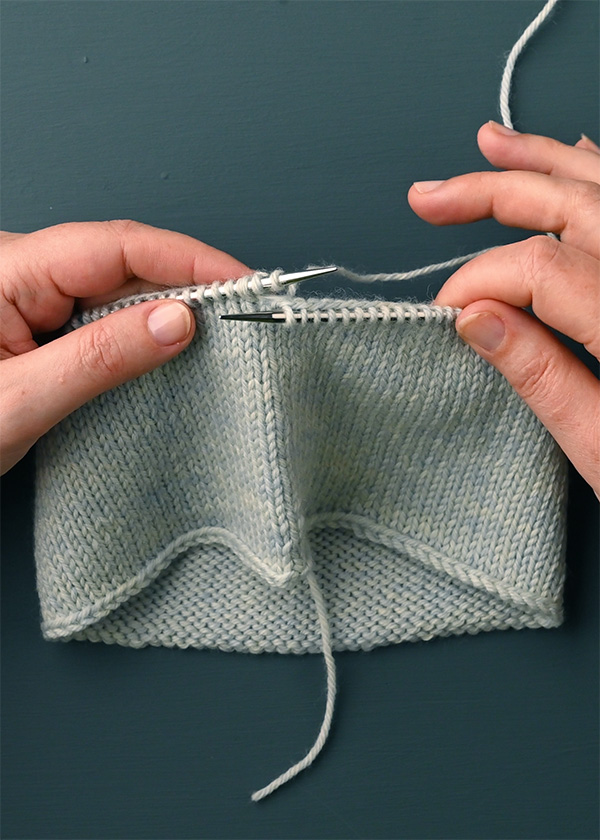
Continue along the whole edge, picking up and knitting until you’re back to your first two I-cord cast-on stitches. If you’re picking up into a cast-on or bind-off edge, as we’re doing here, pick up and knit into every stitch. If you’re picking up along a selvage, pick up and knit into 2 out of every 3 rows, or maybe into 3 out of every 4 rows, depending on your gauge.
Now it’s time to work the bind off!
If You’re Working Live Stitches
If you are working this bind off over live stitches instead of picked up ones, it’s even easier. Begin with the right side facing you and then use a Cable Cast On to add the extra I-cord stitches onto your needle, then just move on to the next step!
Working The Bind Off
Once you have either picked up or live stitches along the whole edge, it’s time to bind off!

First, knit one stitch less than the number you cast on. So, if you cast on two stitches for the I-cord, you’ll just knit one now. If you cast on three stitches, you’ll knit two, and three if you cast on four.

Next, knit two together through the back loop, which will be the last stitch you cast on, plus the first picked up or live stitch. To do this, insert your needle through the back leg of the first stitch, then the back leg of the second stitch, and then wrap your working yarn around your needle and pull a stitch through.

Now slip that stitch back over to the left needle by inserting your left needle into the back leg and passing it from the right needle to the left needle. Then do that again for the second stitch and all your other I-cord stitches.
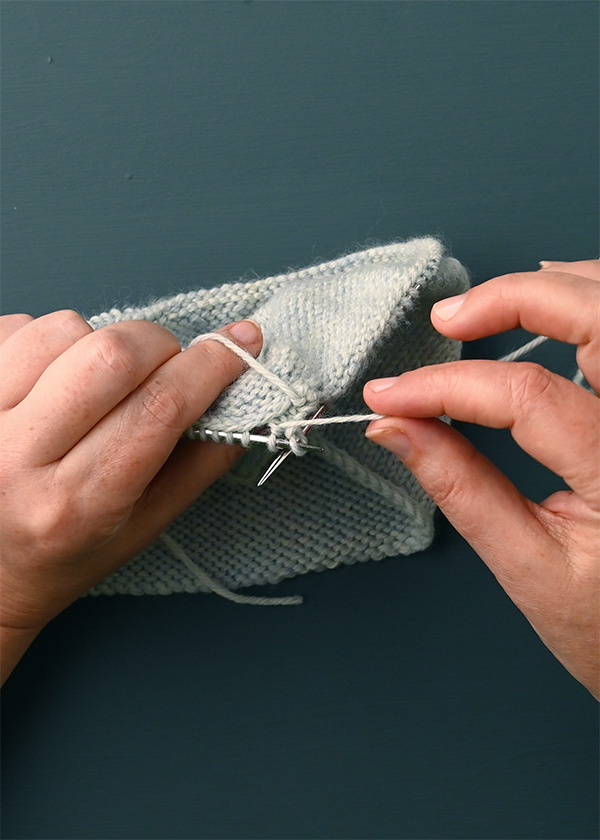
Do that all again by first bringing your yarn across the back of your work (snugly but not too tightly), as for a regular I-cord, so it’s back in position to knit that first stitch.
Again, knit up to your last I-cord stitch, knit the next two stitches together through the back loop, and then slip all those stitches from your right needle over to your left needle.

You’ll see on the right side that you are starting to form a nice round I-cord tube along the edge!
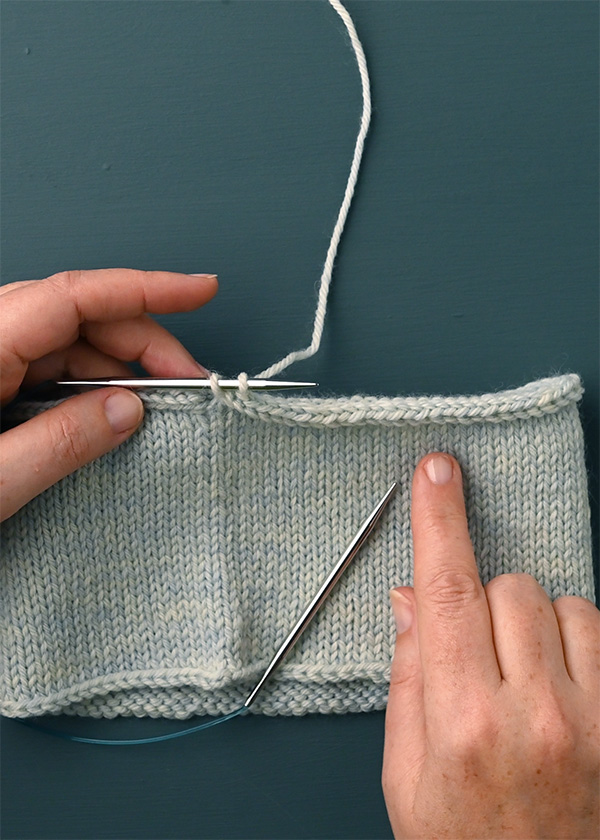
Repeat those steps until you have just your I-cord stitches remaining on your left needle, whether two, three, or four stitches.
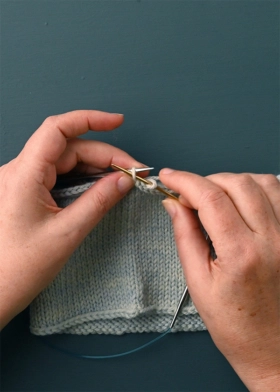
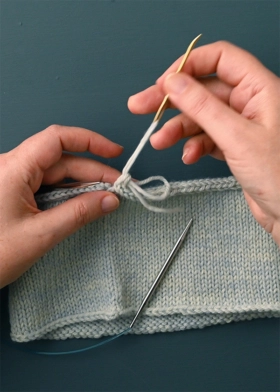
Cut your yarn, leaving a long enough tail for weaving in, and thread the tail onto a tapestry needle. Thread the tapestry needle through your remaining stitches, then pull it through and give a little tug.
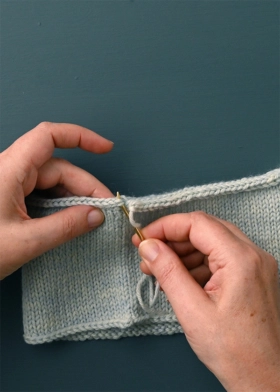
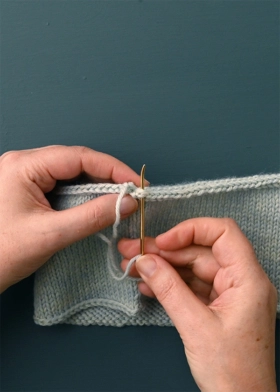
Now you can join the end of your I-cord to the beginning of your I-cord. An easy way to do this is to weave the needle under both legs of the bottom stitch of the first I-cord stitch, then pass it under the top stitch of the last I-cord stitch. Pull the I-cord ends together, and you’re ready to weave your tail into the back of your work.
And that’s how you work an I-Cord Bind Off!
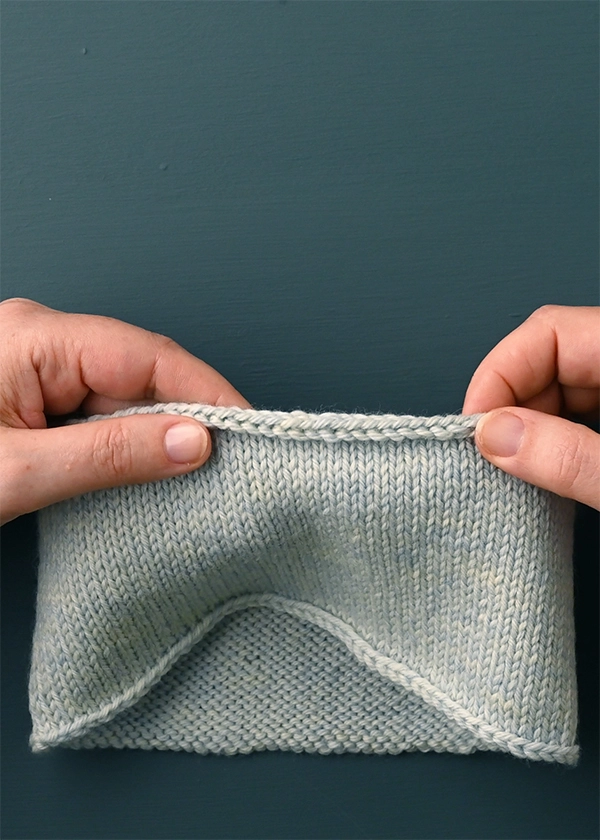
Practice The I-Cord Bind Off!

Spring Top knitting pattern in Morning
You’ll find lots of I-Cord Bind Offs in our Spring Top knitting pattern, where they’re used at the hem, neckline, and armholes. An I-cord bind off gives all of those edges just the right amount of stretch, keeps the stockinette stitch from rolling too much, and looks really beautiful and uniform across the whole garment. It’s a wonderful bind off to have in your toolbox!
Tutorial written by Andrea Lotz + Whitney Van Nes for Purl Soho.
Looking for more inspiration? Explore all of our knitting patterns (including tons of free knitting patterns) and knitting tutorials, buy one of our many knitting kits and yarn bundles, and shop for beautiful yarn. We have over 55 gorgeous natural fiber yarns in 1,000s of magnificent colors, designed to bring integrity, beauty, and joy to your next knitting project and only available at Purl Soho!


Similar Posts You Might Enjoy:


 PRINT
PRINT
Add a comment