Your basket is empty.
Continue Shopping
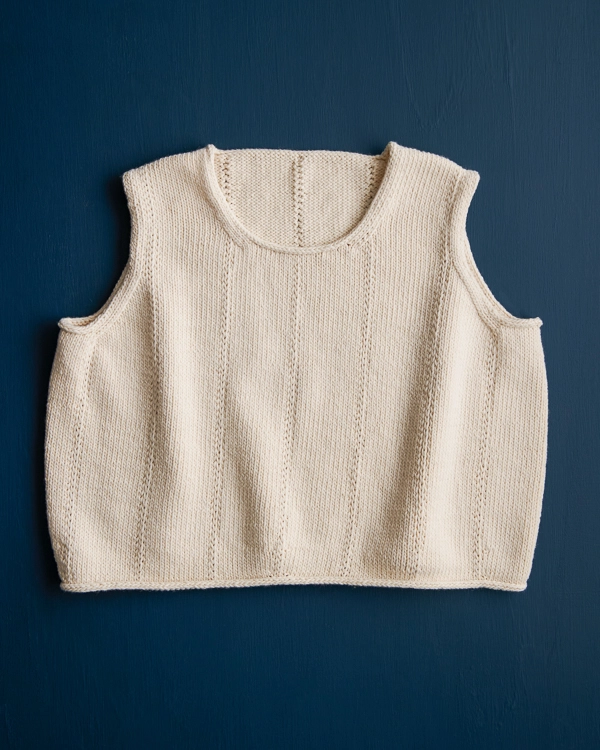
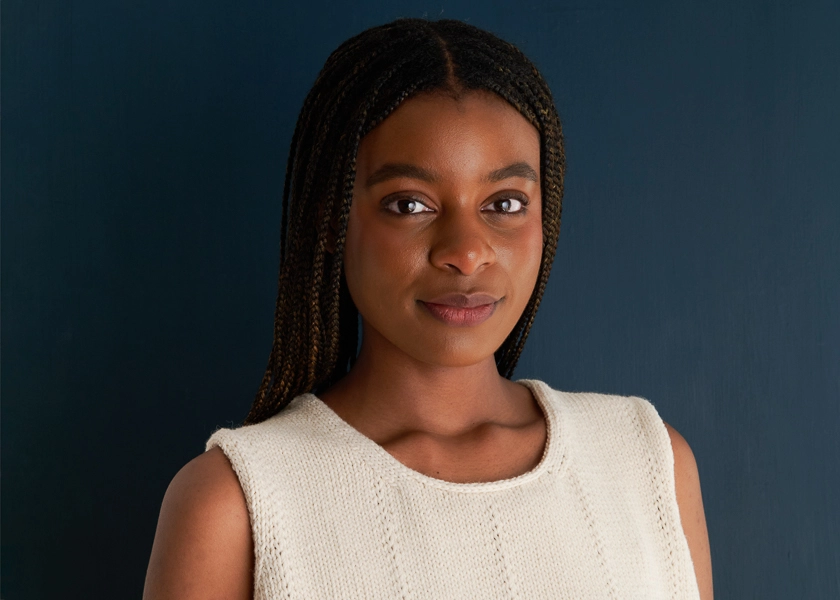
Spring Top
Fresh, cool, and full of possibility, our Spring Top knitting pattern is just right for every moment from April to October. Knit in Morning, a soft and breathable yarn made from organically grown cotton and yak, this sleeveless top has a roomy fit, a slightly cropped length, and a fabric that’s equal parts fluid and structured. Easy to wear and a joy to knit, it’s ready to shine from the first warm breeze to the last golden leaf!
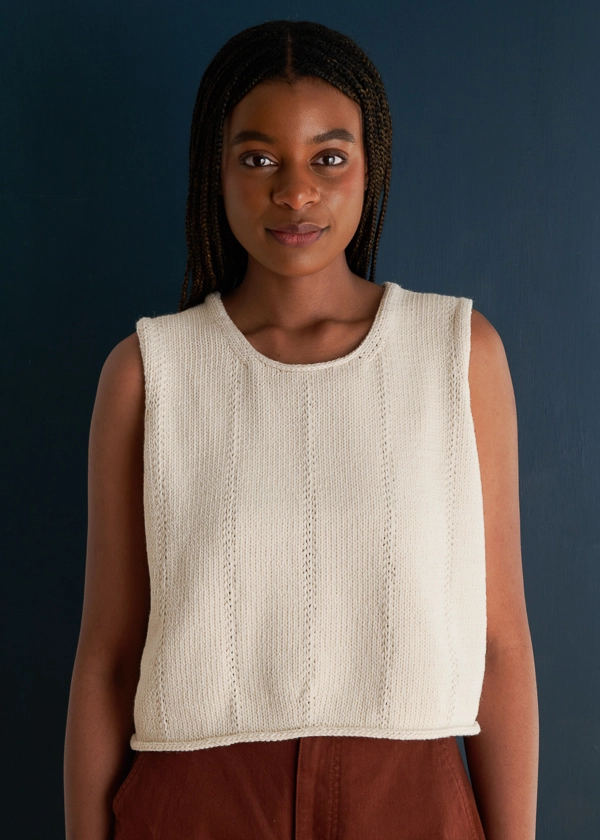
You knit the Spring Top from the bottom up in the round with minimal shaping, dividing at the underarms to work the front and back separately. Most of the pattern is soothing stockinette, but vertical pinstripes formed by knitting into the stitch below add subtle texture and a deeply satisfying rhythm as you knit… A simple technique with big impact!
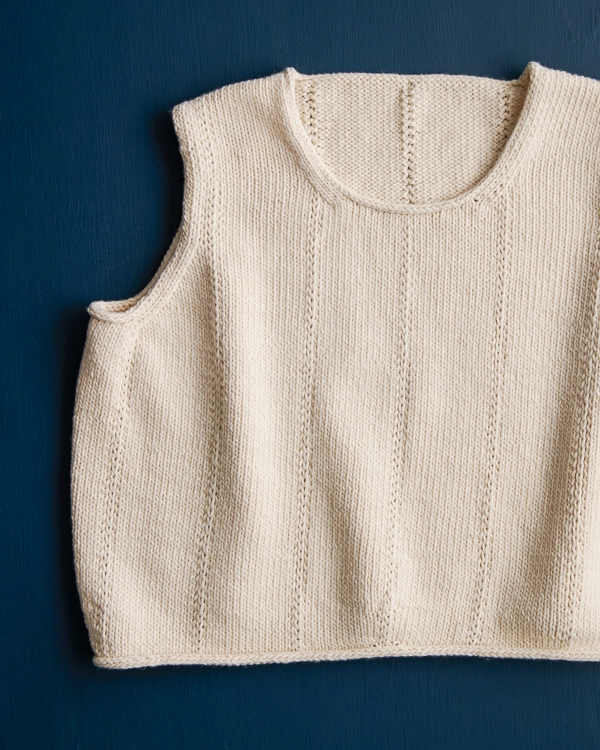
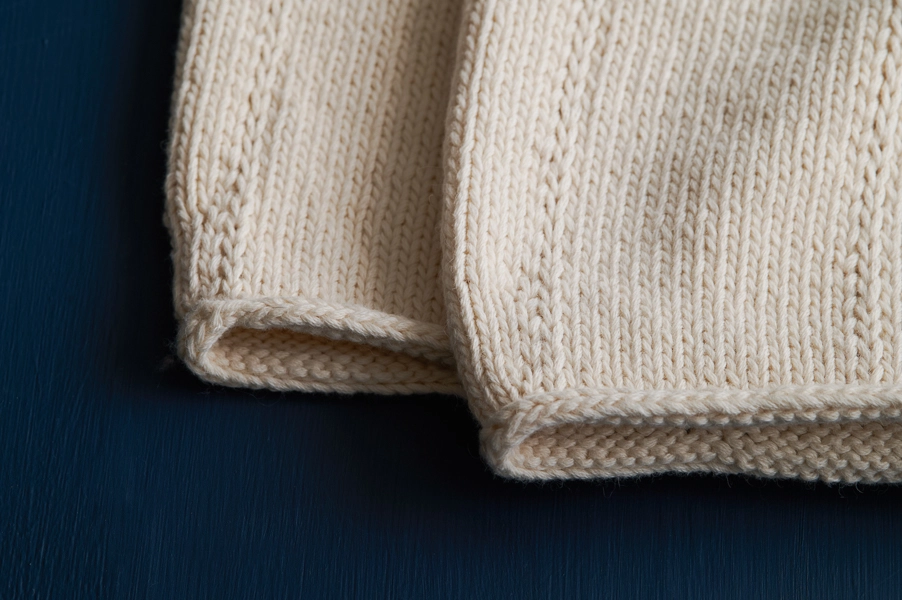
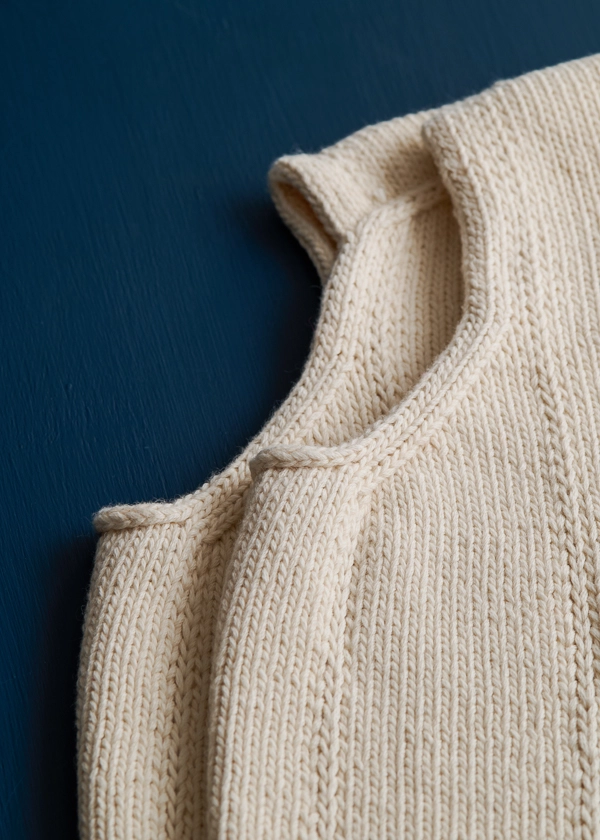
To complete your top, you’ll attach the long front straps to the sloped shoulders in the back, then trim the neckline, armholes, and hem with an easy I-Cord Bind Off. This elevated finish not only gives the edges a polished look but also helps prevent the stockinette stitch fabric from rolling. We have handy tutorials to walk you through all those lovely details!
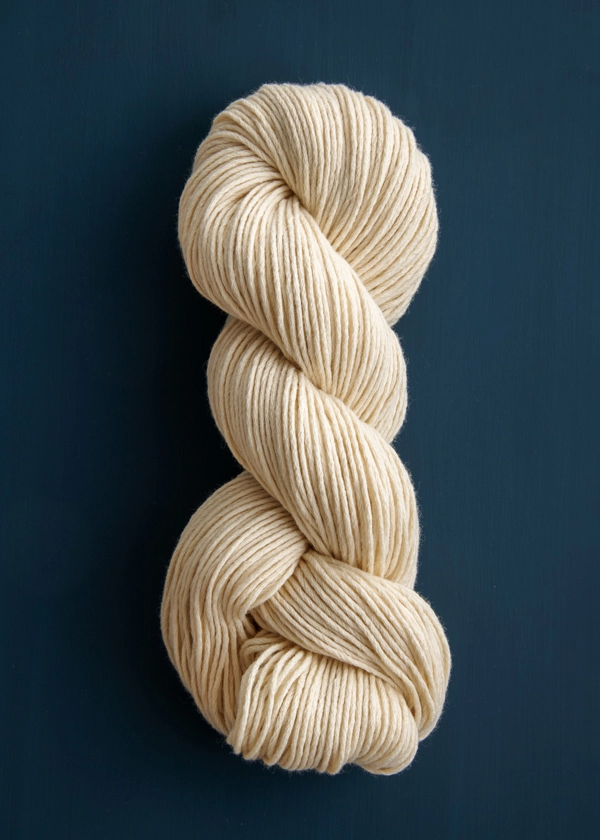
Cast on with Morning and treat yourself to a truly special knitting experience. Made with 75% organically grown cotton and 25% yak, this machine-washable DK-weight yarn has an incredibly soft feel, a smooth hand, and sculptural stitch definition. The cotton lends strength and a summertime coolness, while the yak, sourced from the downy undercoat the animal sheds for the summer, is cozy yet breathable and adds a gentle elasticity… An absolute pleasure to knit!
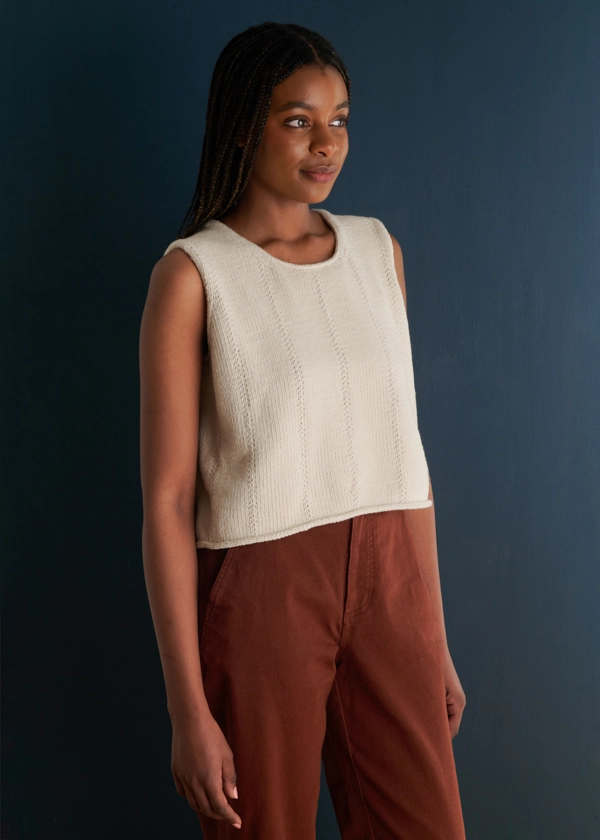
We chose Heirloom White for its timeless simplicity, but Morning comes in 13 more up-with-the sun colors that follow the light from green spring to bright midsummer and into golden autumn… Pick your favorite and cast on for a Spring Top that will carry you through the seasons!
Yarn lovers, if you adore the yarn used in this project, you’ll love exploring all of our other yarn collections! Discover over 55 thoughtfully designed yarns in nearly every natural fiber and in every spectacular color you can imagine. Only available here at Purl Soho’s online yarn store, where every skein is created with care and your creativity in mind!

Pattern designed and written by Purl Soho designer, Laura Ferguson.
Story written by Andrea Lotz for Purl Soho.
Materials
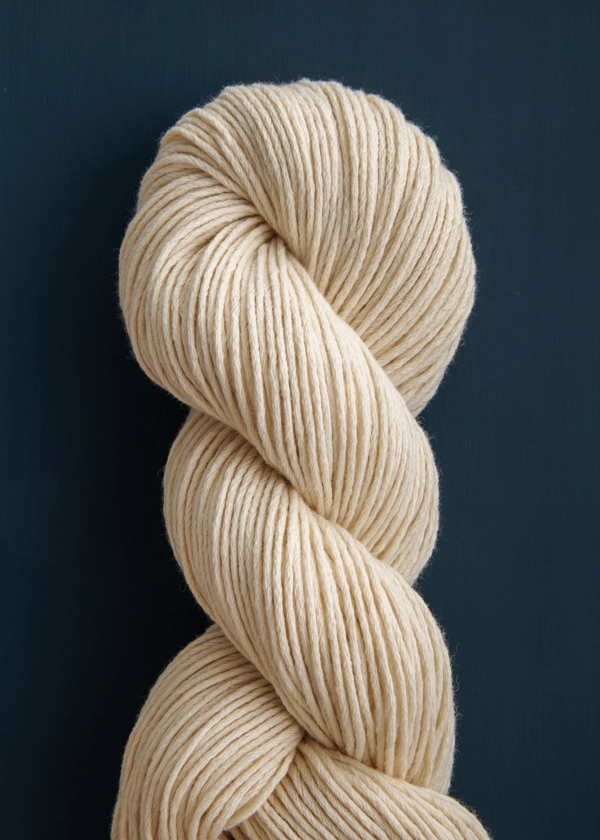
- 3 (4, 4, 4, 5) (5, 6, 6, 6) skeins of Purl Soho’s Morning, 75% organically grown cotton and 25% yak. Each skein of this light worsted/dk-weight yarn is 191 yards/ 100 grams; approximately 570 (640, 700, 760, 825) (885, 975, 1065, 1145) yards required. We used the color Heirloom White.
- US 6 (4 mm), 32-inch circular knitting needles
- US 5 (3.75 mm), 16-inch circular needles
- US 5, 32-inch circular needles
- Stitch markers, including one unique
- Stitch holders or scrap yarn
- A Spring Top Pattern PDF
GAUGE
21 stitches and 30 rows/rounds = 4 inches in stockinette stitch and in stitch pattern
SIZES
NOTE: For help picking a size, please check out our Understanding Ease + Selecting Your Size Tutorial!
38 (42, 46, 50, 54) (58, 62, 66, 70)
To fit actual chest circumference of 30–34 (34–38, 38–42, 42–46, 46–50) (50–54, 54–58, 58–62, 62 66) inches, with approximately 4–8 inches of ease
- Finished Chest Circumference: 38 (42, 46, 50, 54) (58, 62, 66, 70) inches
- Finished Length from Top of Shoulder to Bottom Edge: 20 (20½, 20¾, 21, 21¼) (21½, 22, 22½, 23) inches
- Finished Length from Underarm to Bottom Edge: 12 (12, 11½, 11½, 11½) (11½, 11¾, 12¼, 12½) inches
Sample: The sweater pictured here is size 42 inches, worn with 9 inches of ease.
PATTERN
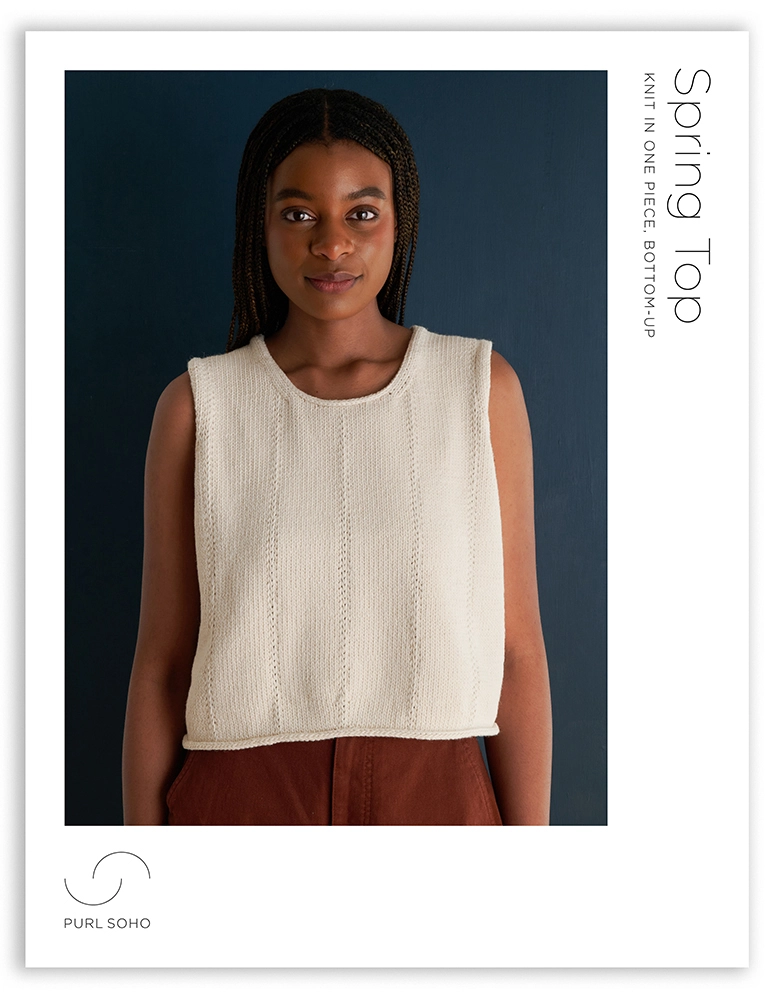
The Spring Top Pattern is available as a PDF.
Share your progress and connect with the community by tagging your pics with #PurlSoho. We can’t wait to see what you make!

LEARN ABOUT MORNING + ALL OUR BEAUTIFUL YARNS
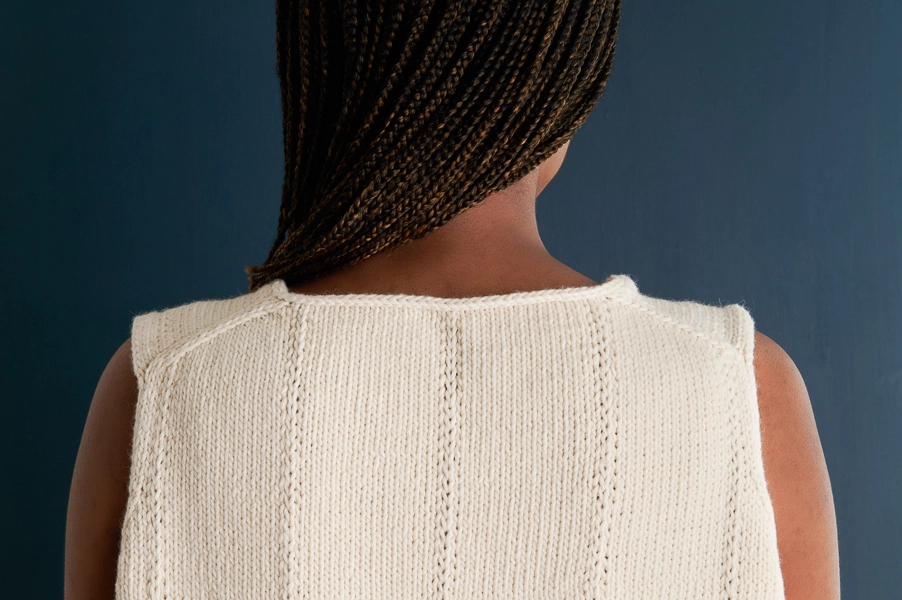
75% organically grown cotton and 25% yak, Morning adds something very special to this project! The cotton lends strength and a cool touch, while the yak is super soft and pliant. Together, this light worsted/DK-weight yarn has a satisfying weight, a very soft feel, and an incredibly lovely hand. In 14 up-with-the-sun colors, Morning is an absolute pleasure to knit!
More Knitting Patterns
- Be sure to explore our vast collection of (mostly free!) Morning knitting patterns and cast on!
More Light Worsted/DK-Weight Yarns
- Shop our entire collection of light worsted/DK-weight yarns (What does DK-weight yarn mean, really? Our guide to DK yarn will answer your questions and demystify.)
- If you want to use a different yarn, be sure to take the time to get the correct gauge. Need help? Check our All About Gauge Tutorial, our Yarn Substitution article, and our Complete Guide To Yarn for lots of helpful information.
More Yarns With Similar Fibers
- Shop cotton yarn (What helps cotton keep its cool? Learn all about this soft, natural fiber in our guide to cotton yarn!)
- Shop yak yarn
Looking for more inspiration? Explore all of our knitting patterns (including tons of free knitting patterns) and knitting tutorials, buy one of our many knitting kits and yarn bundles, and shop for beautiful yarn. We have over 55 gorgeous natural fiber yarns in 1,000s of magnificent colors, designed to bring integrity, beauty, and joy to your next knitting project and only available at Purl Soho!



I have some morning in my stash, and this top is so cute. I don’t like sleeveless, though. Do you think I could pick up stitches to make this into a short sleeve version? Would it be super complicated to work the icord bind off on short sleeves? Thanks.
Hi Nancy,
We’re so thrilled this pattern caught your eye! I think you could certainly add short sleeves. After you pick up stitches around the arm opening, rather than start the I-cord bind-off right away, you can just knit in the round until the sleeve is your preferred length. Then, you can proceed to the I-cord bind-off! I don’t think it would be too complicated at all and we also include step-by-step instructions for how to do the bind-off and a link to our I-Cord Bind-Off tutorial in the pattern as well.
Please let us know if you have any other questions! We’re happy to help!
All the best,
Cat
This is a lovely top. Would it be possible to make it in June worsted, and a bit longer? I realize June is a bit thicker – maybe I could use the instructions for one size smaller? Would that work? Or possibly Serif (I have a stash of both of those)?
Hi Debby,
Thank you for asking! Great questions! This pattern would be absolutely lovely in Serif. I’d recommend swatching to see what gauge you’re getting! Serif can achieve both DK and worsted gauges, so if you’re getting the same gauge as the pattern using Serif, you could follow the instructions as written. June Worsted is a bit thicker, so I’d recommend swatching in this case, too! Going down a size if using June Worsted could be a good option, but it’s best to see what gauge you’re getting to just double check that and determine if there are any other adjustments you might need to make.
You could absolutely make this top longer as well! This project is knit from the bottom up in the round, so you can knit the length of the body before the underarms to the length that you prefer.
I hope this helps, and let us know if you have any other questions!
All the best,
Cat
Thanks so much! I will swatch both and see which works best!
Debby
I just started Spring Top and I’m confused after round 2. It says 10 sts increased but there are 12. I’m doing size 46. I’ve re read it several times and also had a friend read it. Is there a mistake in pattern?
Hi Judi,
We’re so glad you reached out to us about this! I’m afraid we did recently catch an error in this section… We are truly so very sorry for the inconvenience and are working on updating the pattern right away! In the meantime, here are the full corrections for this part:
In the Shape Body section of BODY, the stitch counts at the end of Round 2 should read…
[8 (8, 12, 12, 8) (8, 12, 12, 8) stitches increased]
At the end of the Shape Body section, Round 10 should read…
Sizes 38 (42, -, -, 54) (58, -, -, 70) Only
Round 10: Repeat Round 2. [200 (220, -, -, 284) (304, -, -, 368) stitches]
Sizes – (-, 46, 50, -) (-, 62, 66, -) Only
Round 10: *K2, make 1 left (m1L), knit to one stitch before next marker, make 1 right (m1R), k1, sm, [knit to next marker, sm] – (-, 2, 2, -) (-, 3, 3, -) times, knit to one stitch before next marker, m1R, k1, sm, knit to next marker, sm, k2, m1L, [knit to next marker, sm] – (-, 3, 3, -) (-, 4, 4, -) times, repeat from * one more time. [ – (-, 242, 262, -) (-, 326, 346, -) stitches]
Please don’t hesitate to reach out to us if you have any more questions!
All the best,
Lili
Hello! I’ve completed the armholes for both Front and Back and am now at the Divide Right and Left Front. (I’m knitting size 42).
I’m not sure where exactly to begin the Division Row – are the back armholes still on the stitch holder? Or do I join both front and back? If so, where exactly do I begin the Division Row? If I begin at Left Front then most of the Front is on the stitch holder since there’s only 39 st in the front.
Thanks for any help you can offer!
~ Vicky
Hi Vicky,
After you work the back, you will leave those stitches on your holder and begin to work the front in which you should be on the right side of the work ready to knit. I hope this helps but please let us know if you have any other questions!
All the best,
Gavriella
Hi Gabriella,
Thank you for your prompt reply. All set!
~ Vicky
Hi, I’m right at the Division Row. My question is, once I K1b, K3 and then bind off the next number of stitches (in this size 23), how do I count the bound off stitches? Will I have the K1b, K3 stitches on my right needle and then bind off the next stitch, or is the third knit stitch the first bind off?
Also, when I the previous stitches (119) on a holder, do I include the first stitches of the row on the holder?
I hope I’m explaining this clearly.
Hi PJ!
Thanks for asking! We’re always happy to help clarify so you get your counts right!
In this case, you’ll k1b for the first stitch, k stitches 2, 3, and 4, then k stitches 5 and 6 and pass 5 over 6 to bind off 5. Continue binding off until you pass stitch 27 over stitch 28 and 28 is left on your needle. Then continue on with the rest of the instructions.
When placing 119 stitches on stitch holders or scrap yarn, you’ll count backwards as you put your most recently knit stitches on hold. You should get one set of stitches between the bound off sections on hold and the other set of stitches between the bound off sections on your needles.
I hope this helps! Let us know if you have any more questions!
Andrea
Hi Andrea,
Thanks so much. Your answer plus a cup of coffee and bright morning light have resolved my questions!
PJ
Hi PJ!
I am so glad you figured it out! I also find a cup of coffee is a good problem-solving strategy!
Andrea
I need more help, please. I’m getting a different fabric when I knit in the round than when I knit on the right side and purl back. How can I fix this?
Also, the armholes are quite deep. I wonder if I’ve measured incorrectly when the directions say, [CONTINUE BACK….Repeat rows 1 & 2 until back measures 6 3/4 inches from underarm stitches.]. What constitutes “underarm stitches”? Are those the bound off stitches from the dividing step or should it be measured from the place where you stop shaping the armholes?
Thanks so much. I can send photo if helpful.
PJ
Hi Patricia,
We’re so sorry you are running into issues here! Could you please send a photo of your project to [email protected] so we can have a deeper look? We’ll be able to better visualize what’s going on that way!
All the best,
Gavriella
I am at the finishing stage! Confusion on seaming shoulders. The directions have you put the shoulder stitches on a stitch holder for the right and the stitches are still on the needles for the left when you begin Seam Shoulders instructions. According to the referenced “seaming stockinette stitch stitches to rows” instructions these shoulders should be bound off. So, should I bind off then seam the shoulders? If so, bind off knitwise ?
Hi Alma,
Thanks for writing in, and we’re happy to help! I recommend a hybrid approach here between Kitchener Stitch and Seaming Stitches to Rows. You are essentially using kitchener on the front, live stitches and seaming stitches to rows on the back, bound off stitches. It will give you a nice, clean seam without having to bind off. Start by holding your front and back shoulders together with the front facing you. Insert your needle through your first live stitch from the front as if to purl and leave the stitch on the front needle. Then, moving to your back shoulder, look between the selvage and the first column of stitches and pass your needle under the first horizontal bar of yarn. Lastly, return to your live stitches, insert your needle through the first stitch as if to knit, remove the stitch, insert your needle into the next stitch as if to purl, and continue repeating through the steps.
I hope this helps! Please let us know if there is anything else we can help with!
Kindly,
Andrea
That worked really well, very pleased. Thanks!
A
Thank you! I will give it a go.
Hi 🙂
I’m knitting the spring top and just at the point where I need to pick up a new ball of yarn. My question is about the best way to join Morning (weaving in those ends is never my favorite and I rarely knit in cotton!). I considered and tried the Russian Join but it looked very messy. Would it be best to just pick up a new ball of yarn near the beginning of round in order to weave most ends in along the side of the work? Any advice is most welcome 🙂
Thank you, Lydia
Hi Lydia!
Thanks so much for writing in with your question! Great work so far on your Spring Top!
My favorite knot to join yarn is called the weavers knot as you can snip the ends off after. You can search this technique in your favorite search engine.
However, your instinct is spot on! You can just start knitting with the new ball at the beginning of the round and weave the ends in later. We often recommend this for the most seamless join.
I hope this helps! Please feel free to reach out with any other questions you might have!
Happy knitting!
Hills
Thank you! I will check out the weavers knot 🙂
I’m glad this works well for you, Lydia!
Happy knitting!
Hills
Hello,
It would be so helpful if you included a tutorial on the technique for seaming the shoulders in your instructions.
Love this sweater!
Hi Kim!
Thanks so much for reaching out with your comment! I’m so glad you love the Spring Top!
We have a tutorial for seaming which you can click through. I’ll pass this note along to our team.
I hope this helps, please feel free to reach out with any other questions you might have!
Happy knitting!
Hills
I’m thinking of knitting this in Morning, size 42 probably. I’d like to make it a bit longer. I’m assuming I can just keep knitting the body to my desired length, but could you give me a guesstimate on how much more yarn I will need? Either per inch or something? That size requires 4 skeins and if I buy 5 I’m sure that would be lots. But also is there “room” in 4 skeins? Thank you!
Hi Janice,
Thanks so much for reaching out! I’m so glad to see the Spring Top caught your eye. This sounds like a really great modification!
Unfortunately, the most accurate way to estimate how many yards you will use per inch is by knitting (and blocking) a swatch. Luckily, this will also give you a great idea of whether you like the fabric and if you’re reaching the gauge listed in the pattern. What I can say is that you would have 124 yards leftover from one skein if you worked size 42.
Whether that amount is enough for this modification is a little more complex. Once you’ve worked a gauge swatch, you can estimate how many yards per inch you’re using, as well as how much weight you used. First, weigh your swatch. Then, divide that number by the area of your swatch. You now have grams per square inch. Multiply this number by the area you’re hoping to add. This will be your grams needed. Now we’ll convert grams needed to yards needed. You can use the yarn’s label to get the yards per gram (191 yards per 100 g for Morning). Multiply the grams needed by the yardage-per-gram. This should give you the yards needed! Phew!
I hope this is helpful. Please feel free to reach back out if you would like to follow up on this math after swatching!
Happy knitting,
Hills
Hi! I need some help here!
I am seaming shoulders and the front shoulders come together in the back!! Trying to explain it better: I have 19 stchs for each shoulder at the front and 37 stchs as the back. So when I seam them together I have no space on the neck in the back! Is that correct?
Thanks a lot
Hi Caterina,
I’m so sorry to read that you’ve run into a hiccup here, and I’m happy to help point you in the right direction.
You’ll want to be seaming the live stitches from the front with the side of the decreases that were shaped during the shoulder section. It can be a little tricky, and you may need to use a combination of the Mattress Stitch and the Kitchener Stitch… You can pick up the live stitches in the front as if for Kitchener, and pick up the bar between the stitches in the back as if for Mattress Stitch.
I hope this helps get you back on track. If you’re still running into some trouble, please feel free to email us at [email protected].
All the best,
Hills