Your basket is empty.
Continue Shopping
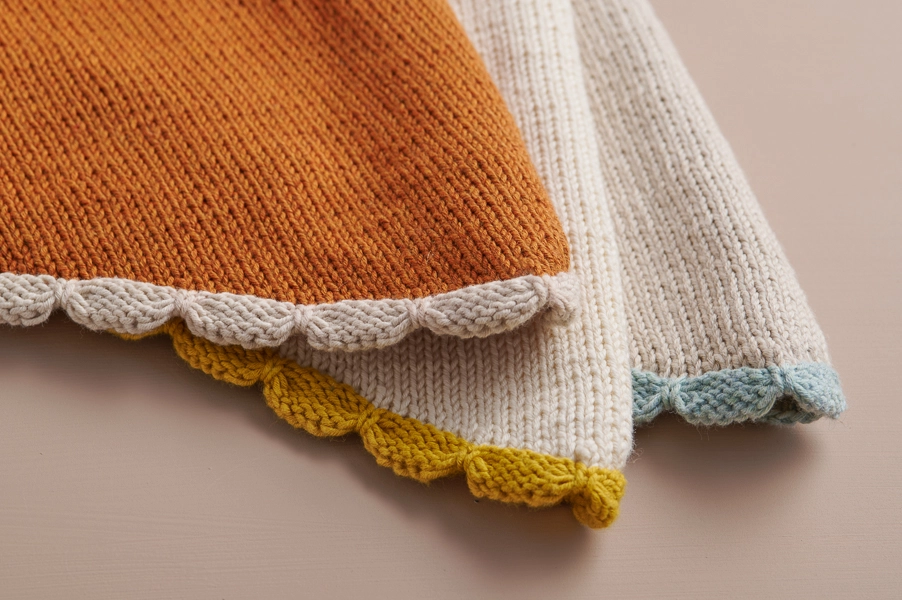


Scallop Edge Bandana
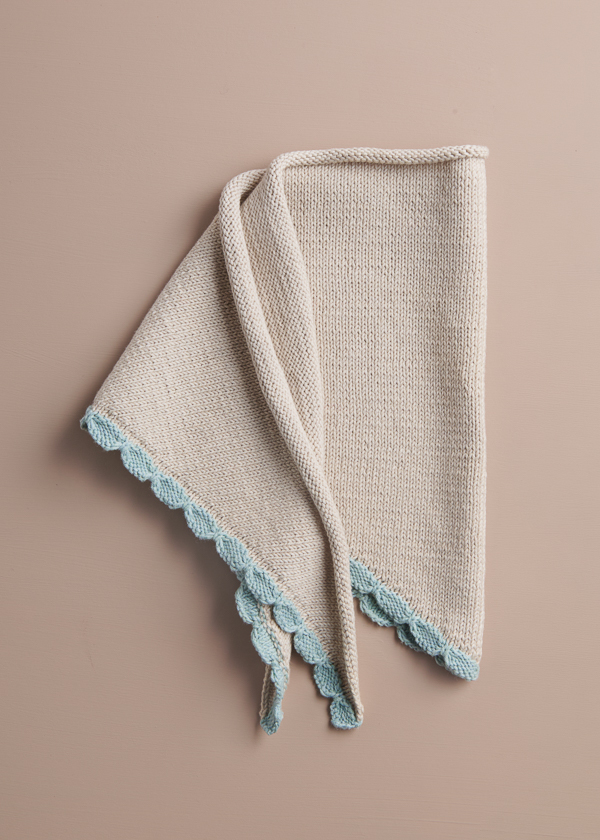
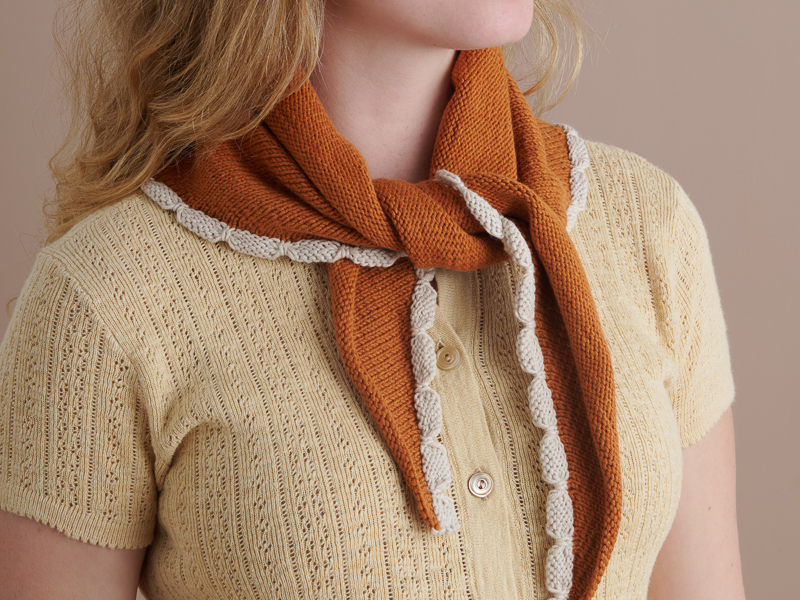
This July is our beloved Cotton Pure’s 10th birthday, and what better way to celebrate than by knitting a bunting-like little bandana? Our Scallop Edge Bandana pattern highlights all of Cotton Pure’s most lovable attributes in a simple project you’ll want to knit again and again!
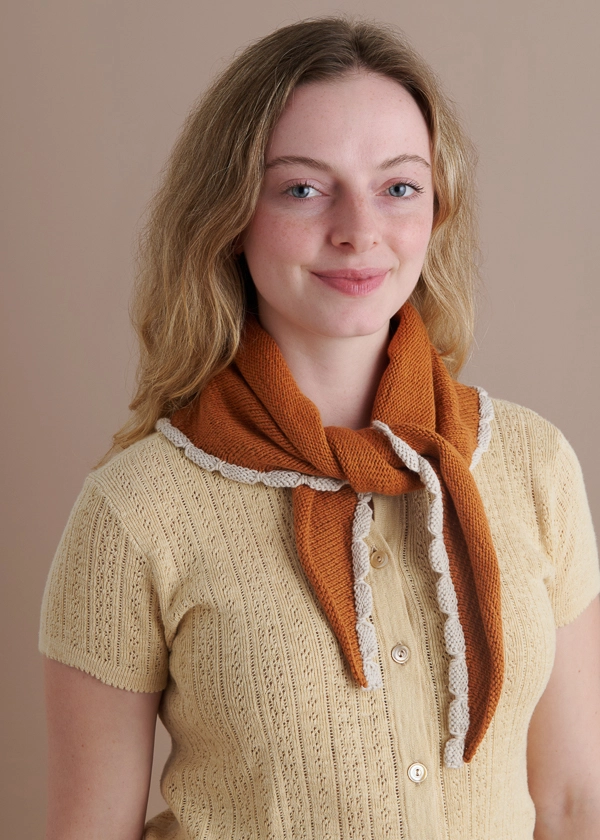
You start this bandana with a delightful Scalloped Edge Cast On, so easy and so charming that you’ll want to use it everywhere. We have step-by-step instructions right in the pattern, then the rest of the knitting is stockinette stitch in your main color, with simple short rows shaping a shallow triangle.
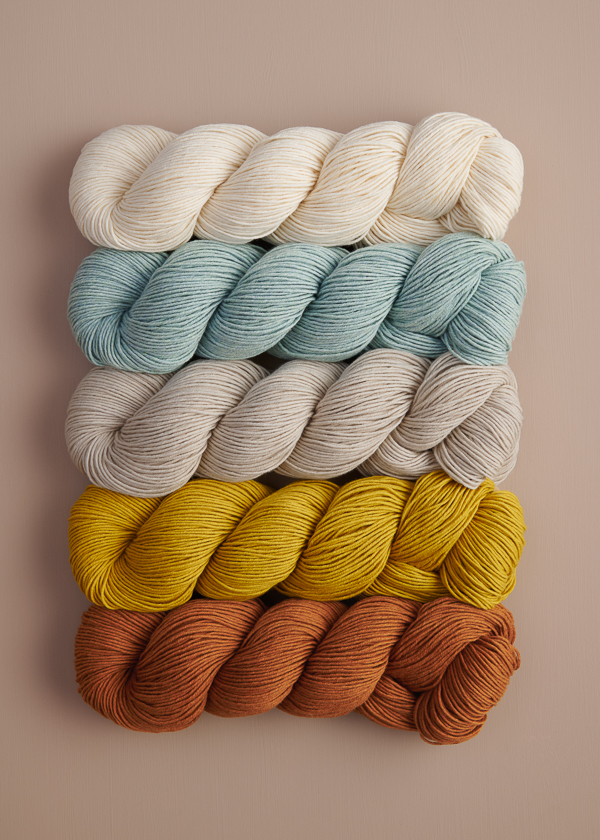
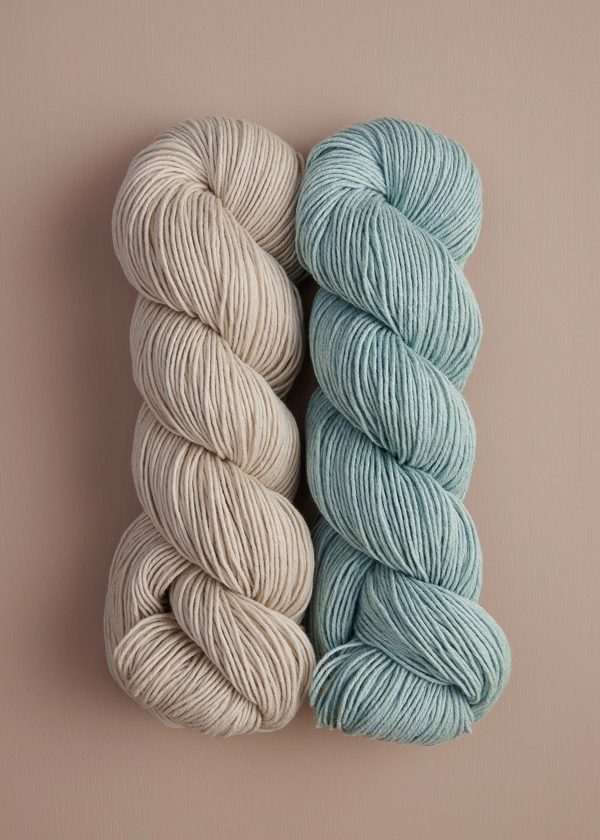
Naturally gorgeous 100% organically grown cotton, Cotton Pure just might be the most beautiful cotton yarn you’ll ever knit with. We chose unmercerized cotton for its slightly earthy texture, gentler environmental footprint, and velvety finish, which gives every color a grounded depth, from cool Mineral Blue to glowing Golden Honey! A tidy multi-ply structure results in a supple, even yarn with clear stitch definition, perfect little textured scallops, as well as a field of smooth stockinette stitch.
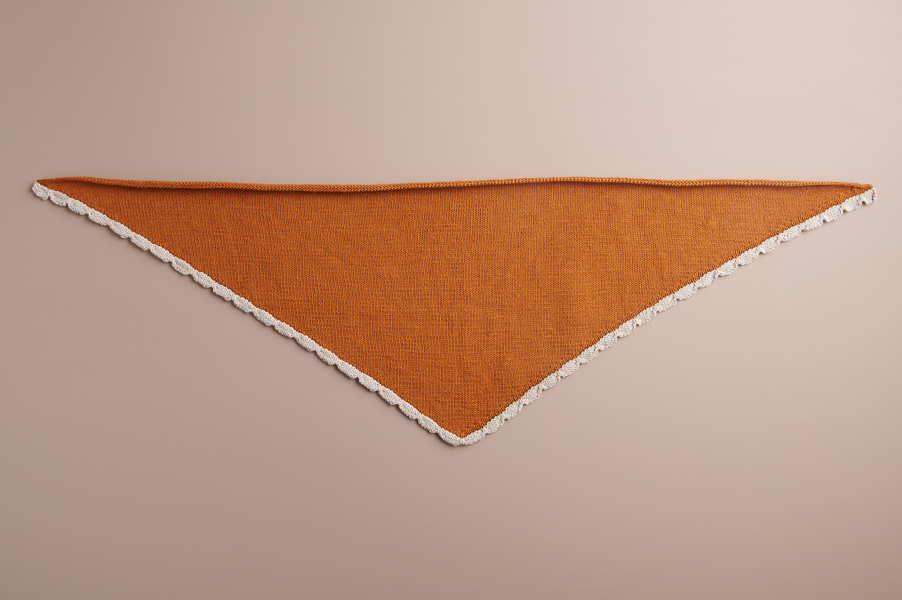
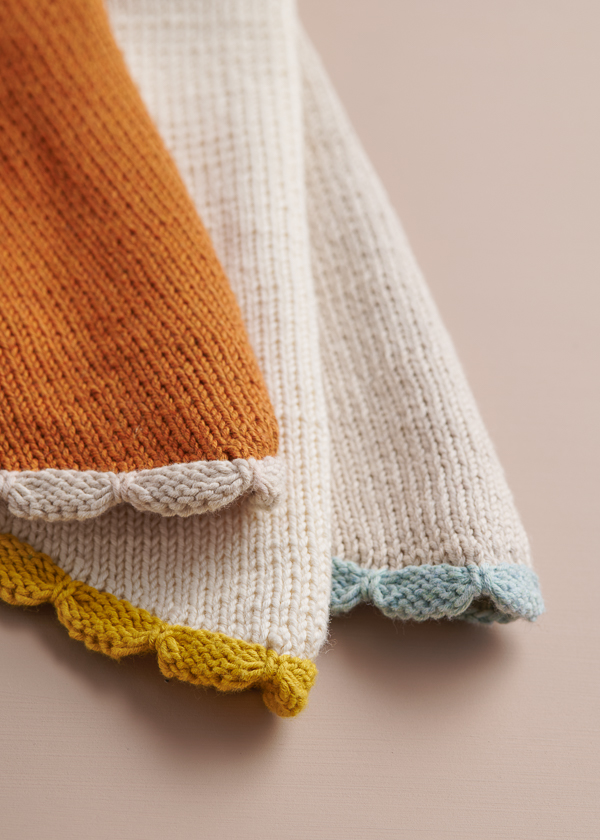
Cotton Pure’s light sport weight, satisfying density, and breathability combine to make the Scallop Edge Bandana a cool little pop of color on a summer’s day. Choose two colors, one skein each, and experience the beauty of this exceptional cotton yarn. Thank you for making Cotton Pure part of your creative lives these past ten years, and here’s to all the beautiful projects, colorful combinations, and joyful making still to come!
Yarn lovers, if you adore the yarn used in this project, you’ll love exploring all of our other yarn collections! Discover over 55 thoughtfully designed yarns in nearly every natural fiber and in every spectacular color you can imagine. Only available here at Purl Soho’s online yarn store, where every skein is created with care and your creativity in mind!
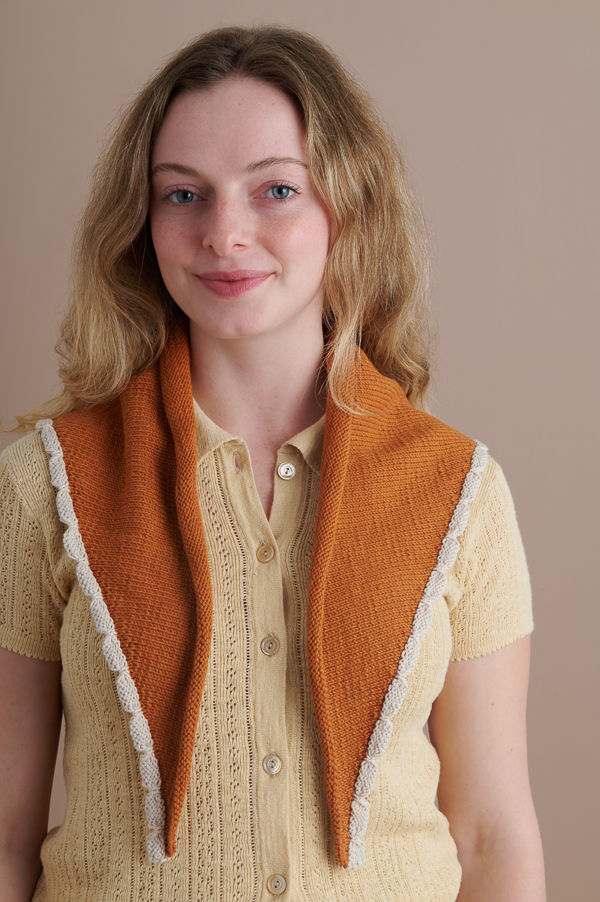
Pattern designed and written by Purl Soho designer, Gianna Mueller. See even more of Gianna’s work on her Instagram!
Story written by Andrea Lotz for Purl Soho.
Want to print this pattern? On desktop, find the “print” icon in the right margin, and on mobile, scroll to the end of the pattern for it. Use the on-screen instructions to remove anything you don’t want to print!
Materials
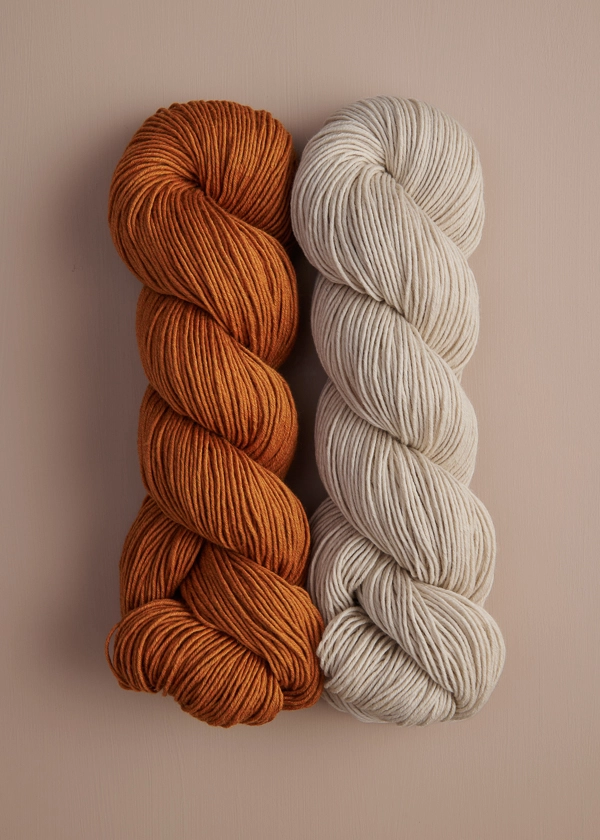
- Purl Soho’s Cotton Pure, 100% organically grown cotton yarn. Each skein of this sport-weight yarn is 279 yards/ 100 grams.
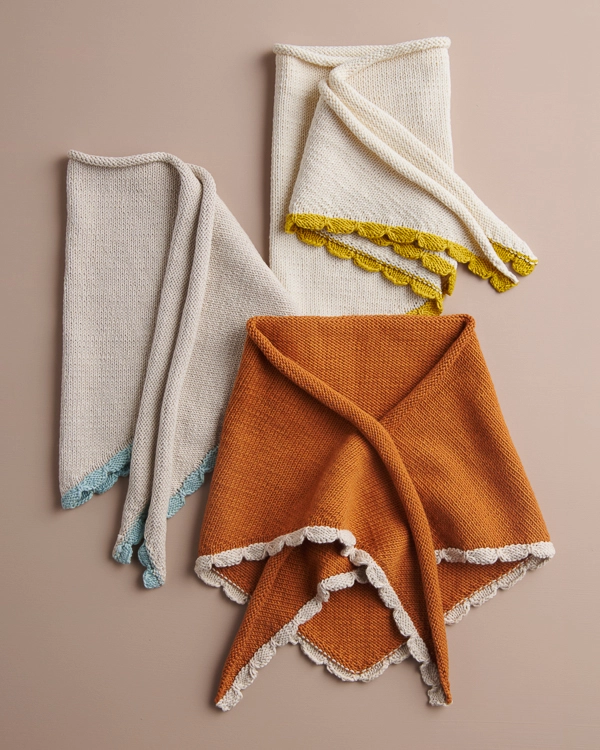
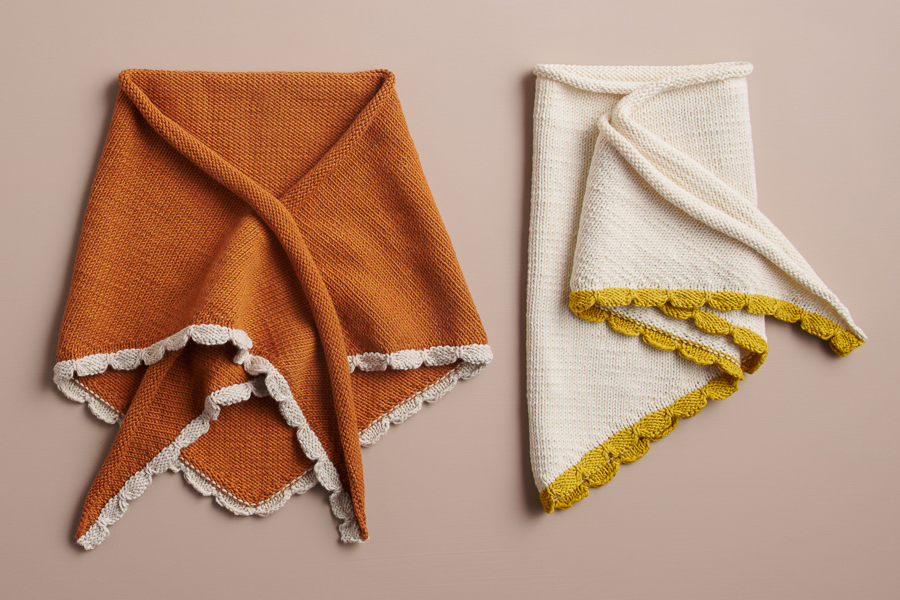
- Main Color (MC): 1 skein; approximately 279 total yards required. We used the colors Apple Cider, Heirloom White, and Alabaster Cream for our three samples.
- Contrast Color (CC): 1 skein; approximately 35 total yards required. We used Alabaster Cream with MC Apple Cider, Honey Yellow with MC Heirloom White, and Mineral Blue with MC Alabaster Cream.
- US 3 (3.25 mm), 32-inch circular knitting needles
NOTE: We used every last yard of MC for our bandanas. To avoid running short, we recommend gauge swatching with your CC and keeping the tail short when you join your MC. Or consider ordering an extra skein of MC. If you don’t end up needing it, you can return unwound yarn for a refund within 30 days of purchase, or within 6 months, for store credit. Our Return Policy has all the details!
GAUGE
24 stitches and 40 rows = 4 inches in stockinette stitch
SIZE
- Finished Length of Wingspan: 42 inches wide
- Finished Depth from Point to Middle of Cast-On Edge: 12¾ inches
NOTES
STITCH MULTIPLE
This pattern works over an odd multiple of 6 plus 5 stitches. For example, 6 stitches x 41 (an odd number) = 246 stitches. Add 5 and you have 251 stitches, the cast on number for this project!
SHORT-ROW SHAPING: WRP-T (WRAP AND TURN)
On the right side: Keeping yarn in back, slip next stitch purlwise from left needle to right needle. Bring yarn to front. Return slipped stitch to left needle. Bring yarn to back. Turn work so wrong side is facing you.
On the wrong side: Keeping yarn in front, slip next stitch purlwise from left needle to right needle. Bring yarn to back. Return slipped stitch to left needle. Bring yarn to front. Turn work so right side is facing you.
For more information about this technique, including how to knit wrapped stitches with their wraps, please visit our Short Rows Tutorial.
PATTERN
SCALLOPED EDGE CAST ON
With Contrast Color (CC) and using a basic Long Tail Cast On, cast on 251 stitches.
TIP: When you’re casting on so many stitches, it really helps to place a marker or piece of scrap yarn every 50 stitches. That way, if you lose count, you won’t have to recount all the stitches. Just remember to remove these markers when you work the first row.
Row 1 (right side): Purl to end of row.
Row 2 (wrong side): Knit to end of row.
Repeat Rows 1 and 2 one more time.
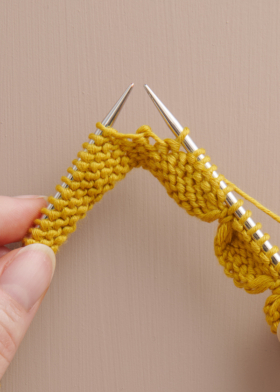
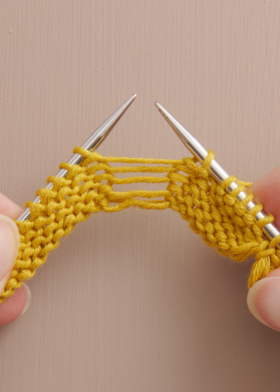
Next Row (right side): *P5, drop next stitch off needle and unravel to bottom…
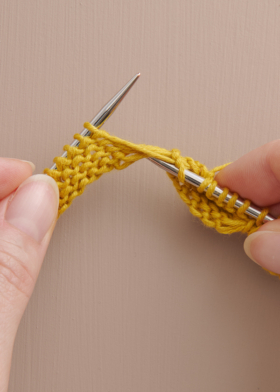
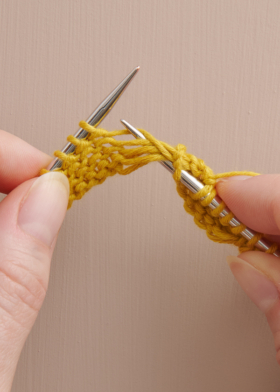
…bring right needle under all the strands from front to back, then use tip of needle to come from back to front under the top strand…
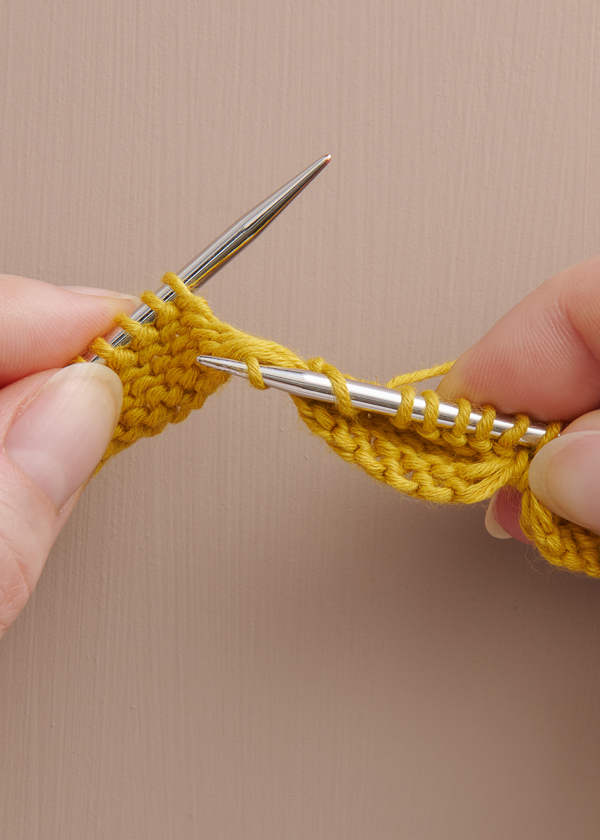
…and swoop your needle from back to front under the other strands.
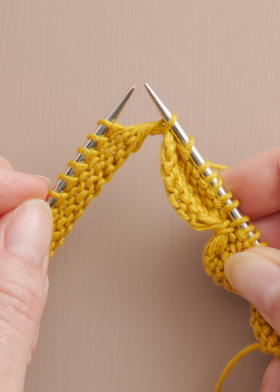
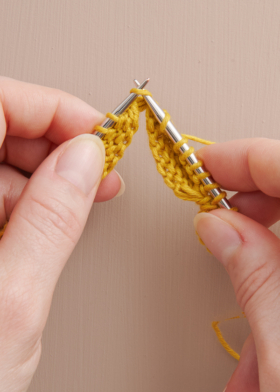
Slip this new stitch to the left needle…
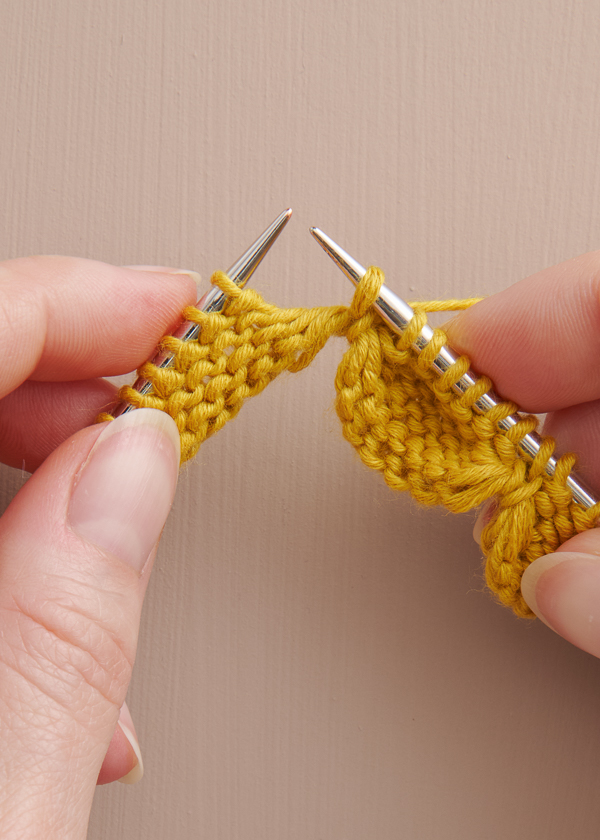
… and knit the new stitch, then repeat from * to last 5 stitches, p5.
Cut CC.
BODY
Join Main Color (MC), ready to work a wrong-side row.
Set-Up Row (wrong side): Purl to end of row.
Short Row 1 (right side): Slip 1 purlwise with yarn in back (wyib), k125, wrp-t (see Notes).
Short Row 2 (wrong side): P1, wrp-t.
Short Row 3: Knit to wrapped stitch, knit wrapped stitch with its wrap, k1, wrp-t.
Short Row 4: Purl to wrapped stitch, purl wrapped stitch with its wrap, p1, wrp-t.
Repeat Short Rows 3 and 4 until 2 stitches remain unwrapped after each wrap, ending with Short Row 4.
Next Short Row (right side): Knit to wrapped stitch, knit wrapped stitch with its wrap, k1, slip 1 purlwise wyib.
Bind-Off Row (wrong side): Slip 1 purlwise with yarn in front, *p1, slip second stitch on right needle over first and off needle, repeat from * to last 2 stitches, purling wrapped stitch with its wrap as you come to it; purl 2 together, slip second stitch on right needle over first and off needle, cut yarn and pull through remaining stitch.
FINISHING
Weave in ends and gently wet block.
Share your progress and connect with the community by tagging your pics with #PurlSoho. We can’t wait to see what you make!
Learn About Cotton Pure + All Our Beautiful Yarns
As special as it is popular, our Cotton Pure brings true natural beauty to this project. 100% organically grown cotton, this sport-weight yarn feels exceptionally soft and supple in your hands, and it comes in tons of gently heathered colors you won’t find anywhere else! Making something big, like a blanket or sweater? Shop our 1,000-gram Cotton Pure On A Cone collection, too!
More Knitting Patterns
- Be sure to explore our vast collection of (mostly free!) Cotton Pure knitting patterns and cast on!
More Sport-Weight Yarns
- Shop our entire collection of sport-weight yarns (What is sport-weight yarn, really? Learn all about sport-weight yarn in our deep-dive article!)
- If you want to use a different yarn, be sure to take the time to get the correct gauge. Need help? Check our All About Gauge Tutorial, our Yarn Substitution article, and our Complete Guide To Yarn for lots of helpful information.
More Yarns With Similar Fiber
- Shop cotton yarn (What helps cotton keep its cool? Learn all about this soft, natural fiber in our guide to cotton yarn!)
- Shop plant-based yarn
- Shop machine-washable yarn
Looking for more inspiration? Explore all of our knitting patterns (including tons of free knitting patterns) and knitting tutorials, buy one of our many knitting kits and yarn bundles, and shop for beautiful yarn. We have over 55 gorgeous natural fiber yarns in 100’s of magnificent colors, designed to bring integrity, beauty, and joy to your next knitting project and only available at Purl Soho!



I really, really would like to make this pattern into a kerchief. It would be doable, if I knew the ratio of wrap and turn stitches to cast on stitches. I could do an I cord for about 14 inches, then knit the edge and finish with another I cord. Then cast on the appropriate contrast yarn and start the body of the kerchief.
I believe there is an error in the description of the scalloped edge cast on.
Hi Ellen,
Thank you so much for reaching out. We would love to look into this further! Could you kindly tell me a bit more about the error you’re seeing?
All the best,
Hills
Before I start…
Is there an error or not?
Hi Jean,
Thanks so much for reaching out. I’m really glad to see you’ll be working on the Scallop Edge Bandana next.
We haven’t found an error in the scalloped edge yet, and some folks on our team have completed this project. Please feel free to reach out if you have any trouble, though. We can also be reached at [email protected] anytime, and we’re always eager to help point knitters in the right direction.
Kindly,
Hills
really like this design! I am currently working on the True Knit Shawl in Large size and would like to incorporate the scalloped edges. Would like to know how many stitches to cast on if to incorporate the edges to that? I am a beginner and not exactly sure how it works
Hi Michelle.
Thanks so much for reaching out! Welcome to the craft! We’re so happy to have you here with us. I’m really glad to see you’re considering the Scallop Edge Bandana, and even more thrilled to see you’re currently working on the True Knit Shawl.
I’m afraid the True Knit Shawl is knit from the bottom up, whereas the Scallop Edge Bandana is worked from side-to-side. This distinction in direction means that you can’t really add a scalloped edge as you work on the True Knit Shawl. You may be able to research adding a scalloped edge during the finishing steps.
I hope this helps! Please reach back out anytime.
Happy knitting,
Hills
Hi Hills,
Thank you so much for your reply. Perhaps I can make this into a shawl. Will it works if I doubled the stitches to make it into a shawl size? Thanks!
Hi Michelle,
Thanks so much for your reply! This is a really fun idea, and I do think it could work.
One thing to keep in mind is that you would be casting on over 500 stitches to make this work. You’d want to use stitch markers every 20 stitches or so on your cast-on so that you can keep track of the number. It can be a little tricky to count 500 stitches without markers. This should work out to about 84 inches at the cast-on, and you may consider using two 40″ cords connected… it may work on a 60″, but you may also find the stitches feel a little cramped.
I hope this points you in the right direction, and please reach back out anytime!
Kindly,
Hills
Thank you Hills! 🥰
Hello I am currently working on the beautiful Scallop edge bandanna but am stuck and can’t figure out how to continue.
I have knit the 125 stitches and ready to do the wrp-t short row
Do I complete all the short rows 1 through four? and where do I continue to knit all the other stitches.
This seems like a dumb question but I am a beginner.
Is it a matter of completing a triangle and then knitting the rest of the scarf .
I need an extremely step by step set of instructions
Thank you
very confused Amanda
Hi Amanda,
I’m so sorry to read that this is giving you pause. I also want to welcome you to the craft…we’re so glad to have you here with us! There are no dumb questions here! Every knitter of every level is consistently learning new skills; it’s one of the most fun parts about the craft! Short Rows can be pretty tricky to get the hang of, and I’m happy to help clarify.
You will need to work Short Rows 1-4, and then repeat Short Rows 3+4 until only 2 stitches remain beyond the short rows, ending with Row 4. Short Rows work by taking a small portion from the whole project and working only that small slice, over and over. These short rows in particular work by increasing the length of the short row each time, moving outwards. This will create a “wedge” of fabric in line with the row you’re working. This wedge will grow, creating the shaping necessary for this triangular bandana. You’ll resolve the stitches remaining on the outside of the short rows in the last row of your short rows (“knit wrapped stitch with its wrap”), and in the bind-off row, where it says, “…to last 2 stitches, purling wrapped stitch with its wrap as you come to it; purl 2 together, slip second stitch on right needle over first and off needle…”
I’d suggest checking out this tutorial on Wrap + Turn Short Rows! The picture in this post shows the short row section worked in white, and the rest of the project in brown.
I really hope this is helpful. If you’re still running into trouble, please don’t hesitate to reach out to us at [email protected]. We’re very eager to get you back on track!
All the best,
Hills
Hi, I really like this pattern but I just can’t seem to figure out the W&T. I’m not new at knitting but just can’t seem to get it. Please help! Ever time I try the W&T it looks funny and I think I’m doing something wrong. I look it up and watch videos and I think I’m doing the right thing but it always comes out weird looking. Do you just have to trust the process on this one? I have never knit a shawl before so this is new ground to me. I don’t know if this would work but couldn’t you just do yarn overs, increasing till it gets the size you want it to be? I don’t know if that works that way though, since I’ve never knit a shawl before. Anyway, please HELP! I really want to knit this!
Hi Hope,
I’m so sorry to read that you’ve run into some trouble with your Wrap and Turns! Short rows can be a little tricky, and I’m happy to help.
We have an amazing tutorial on Short Rows: Wrap + Turn that you might find helpful! The wrap and turns are used for shaping, as they create a wedge of fabric in one spot, without adding more stitches. With that in mind, a yarnover wouldn’t be a great substitute. The beauty of Short Rows is that it does this without creating holes; a yarnover would create a hole in your fabric.
If you find them easier, you could substitute German Short Rows! If you’re still running into trouble, please feel free to email us at [email protected]. We would be so happy to get you back on track for some fun knitting. We’ll keep an eye out for your email, Hope!
All the best,
Hills
Thanks so much, I’ll definitely look at your tutorial!
This is so frustrating. I am on short row 1(right side). I knitted 125 stitches follow by wrp-t. I am now on the wrong side – correct? Do I now purl back the 125 stitches. If that is the case. On short row 2, honestly I do not see how I can be on the wrong side. It also seems I am working the 125 stitches over and over again? What happens to the remaining 125 stitches. This is my first time knitting WRP-T . Please excuse the dumb questions.
Hi Judy,
I’m so sorry to read that you’ve run into trouble with your Scallop Edge Bandana. Short Rows can be a little tricky, and I’m happy to help!
If you just worked your first short row, you should be near the center of your project. You’ll work the wrap + turn, and work back in a very short row for 1 stitch before wrapping and turning again. You’ll then knit to the wrapped stitch, knit the wrapped stitch with its wrap, k1, wrap, and turn again. This is orienting you in the middle of the project to work enlarging short rows each row. I like to picture it a bit like a pendulum when short row shaping is used in this way. This will create a wedge of fabric that begins at the obtuse-angled triangular point, working upwards towards the long edge of the bandana.
I hope this helps! If you’re still running into trouble, please feel free to email us at [email protected].
All the best,
Hills
Hi, I am working on the scalloped edge and I noticed a discrepancy between the description and the photos provided. In the images it looks like there are 6 purl stitches in between each dropped + unraveled knit stitch (to form the scallop).
Maybe I’m totally misunderstanding the written instructions, but just want to confirm it is in fact 5p and not 6p.
Thanks!
Hi Lucy,
I’m so sorry to read that you’ve run into a bit of trouble with the scalloped edge, and I’m happy to help clarify!
For this pattern, the scallops are worked over a multiple of 6 + 5. You’ll work 5 purl stitches per scallop, and drop the 6th stitch to pick up again from the top strand only, in a swooping movement under the other strands. The additional 5 stitches (to make the pattern multiple work) function as the last scallop, which does not have a final swoop after its repeat.
I hope this helps get you back on track! Please feel free to reach out with any other questions you might have.
All the best,
Hills
Hi,
I’m late to the knit bandana trend & this looks fun. I’m not sure why short rows are used except to make the edges nice. Can’t I just make a triangle by inc/dec? They seem to roll anyway.
Thanks!
Hi Lolly,
Great question! Short rows are used in this pattern because you are working the bandana from the bottom up in order to work the scalloped edge. Once you have worked the scalloped edge, you will work through half of the stitches and begin working back and forth in short rows, knitting more stitches as you go along which forms the point of the bandana.
I hope this helps, and happy knitting!
All the best,
Mia
Hello,
I love the knitted scallop edge and was wondering if there was a way to put it as a border around a baby blanket. Do you have any suggestions for that?
Thank you,
Marcia
Hi Marcia,
Thank you so much for reaching out! I’m so glad to see you love the scallop edge.
This edge is worked as the cast-on, and the bandana is worked outwards to the longer wingspan. To use this specific cast-on, you could try casting on for knitting in the round and work down to the center. This cast-on can be customized for any stitch multiple. For this pattern, they are worked over a multiple of 6 + 5, and they are 4 rows deep. There isn’t really a way to bind off with a scalloped edge in knitting, though you may be able to find a crochet tutorial for scalloped edges during finishing.
I hope this helps point you in the right direction! Please feel free to reach out with any other questions!
Happy knitting,
Hills