Your basket is empty.
Continue Shopping
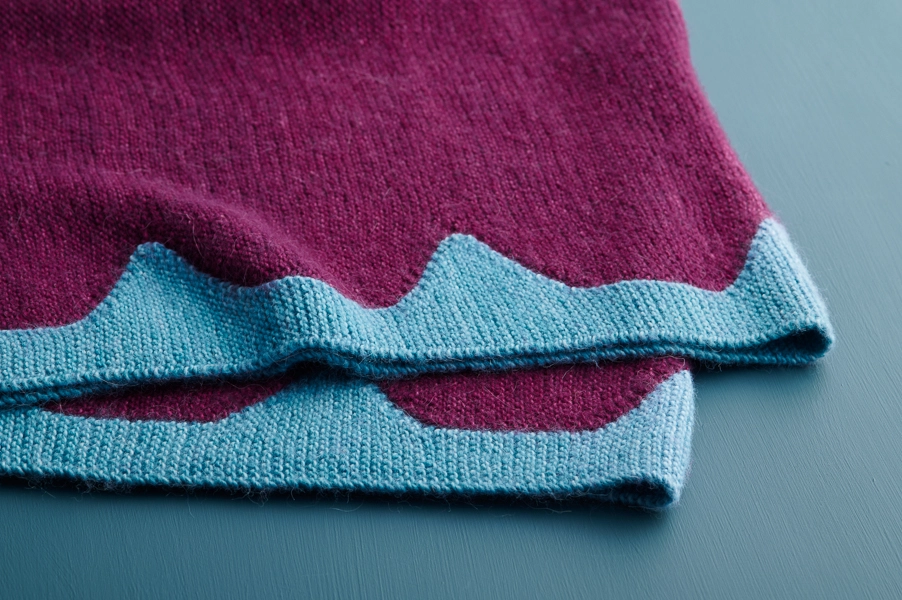


Topiary Blanket
Our bold Topiary Blanket pattern uses simple intarsia to shape a perfectly trimmed little hedge. Its luminous beauty comes from Goldenberry Alpaca, a dreamy single-ply yarn spun from the softest baby alpaca, in a palette of stunning kettle-dyed colors.

The Topiary Blanket is an approachable intro to intarsia, a colorwork technique where you knit glorious areas of color without carrying yarn or slipping stitches. You won’t believe how easy it is—especially in garter stitch—and we have a great tutorial to walk you through it!

This blanket positively glows in Goldenberry Alpaca, our incredibly special hand-dyed yarn made of the loveliest pure baby alpaca you can imagine. A smooth single-ply spin amplifies the alpaca fiber’s natural luster and cloud-like softness. This DK-weight yarn knits up into a sumptuous, opulent fabric with beautiful drape and a delicate halo that floats above the surface of the stitches.

Goldenberry Alpaca’s radiant palette is drawn from the treasures of nature, including the jewel-like Wild Juneberry and Blue Parakeet we chose for our Topiary Blanket. Shifting dark, medium, and light tones shimmer across your stitches, creating movement and dimension, with a subtle warm white core that illuminates each color from within.

Pick up 7 or 9 skeins of your main color and two of your contrast to knit either a Crib or Throw size Topiary Blanket and enjoy the pleasure of shaping each curve into a graceful form grown by your own hands!
Yarn lovers, if you adore the yarn used in this project, you’ll love exploring all of our other yarn collections! Discover over 55 thoughtfully designed yarns in nearly every natural fiber and in every spectacular color you can imagine. Only available here at Purl Soho’s online yarn store, where every skein is created with care and your creativity in mind!

Pattern designed and written by Purl Soho designer, Hiromi Glover. See even more of Hiromi’s work on her Instagram!
Story written by Andrea Lotz for Purl Soho.
Want to print this pattern? On desktop, find the “print” icon in the right margin, and on mobile, scroll to the end of the pattern for it. Use the on-screen instructions to remove anything you don’t want to print!
Materials

- Purl Soho’s Goldenberry Alpaca, 100% baby alpaca. Each skein of this light worsted/DK-weight yarn is 219 yards/ 100 grams.
- Main Color (MC): 7 (9) skeins; approximately 1400 (1870) yards required. We used the color Wild Juneberry.
- Contrast Color (CC): 2 skeins; approximately 250 (285) yards required. We used the color Blue Parakeet.
- US 5 (3.75 mm), 32- or 40-inch circular knitting needles
- Removable stitch markers
GAUGE
23 stitches and 46 rows (23 ridges) = 4 inches in garter stitch
SIZES
Crib (Throw)
Finished Dimensions: 31¾ inches wide x 42¾ inches long (36 inches wide x 48¾ inches long)
SAMPLE: We knit the Crib size.
NOTES
GARTER RIDGE
A “garter ridge” equals two rows of garter stitch. It looks like a prominent horizontal ridge and is an easy way to count rows!
SLIP STITCHES
Slip all slip stitches knitwise with yarn in back.
INTARSIA
The colorwork in this project is done with a technique called “intarsia.” You will work three balls of yarn along each row, which is much easier than it may sound! For full details on this technique, visit our Intarsia in Garter Stitch Tutorial.
PATTERN
BEGIN + SET UP
NOTE: Wind both skeins of Contrast Color (CC) into balls before casting on. You will need them both!
Using a basic Long Tail Cast On, cast 182 (207) stitches onto needles as follows…
With one CC ball, cast on 10 stitches, drop first CC without cutting it; then with MC, cast 162 (187) stitches onto the same needles, drop MC without cutting it; then with other CC ball, cast 10 stitches onto the same needles. (At this point, the colors are not attached to each other, but as you work intarsia they will be!)
Working Intarsia (see Notes) at every color change by crossing the old yarn over the new yarn on the wrong side of the work…
Set-Up Row (wrong side): With CC, slip 1 (see Notes), k9; with MC, k162 (187); with CC, knit to end of row.
Row 1 (right side): With CC, slip 1, k9; with MC, k162 (187); with CC, knit to end of row.
NOTE: Mark previous row with a removable stitch marker or piece of scrap yarn to indicate right side.
Repeat Row 1 thirteen more times, ending with a wrong-side row. [8 garter ridges on right side]
CONTINUE WITH THREE BALLS OF YARN
NOTE: Place a removable marker on the first stitch of this section each time it is worked. This marker indicates where to begin counting ridges for each repeat.
INCREASE CC + DECREASE MC
Row 1 (right side): With CC, slip 1, knit to last 2 CC stitches, knit front and back (kfb), k1; with MC, k1, knit 2 together (k2tog), knit to last 3 MC stitches, k2tog, k1; with CC, kfb, knit to end of row. [1 stitch increased for each CC; 2 stitches decreased for MC; total stitch count remains even]
Row 2 (wrong side): With CC, slip 1, knit to end of CC stitches; with MC, knit to end of MC stitches; with CC, knit to end of row.
Repeat Rows 1 and 2 three more times, ending with a wrong-side row. [14 stitches for each CC; 154 (179) stitches for MC; 4 garter ridges on right side, counting from removable stitch marker]
Repeat Row 1 every row 12 times, ending with a wrong-side row. [26 stitches for each CC; 130 (155) stitches for MC; 10 garter ridges on right side, counting from removable stitch marker]
DECREASE CC + INCREASE MC
Row 1 (right side): With CC, slip 1, knit to last 3 CC stitches, k2tog, k1; with MC, kfb, knit to last 2 MC stitches, kfb, k1; with CC, k1, k2tog, knit to end of row. [1 stitch decreased for each CC; 2 stitches increased for MC; total stitch count remains even]
Repeat Row 1 every row 12 more times, ending with a right-side row. [13 stitches for each CC; 156 (181) stitches for MC; 16 garter ridges on right side, counting from removable stitch marker]
Row 2 (wrong side): With CC, slip 1, knit to end of CC stitches; with MC, knit to end of MC stitches; with CC, knit to end of row.
Repeat Rows 1 and 2 three more times, ending with a wrong-side row. [10 stitches for each CC; 162 (187) stitches for MC; 20 garter ridges on right side, counting from removable stitch marker]
WORK EVEN
Row 1 (right side): With CC, slip 1, k9; with MC, k162 (187); with CC, knit to end of row.
Repeat Row 1 twenty-nine more times, ending with a wrong-side row. [35 garter ridges on right side, counting from removable stitch marker]
CONTINUE
Repeat Continue With Three Balls Of Yarn section 5 (6) more times.
Repeat Increase CC + Decrease MC and Decrease CC + Increase MC sections one more time.
Repeat Row 1 of Work Even Section 16 times, ending with a wrong-side row. [28 garter ridges on right side, counting from removable stitch marker]
Bind Off (right side): With CC, slip 1, *k1, pass first stitch over second stitch, repeat from * until 2 CC stitches remain (one on each needle), cut CC; with MC, knit remaining CC stitch from left needle, pass first stitch over second stitch, continue to bind off until 2 MC stitches remain (one on each needle), cut MC; with CC, knit remaining MC stitch from left needle, pass first stitch over second stitch, continue to bind off to end of row.
FINISHING
Weave in all ends and gently wet block to finished dimensions.
Share your progress and connect with the community by tagging your pics with #PurlSoho. We can’t wait to see what you make!


Learn About Goldenberry Alpaca + All Our Beautiful Yarns
Goldenberry Alpaca brings hand-dyed beauty to this project! A light worsted/DK weight yarn, it is a luminous single ply of softest baby alpaca with a delicate, cloud-like halo. Goldenberry Alpaca glows with a warm white core that shines through shifting tones, adding movement and depth to a hand-dyed palette of colors drawn from nature’s treasures. Knit elegant fabric where light and shadow flow across every row, revealing luminous depth stitch by stitch!
More Free Knitting Patterns
- Be sure to explore our growing collection of Goldenberry Alpaca knitting patterns and cast on!
More Light Worsted/DK-Weight Yarns
- Shop our entire collection of light worsted/DK-weight yarns (What does DK-weight yarn mean, really? Our guide to DK yarn will answer your questions and demystify.)
- If you want to use a different yarn, be sure to take the time to get the correct gauge. Need help? Check our All About Gauge Tutorial, our Yarn Substitution article, and our Complete Guide To Yarn for lots of helpful information.
More Yarns With Similar Fiber
- Shop alpaca yarn
- Shop hand-dyed yarn
Looking for more inspiration? Explore all of our knitting patterns (including tons of free knitting patterns) and knitting tutorials, buy one of our many knitting kits and yarn bundles, and shop for beautiful yarn. We have over 55 gorgeous natural fiber yarns in 1,000s of magnificent colors, designed to bring integrity, beauty, and joy to your next knitting project and only available at Purl Soho!


Similar Posts You Might Enjoy:


I’d love suggestions for other color combos in this yarn for this blanket!
Hi Allyson,
Thank you so much for reaching out! We so love this blanket and I’m happy to see you’re considering it for your next project!
The Topiary Blanket would look fantastic in:
Yellow Sultana + Turquoise Cove
Yellow Pear + Wild Juneberry
Ripe Strawberry+ Purple Freesia or Purple Thistle
Forrest Moss + Golden Amber
Deep Sea Green + Mauve Quartz
…and more, I’m sure! I am sure whichever combination you choose will be lovely! We would love to see the results!
I hope this helps, and please feel free to reach back out with any other questions you might have!
Happy knitting!
Hills
I would like to make a scarf using this pattern with the contrast color running along only one side. Please tell me how much yarn of each color I would need.
Hi Nancy,
Thank you so much for reaching out with this question! This sounds like a really beautiful project, and I’d love to help!
We divided the original yardage of the blanket in half (as you’re looking for just one side of contrast), and did a little adjusting for scale… It looks like, if you’re aiming for a scarf about 10″-12″ by 72″, you would need 4 skeins of the Main Color and 1 skein of the Contrast Color.
We would suggest casting on 81 stitches in the main color and 10 stitches in the contrast color, either before or after the main color (depending on which side of the scarf you’d like the contrast column). We’d also suggest swatching to ensure your gauge is consistent with the pattern. (These calculations might not be as helpful if the suggested gauge isn’t met…)
I hope this helps, but please reach back out if you have any other questions!
Happy knitting!
Hills
It’s a stunning blanket. I’d like to increase the size by 30% approximately. Any suggestions on how I might accomplish that. Thanks so much.
Hi Claire,
I’m so glad to see you love the Topiary Blanket as much as we do! I would be happy to help with this modification… what a wonderful idea!
To increase the size of this blanket by 30% you would need 2,802 yards: 2,431 yards of the Main Color, and 371 yards of the Contrast Color (or 12 skeins of the main color and 2 skeins of contrast color based on the 219 yards per skein of Goldenberry Alpaca).
I would suggest casting on 14 stitches in the main color (at the beginning and end), and 242 stitches in the main color (a total of 270 stitches). This would allow for the proportions to scale up by 30%, as well. I’m including a few changes to the pattern below to adapt it for you.
PATTERN
BEGIN + SET UP
[…]
INCREASE CC + DECREASE MC
DECREASE CC + INCREASE MC
WORK EVEN
I’d also suggest swatching to see how you like the fabric and that you can achieve gauge (otherwise, these modifications may not be as helpful at a different gauge).
I so hope this helps! Please reach back out with any other questions or if you run into trouble with any of these modifications!
Happy knitting,
Hills
Wow- thanks so much. you and Purl Soho are terrific!
Hi I would like to use a cotton yarn for this. I like big sky otganic cotton yarn. What adjustments are needed
Hi Virginia,
Thanks so much for reaching out. I’m really glad to see the Topiary Blanket caught your attention.
I would suggest using the sport weight to achieve the gauge listed in the pattern. If you’re able to reach the same gauge in your gauge swatch (after blocking), then you would need the same amount of yarn in yards.
You may enjoy reading more about substituting yarns in our handy article, Yarn Substitution Made Easy.
I hope this helps!
Happy knitting,
Hills
I am currently knitting the topiary blanket. The contrast color is puckering at the point. I’m not sure what I’m doing wrong! Do you think this is something that will tighten up if I steam and block it?
Hi Kristine,
I’m very sorry to read that you’ve run into a bit of trouble here.
Goldenberry Alpaca is a little unusual in that it doesn’t relax as much as other alpaca yarns when blocked. We recommend hand washing the finished piece and laying it flat to dry, as it is a bit delicate. I would suggest steaming your swatch first to check that it doesn’t agitate the fibers in some undesirable way…
I’m also wondering if you might be able to send us a photo of your work with a ruler at the bottom for reference. We can be reached at [email protected], and we’re very eager to get to the bottom of this for you.
We’ll keep an eye out for your reply!
Kindly,
Hills
Beautiful pattern. Could you recommend a cotton yarn that would be suitable for a California baby?
Hi Renee,
Thanks so much for reaching out! This would make a lovely project in cotton for warm-weather babies.
I recommend Cotton Chirp DK as a good substitute for this project! It’s 100% Peruvian Pima cotton, machine washable (great for baby knits), and has 32 vibrant colors to choose from. As always when substituting yarn, we recommend swatching to ensure you meet the project gauge.
I hope this helps, and please feel free to reach back out if you have any other questions!
Happy knitting,
Sam
Would June Worsted be a good match? I like the colors more.
June Worsted is another great yarn for a warm weather blanket, and I’m glad to hear you like the color selection!
Since this is a bit thicker than Goldenberry Alpaca, you may need to adjust the recommended needle size to meet the pattern gauge. For the Main Color, you’ll need 9 (12) skeins of June Worsted, and for the Contrast Color you’ll need 2 (2) skeins.
I hope you enjoy your project, and let us know if you need anything else!
Kindly,
Sam
Would Santolina work for this? I have a few skeins of it.
Hi Mimi,
Thanks for reaching out! A blanket in Santolina sounds lovely, and I’d be happy to find a good project for those extra skeins you have.
Since this pattern is written for light worsted/DK-weight Goldenberry Alpaca and Santolina is fingering-weight, I would recommend going with one of our lighter weight blanket patterns instead. Our Droplet Blanket calls for Santolina and is made with a beautiful Japanese wrap stitch. We also have the Sand Drift Blanket in Santolina, that uses a slip stitch pattern for some fun colorwork.
If you’d like more in-depth help with picking a project, you can also email us at [email protected] with the specifics of how much yarn/what colors you have left, and we can find the best fit for the materials you have on-hand!
Kindly,
Sam
Hello, I have a question about th work even section (after decrease and increase section. If you complete row 1 twenty-nine more times, how does this equal 35 garter ridges? thank you.
Hi Alda,
Thank you so much for reaching out! This is a really great question, and I’m happy to help!
It looks like you’re counting ridges from your last-placed removable marker. In the previous section, you’ll form 20 garter ridges after the marker. If you were to work an additional 29 rows (plus the 1 row to get started, for a total of 30 rows), you would add 15 ridges to this count.
If you’re still running into trouble, please don’t hesitate to reach back out! We can also be reached at [email protected] anytime.
All the best,
Hills