Your basket is empty.
Continue Shopping
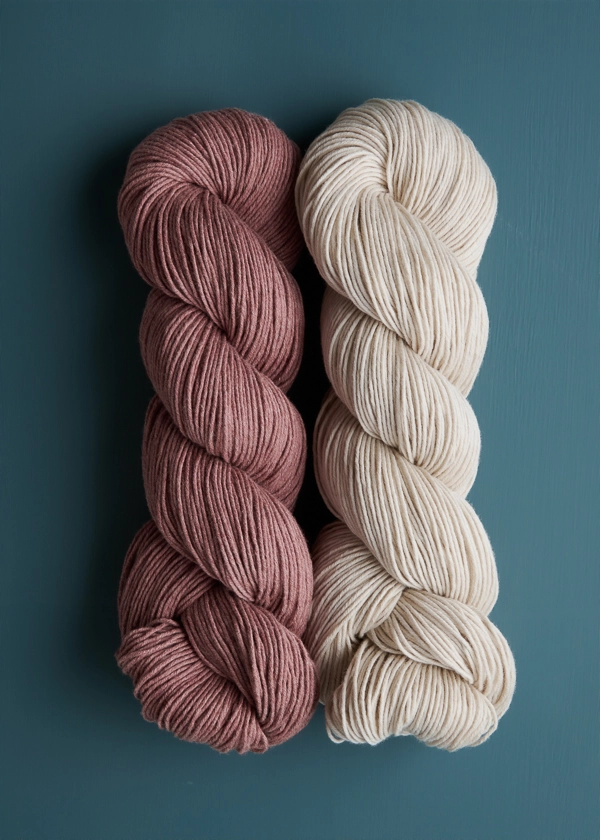
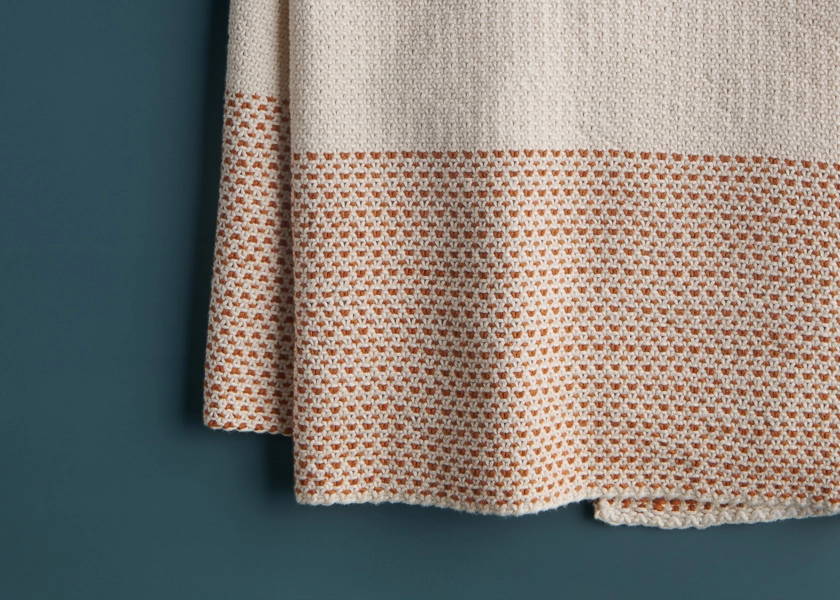

Colorfield Hand Towels
Our Colorfield Hand Towels in Cotton Pure bring handmade beauty into the rhythm of your day, turning an everyday moment into something worth lingering over.
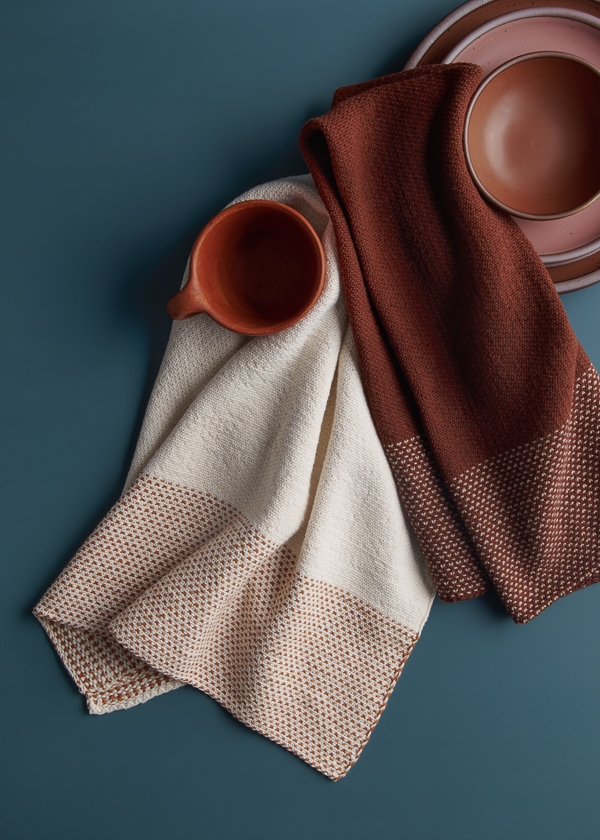
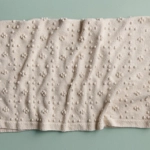
The fabric has a marked elegance thanks to the wonders of linen stitch, a simple slip stitch pattern that reads almost like smooth woven cloth on one side, while the other side is gently nubbly. You have two layouts to choose from, one with two-color linen stitch at the ends and another with a block of colorwork in the middle.
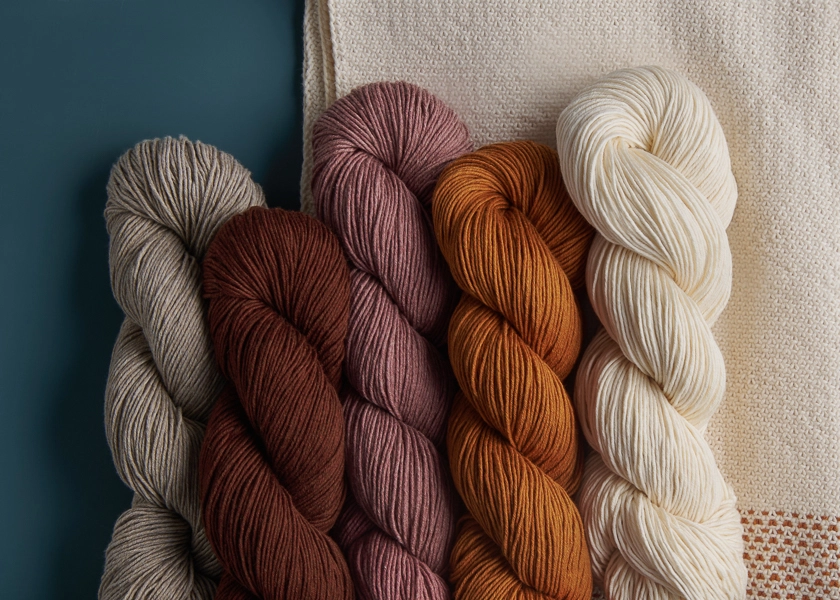
In our Cotton Pure yarn, the Colorfield Hand Towels are wonderfully suited to their task. This organically grown cotton is unmercerized, making the yarn softer to the touch and more absorbent—just what you want for a hardworking towel—with a matte, almost earthy finish. Durable and machine washable, it’s as practical as it is lovely.

There’s something grounding about reaching for a handmade piece throughout the day, a small reminder of the time and care that went into making it. Choosing colors you love makes that ritual all the more personal, and you have 30 beautiful shades to choose from. Pick your favorites and cast on for this simple and deeply satisfying pattern!
Yarn lovers, if you adore the yarn used in this project, you’ll love exploring all of our other yarn collections! Discover over 55 thoughtfully designed yarns in nearly every natural fiber and in every spectacular color you can imagine. Only available here at Purl Soho’s online yarn store, where every skein is created with care and your creativity in mind!
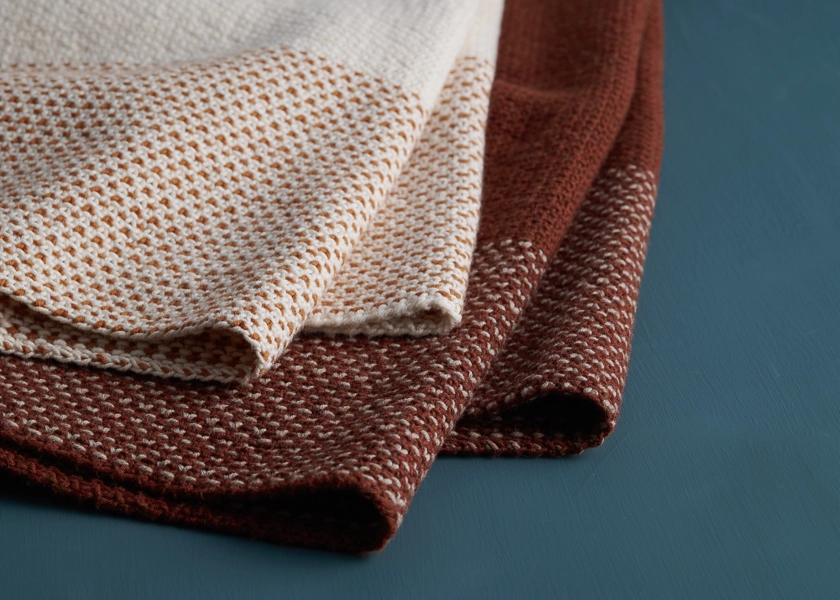
Designed by Purl Soho designer, Jake Canton. Click here to see even more of Jake’s designs!
Story written by Andrea Lotz for Purl Soho.
Want to print this pattern? On desktop, find the “print” icon in the right margin, and on mobile, scroll to the end of the pattern for it. Use the on-screen instructions to remove anything you don’t want to print!
Materials
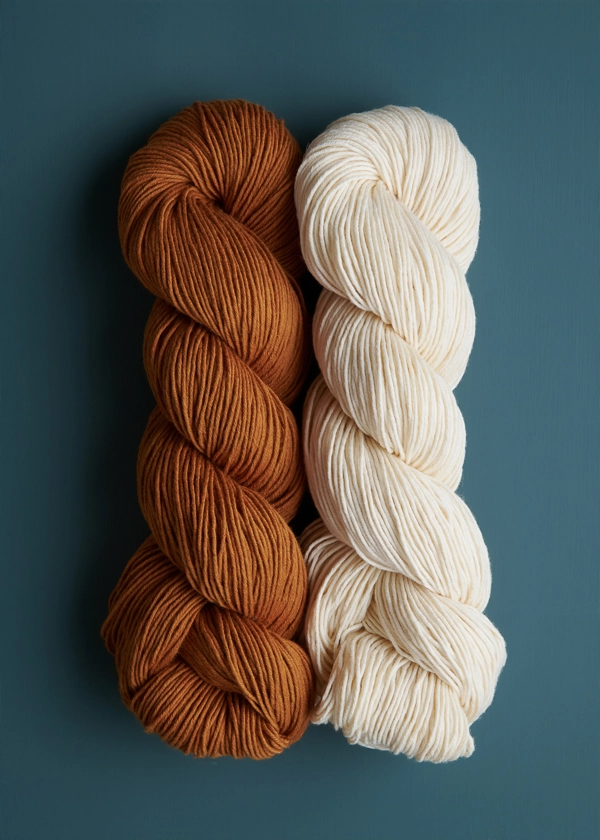
To make a set of two towels in either layout, you’ll need…
- Purl Soho’s Cotton Pure, 100% organically grown cotton yarn. Each skein of this sport-weight yarn is 279 yards/ 100 grams.
- Main Color (MC): 6 skeins; approximately 1,674 yards required.
- Contrast Color (CC): 1 skein; approximately 220 yards required.
- US 7 (4.5 mm), 24- or 32-inch circular knitting needles
NOTE: To make just 1 towel, 3 skeins of MC will do the trick!
We used these color combos for our towels…
- Layout 1: MC Alabaster Cream + CC Pink Smoke
- Layout 2: MC Brown Date + CC Warm Rock
- Layout 2: MC Heirloom White + CC Apple Cider
GAUGE
28 stitches and 50 rows = 4 inches in stitch pattern
SIZE
Finished Dimensions: 22 inches wide x 37 inches long
NOTES
STITCH MULTIPLE
This pattern works over an odd number of stitches.
SLIP STITCHES
Slip all slipped stitches purlwise.
TURN + SLIDE
When you work the Two-Color Spaced-Out Linen Stitch Pattern, you either “slide” or “turn” the work at the end of each row.
“Turn work” means to do what you would normally do when knitting rows with circular needles: Transfer the needle from your left hand into your right hand and the needle from your right hand into your left, flipping the work around so the opposite side is facing you.
“Slide work” means to keep the same side of the work facing you and to push all the stitches to the right end of the circular needles. Without turning the work, start the new row as you normally would.
You will know that you’re doing this right if the yarn you need to complete the next row is right there waiting for you! To see this technique in action, visit our Turn + Slide Tutorial.
STITCH PATTERNS
ONE-COLOR LINEN STITCH
Row 1: (wrong side): Slip 1 with yarn in front (wyif), *p1, slip 1 with yarn in back (wyib), repeat from * to last 2 stitches, p1, slip 1 wyif.
Row 2 (right side): *K1, slip 1 wyif, repeat from * to last stitch, k1.
TWO-COLOR SPACED-OUT LINEN STITCH
Row 1 (wrong side): With MC, slip 1 wyif, *p1, slip 1 wyib, repeat from * to last 2 stitches, p1, slip 1 wyif. Turn work.
Row 2 (right side): Crossing CC below MC (MC is in front of CC), use CC to *k1, slip 1 wyif, repeat from * to last stitch, k1. Slide work.
Row 3 (right side): With MC, slip 1 wyib, *k1, slip 1 wyif, repeat from * to last 2 stitches, k1, slip 1 wyib, Turn work.
Row 4 (wrong side): Crossing MC below CC (CC is in front of MC), use MC to *p1, slip 1 wyib, repeat from * to last stitch p1. Turn work.
Row 5 (right side): With MC, repeat Row 3. Turn work.
Row 6 (wrong side): Crossing CC below MC (MC is in front of CC), use CC to *p1, slip 1 wyib, repeat from * to last stitch, p1. Slide work.
Row 7 (wrong side): With MC, slip 1 wyif, *p1, slip 1 wyib, repeat from * to last 2 stitches, p1, slip 1 wyif. Turn work.
Row 8 (right side): Crossing MC below CC (CC is in front of MC), use MC to *k1, slip 1wyif, repeat from * to last stitch, k1. Turn work.
PATTERN
BEGIN: BOTH LAYOUTS
With Main Color (MC), cast on 155 stitches. We used a basic Long Tail Cast On.
LAYOUT ONE
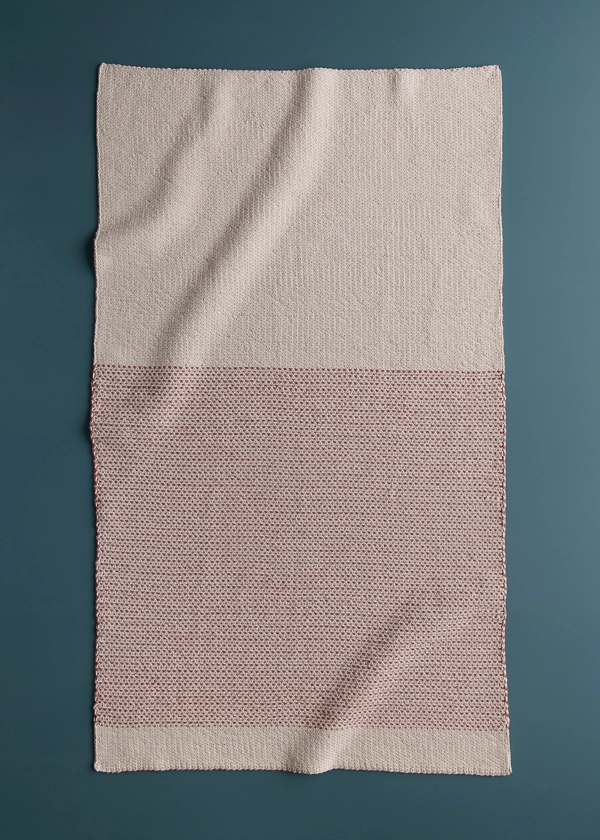
Repeat Rows 1 and 2 of ONE-COLOR LINEN STITCH until piece measures 2 inches from cast-on edge, ending with Row 2.
Repeat Rows 1-8 of TWO-COLOR SPACED-OUT LINEN STITCH for 19 inches or until piece measures 21 inches from cast-on edge, ending with Row 8.
Repeat Rows 1 and 2 of ONE-COLOR LINEN STITCH for 16 inches or until piece measures 37 inches from cast-on edge, ending with Row 1.
Go on to the End section, below.
LAYOUT TWO

Repeat Rows 1-8 of TWO-COLOR SPACED-OUT LINEN STITCH until piece measures 6 inches from cast-on edge, ending with Row 8.
Repeat Rows 1 and 2 of ONE-COLOR LINEN STITCH for 25 inches or until piece measures 31 inches from cast-on edge, ending with Row 2.
Repeat Rows 1-8 of TWO-COLOR SPACED-OUT LINEN STITCH for 6 inches or until piece measures 37 inches from cast-on edge, ending with Row 7.
END: BOTH LAYOUTS
Cut CC.
With the right side facing you, bind off in stitch pattern. Here’s how…
Bind-Off Row (right side): With MC, k1, *slip 1 wyif, pass stitch over, k1, pass stitch over, repeat from * to end of row. Weave in the ends and lightly steam or wash on a cold, gentle cycle and air dry to block.

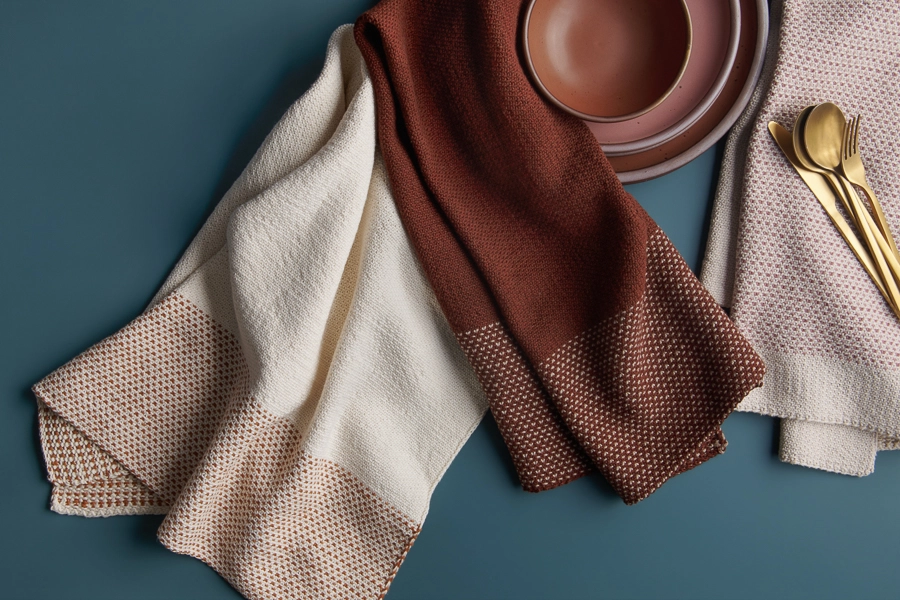
Learn About Cotton Pure + All Our Beautiful Yarns
As special as it is popular, our Cotton Pure brings true natural beauty to this project. 100% organically grown cotton, this sport-weight yarn feels exceptionally soft and supple in your hands, and it comes in tons of gently heathered colors you won’t find anywhere else! Making something big, like a blanket or sweater? Shop our 1,000-gram Cotton Pure On A Cone collection, too!
More Knitting Patterns
- Be sure to explore our vast collection of (mostly free!) Cotton Pure knitting patterns and cast on!
More Sport-Weight Yarns
- Shop our entire collection of sport-weight yarns (What is sport-weight yarn, really? Learn all about sport-weight yarn in our deep-dive article!)
- If you want to use a different yarn, be sure to take the time to get the correct gauge. Need help? Check our All About Gauge Tutorial, our Yarn Substitution article, and our Complete Guide To Yarn for lots of helpful information.
More Yarns With Similar Fiber
- Shop cotton yarn (What helps cotton keep its cool? Learn all about this soft, natural fiber in our guide to cotton yarn!)
- Shop plant-based yarn
- Shop machine-washable yarn
Looking for more inspiration? Explore all of our knitting patterns (including tons of free knitting patterns) and knitting tutorials, buy one of our many knitting kits and yarn bundles, and shop for beautiful yarn. We have over 55 gorgeous natural fiber yarns in 100’s of magnificent colors, designed to bring integrity, beauty, and joy to your next knitting project and only available at Purl Soho!




Hi, I love this pattern, but the size seems very large for a hand towel. Is this intentional or is it a misprint?
Hi Kathy,
Thanks for writing in! So glad you love the pattern! This might be a slightly larger hand towel but when folded in half and hanging, the length is only a little over 18″. This pattern is easily customizable to the size you would like as long as you cast on an odd number of stitches, and knit to the length you like!
Happy knitting
Jessica
Such a sweet pattern. Thank you!
Krissy, I’m with you – as a senior on a *very* fixed (in the red) budget of SS.
It’s not easy to run a business and, hopefully, all our loved places will be able to survive during this horrific time.
I appreciate Purl Soho-Purl Bee for sharing their creativity – they help make my life a bit easier just seeing what is available. Someday… over the rainbow.
what are the yard colors in this towel
Hi Lisa
Thanks for writing in! We used 6 skeins of Heirloom White, and 1 skein of Jonquil Yellow in Cotton Pure to make the 2 hand towels.
Happy knitting!
Jessica
what does crossing color B below A mean?
Hi Maureen
Thanks for writing in! When knitting the Two-Color Spaced-Out Linen Stitch Section, the slipped edge stitches will alternate between color A and B. After working
Row 1 (wrong side): With Color A, slip 1 wyif, *p1, slip 1 wyib, repeat from * to last 2 stitches, p1, slip 1 wyif. Turn work, yarn A will be at the back of your work, and with your left hand you will reach under yarn A and grab yarn B. Yarn A should be hanging off the right of your work, yarn B will be ready to work the first stitch.
Row 2 (right side): Crossing Color B below Color A (A is in front of B), use Color B to *k1, slip 1 wyif, repeat from * to last stitch, k1. Slide work. I hope this explains it a little better for you! Please reach out if you need more help!
Best
Jessica
I’m confused. How can you p1 after you slip wyib.? Do you move the yarn to the front first, then p1?
Hi Mary,
Great question! Yes, it sounds like you’ve got it! After slipping the stitch with the yarn in back, you will move the yarn to the front between the needles, just as you would when switching between a knit and a purl, to get ready to purl the next stitch.
Happy knitting!
Julianna
If I made this exactly twice as big, would I have a bath towel? And would it be too heavy?
Hi Judy
Thanks for writing in! If you doubled this hand towel you would have a 44″ X 74″ which would definitely be bath sheet size! Bath towel sizes can range, but are generally around 30″ X 50″. It might be a little heavy, but it would be beautiful and so absorbent! Let us know if you try this!
Happy knitting
Jessica
Would love to make these towels in red/white and green/white for gifts. Is the yarn color fast? Would hate for the colors to run on washing. Thanks so much.
Hi Carol
Thanks for reaching out! We have washed many items out of Cotton Pure, both by machine and by hand, and haven’t experienced any color bleeding, so I don’t think you have anything to worry about!
Happy knitting
Jessica
How many stitches should be cast on for a 15” x 24” towel?
Hi Judy,
Thanks for writing in! If you are getting the recommended gauge of 7″ to the inch, a cast on of 85 stitches will measure about 15″. Hope this helps and happy knitting!
Best
Jessica
If I wanted to make this into a crib blanket how many stitches should I cast on?
Hi Karrie,
Thanks for writing in! For a typical crib blanket measuring 28 inches by 37 inches, you will need to cast on 196 stitches, and you will need four skeins of Color A and one skein of Color B.
Happy knitting!
Julianna
I have been working on the spaced out two color for this pattern for a couple of hours and my mind is boggled so this is probably a silly questions. I decided since I am doing the linen stitch for the first time to stick with just one color. My question: do I repeat rows 1 and 2 until required length, or after knitting first 2 rows knit go to “layout one” and follow those directions until required length?
As always I love your patterns, once I figure the new ones out and appreciate the ability to send questions. After this virus I would love to see a video of the linen stitch with 2 colors.
Caroline
Hi Caroline,
Thanks for writing in and for the wonderful tutorial suggestion – I’ll be sure to pass it along to the design team! For both versions of this hand towel, after casting on 155 stitches, you will go immediately to either Layout One or Layout Two and begin following those instructions for how long to work each stitch. For instance, if you are knitting Layout One, you will cast on 155 stitches, and then right away repeat rows 1 and 2 of one-color linen stitch for two inches.
I hope that clears things up!
Julianna
Thanks, Julianna for your response. I continue to practice with the one color in order to get familiar with the pattern. Getting better. But, another question, please. I would like to make a smaller towel, about 18-20 inches in width. Could you tell me how many stitches I would need to make a smaller towel of 18-20 in.
Thank you!
Caroline T
Hi Caroline,
I’m so glad to hear it’s going well! If you are getting the correct gauge, you can multiply the desired width of your hand towel by 7 stitches per inch to cast on any size towel you like. For instance, for an 18-inch towel, you would cast on 126 stitches.
Best,
Julianna
remember to cast on an odd number of stitches.
My sister wants a yellow throw for her couch, I love this yellow and this pattern. I have never knit the linen stitch would it be difficult to make this into a throw size blanket? Too heavy or too thick etc? For reference I’m currently making the sand drift blanket from your store and would like something of similar weight and time commitment. Also can you tell me how much yardage I would need and how many stitches to cast on? Thanks for the beautiful pattern! If the blanket isn’t a go I will definitely try the towel!
Hi Carrie,
Thanks for writing in! I think scaling this pattern up to a throw would be just wonderful! Linen stitch is fairly dense, but in a thinner yarn like Cotton Pure, the throw should have a pleasing heft without being overwhelming. It will probably feel a little heavier than the Sand Drift Blanket, but still be a similar thickness. For a 44 inch by 60 inch blanket, you will need to cast on 307 stitches, and you will need 11 skeins total of Cotton Pure, divided how you would like between the two colors. 9 skeins of your main color and 2 of the contrast color should give you a similar color distribution to the towels!
I hope that helps, and happy knitting!
Julianna
Thanks for the information! I’m definitely going to make this!
Hello, well my yarn finally arrived! I suppose I ordered it a month ago, but with the hurricanes and COVID, everything took its time to get downunder. I am really excited to start the handtowels. Unfortunately one of my puppers thinks that sitting down time is cuddling time, so he jumps on my lap while I am knitting. Just as well he is little. Thank you and I hope everyone is keeping safe over there. Christine.
I love your website and your wonderful patterns and thank you so much for making so many of your patterns free to use. I would love to see a pattern for making placemats and/or coasters using the knitted mosaic technique..I think a whole mosaic throw is beyond me but would love to try the technique on something smaller. Keep up the good work and stay healthy.
Regards Jane
Hi Jane,
Thank you so much for the kind words! I will certainly pass your request along to the design team, but in the meantime, you could always modify our Mosaic Blanket pattern to try it out on a smaller scale and create your own placemats and coasters! This pattern works with any multiple of 12 plus 3 stitches, so I would start with 27 stitches to create a 5.5 inch wide coaster. After that, you should be able to easily figure out how wide you would like your placemat to be!
I hope that helps, and happy knitting!
Julianna
Hi there! It’s me again..
I’m about 4” in length into these towels & have noticed the edges of my knit are a little messy once I added the second color. The single color edges are lovely, it’s as soon as I added the CC that I had an issue.
I’ve read that I could slip the first stitch in every row to avoid this issue but is this possible in this pattern or is there another tip?
Thank you kindly in advance!
Hi Cristina,
Thanks for writing in! I wouldn’t recommend slipping the first stitch in this pattern since it will affect your stitch count and could throw off the pattern. I think that focusing on your tension when switching colors to keep everything as consistent as possible should tidy things up a bit! Also, it can be tricky to get the yarns in the proper order at the beginnings of rows 2, 4, 6, and 8. If you make sure the color you are starting to knit with goes behind the old color so the two yarns don’t twist together at the edge of your work, that should also help.
Best,
Julianna
Hi there,
I love your patterns and your store! I am making both the layouts as a gift. I just started making them and i was following along the first pattern. The pattern says: Row 5: Repeat Row 3 . Turn work.
Then for Row 6: cross col B below Col A.. but i have both the colors at either end.. did I make a mistake or did i miss something?
Any help would be greatly appreciated…
Thanks and please stay safe..
Manju
Hi Manju,
Thanks for writing in! It sounds like you might have skipped a row – it can be hard to keep track of which row you are on in this part of the pattern! While knitting the Two-Color Linen Stich, after the odd-numbered rows, both yarns will be on the same side of the work, and after even-numbered rows, will be on either side of the work. If you take a look at the beginning of this block, you should be able to spot the first row of Color B, which would be Row 2 of the pattern. You can then count up to see which row you are on!
I hope that helps!
Julianna
Hello, Purl Solo, is Cotton Pure un mercerized cotton. I have been knitting towels using your patterns only to discover they are not absorbent enough to dry my hands.
Thank you
Caroline T
Hi Caroline,
Thanks for reaching out! Our Cotton Pure is unmercerized and one hundred percent organically-grown, which makes it soft and absorbent with a lovely matte finish!
All the best,
Gianna
for the yarn used in the pattern, sport weight, recommended needle size is 3-5, but pattern calls for US 7, is this because it’s a slip stitch color pattern? Or to allow shrinkage? thanks.
Hi Nancy,
Thanks for reaching out! We used a US 7 to get the best effect for the Linen Stitch!
All the best,
Gianna
Hola, qué significa wyif y wyib
gracias
Hi Sila,
Thanks for reaching out! Wyif means with yarn in front and wyib means with yarn in back! This signifies the orientation of the yarn when you slip the stitches, for example, in row 1 you will slip the first stitch wyif (with the yarn in front!)
I hope this helps, happy knitting!
Gianna
I have finally had to give up on this pattern after ripping it out 4 times! I get to the color part with the 8 row pattern and it will not come out right! There is a ridge on the knit side of the first few rows. What am I doing wrong? The first two inches of the pattern are perfect.
Very frustrated!
Hi Sheryl,
Thanks for reaching out! We are happy to help, if you can please email us a few photos of your work to our team at [email protected] and they can troubleshoot further what may be happening!
Warmly,
Gianna
I’m having the same issues with the ridges. Any advice on how I can get on track.
Thanks.
Hi Mari,
I’m sorry to hear that you’re running into the same problem! We’d recommend sending a photo of your work to [email protected]. That way, we can visualize exactly what’s going on and give you advice on how to get back on track!
All the best,
Lili
I need a video to see how this two color pattern rows are knitted.
Hi Linda,
Thanks for reaching out. I’m sorry to say that we don’t yet have a video tutorial on two-color linen stitch yet! Apologies for the inconvenience, and I’ll absolutely pass along your interest, in case we make one in the future. I also want to suggest signing up for a 1-On-1 Pattern Help session, where we can demonstrate this stitch in real time, if that would be helpful!
All the best,
Lili
Can I use buttercup cotton instead of cotton pure?
Hi Hillary,
Thanks for writing in. You can absolutely use Buttercup Cotton for this pattern! All you’ll need to do is adjust how many stitches you cast on, so that the dimensions come out correct. To figure out your cast-on number, you will want to first knit a gauge swatch in pattern (if this is daunting, we have a wonderful tutorial called All About Gauge: https://www.purlsoho.com/create/2020/08/20/all-about-gauge/). Once you know how many stitches you are getting per inch, you can multiply that number by the width that you would like and cast on the nearest odd number. Then you can follow the pattern as written!
All the best,
Lili
Love the look of this. I’d like to use this pattern to make placemats (13”x18”). If I want to make them only in the two color spaced out linen stitch would I need the equal number of skeins of color A and B? About how many of each color? Thank you!
Hi Michael,
Thanks for writing in! The ratio of Color A to Color B in the Two-Color Spaced-Out Linen Stitch is approximately 4:1. If you’re making 13″ by 18″ placemats, you’ll need a total of 280 yards, so 210 yards of Color A and 70 yards of Color B. This means you’ll only need 1 skein of each color to make 1 placemat! Hope this helps you plan your project.
All the best,
Lili
In June, 2020 , a knitter asked how many sts to cast on for a 15×24 towel. The response was, at 7 sts per inch, casting on 85 would give you ca. 15 inch width. By my math it would be casting on 105 not 85 (7×15=105).
Am I correct or am I missing something?
I’m addicted to the half and half dish clothes knit with cotton pure. I need to branch out so thought this towel would be my next project since I’m familiar with linen stitch having knit several towels using field linen.
Hi Maralie,
Thanks for reaching out. It looks like our previous reply contains a typo! You’re correct, with a gauge of 7 stitches per inch, you would need to cast on 105 stitches to get a 15″ width. Thanks for pointing that out!
All the best,
Lili
I would love some help, if busy Purl Soho has time – I have dropped a stitch! I was on the wrong side of the pattern using just one color: I purled one and was moving the yarn ready to slip the next stitch, but I dropped it instead. I understand this was a knit stitch in the row below, which itself came from a slipped stitch in the row below that – but now I have just a ladder, with no obvious loop to pick up again… it’s perplexing. I tried to knit the same pattern on different needles and recreate my mistake, but I don’t get something that looks identical to my “real” mistake, instead I do get a loose loop from the knit stitch below that I dropped, and not just flat strands of yarn. I know from the stitch count that I have only dropped one, but I am not sure whether it went down one row only, or two. Luckily for me, the web of slipped stitches with the yarn wrapped around them means that my dropped stitch won’t go any further. Any help greatly appreciated!
Hi Mrs. Bee,
Thanks for writing in! Without seeing your work, it’s a little hard for me to tell exactly what the problem is, other than a dropped stitch, but I can certainly give you advice on picking up dropped stitches in linen stitch. It may not look like it, but the reverse side of linen stitch is essentially just reverse stockinette (the purl bumps)! Each column of stitches is shifted by a row, so it ends up looking more like seed stitch, but the construction is the same as reverse stockinette. Therefore, you can just rescue a dropped stitch using a crochet hook, exactly like you would for stockinette! You would just need to take extra care not to pick up any of the “bars” on the front by accident.
I hope this helps, and feel free to email a photo of your work to [email protected] so we can take a closer look!
All the best,
Lili
Hi! How do you suggest we weave in the ends? I realize that the back side of the towel will be mostly purls so I can see Color A blending quite easily. What about Color B?
Hi Sara,
Thanks for reaching out. Because the wrong side of linen stitch looks like a cross between garter stitch and seed stitch, I’d recommend using a method of weaving in ends that works well for either of those stitches! We have a great tutorial called Weaving in Your Ends which demonstrates a number of useful techniques for different stitch patterns. You can weave in the ends from Color B over the two-color section so that they blend in more. But since all the ends will be woven in on the wrong side of the work, they will not be visible from the front at all! Hope this helps you finish up your project.
All the best,
Lili
I have been trying to knit the first two inches of one-color linen stitch for two days and am frustrated to tears. Because there is no instruction otherwise, I am turning the work at the end of each row. The resulting “fabric” bunches into wads because of repeatedly sipped stitches. I know I am not stupid and that I can read because I am a retired lawyer. Could you please provide the omitted instruction from “one-color linen stitch” to explain how the pattern creates the towels in the photos? Because I am trying to use what appears on the site and nothing remotely similar comes out.
Hi Elaine,
I am so sorry to hear that you are frustrated by this project, and we are here to help! Linen stitch is worked with slipped stitches and purls on the wrong side, and slipped stitches and knits on the right side. When alternating sides, you will be slipping the stitches that were worked on the previous row and working the stitches that were slipped on the previous row. It is also worth noting that the slipped stitches in Row 1 of the One-Color Linen Stitch are slipped with the yarn in back (with the exception of the first and last slip stitch), even though you are purling every other stitch, which creates the bars across the slipped stitches for the Linen Stitch look. For both rows of the One Color Linen Stitch, you will be moving your work yarn between your needles between every stitch (just like you would for a 1×1 rib) to create the V-shaped stitches and bar stitches for Linen Stitch!
Please know we are happy to do whatever we can to help bring you back to a happy knitting place, so if you would like to discuss this further, feel free to reach out to us at [email protected]!
All the best,
Margaret
Hi PurlSoho,
I’m tackling the two color spaced out linen stitch for Layout One. Can you advise how the edges should look as was thinking they should be a lovely chain link edge? Instead, if I follow the instructions for rows 1-8 with crossing colors below the other, I seem to end up with a messy border—ie, not a consistent chain stitch up the side. Is this intentional as am reworking any affected row to make it look more like chain stitch but am now thinking the pattern isn’t designed that way and I should simply follow it and not mess around. Or, if meant to look like a consistent edge, then what am I doing wrong?
Hi Julie,
Thanks for reaching out! It sounds like maybe you aren’t slipping the first stitch purl-wise with yarn in front for row 1 or with yarn in back for row 3. These stitches are slipped this way in order to maintain a consistent chain along the edge, so you are slipping them so they are facing the correct direction.
I hope this helps and please let me know if you have any questions!
All the best,
Carly
Could you give me the yarn sequence after each row in the two-colored spaced -out linen stitch? The first towel I made I had no trouble. Now, I get messed up around rows 3 and 4. Obviously, row 1 is AAAAA when complete. Row 2 adds in color B and results in BABAB etc when complete. I slide my work after row 2 then get messed up at row 4. If I knew the pattern I might catch what I am doing wrong. Thanks for your help.
Hi Mommo,
That’s a great question, and I think that the answer will benefit many others as well! Here’s what each row of the Two-Color Spaced-Out Linen Stitch should look like:
Row 1: AAAAA…
Row 2: BABAB…
Row 3: BABAB…
Row 4: AAAAA…
Row 5: AAAAA…
Row 6: BABAB…
Row 7: BABAB…
Row 8: AAAAA…
I hope this helps get you back on track!
All the best,
Lili
Thank you so much for your response. I can’t believe I’m having so much trouble after having already knitted one towel🤷🏼♀️ Thanks again.
My problem was that I had marked row 4 as BABAB…when it was actually AAAAA…. No wonder I was having trouble. I am now progressing nicely. Thanks again.
Hello,
I’ve just finished my first colorfield towel and I need to darn in some loose ends. They are kind of obvious in this stitch… Is there a way you can suggest that let’s me tidy up the ends invisibly at all?
Kind regards, Cerstin
Hi Cerstin,
That’s a great question! In general, using duplicate stitch is typically the most invisible way to weave in ends. Most tutorials on duplicate stitch are for stockinette stitch (either knit or purl side), but you can totally do a similar process in most any stitch pattern. All you need to do is essentially follow along the path of the yarn across one row with your tapestry needle, which weaves in the end along that same path, duplicating the stitches on that row.
All the best,
Lili
Lili,
Since this is such a popular pattern, it would be great if you would add a picture tutorial of weaving in ends on linen stitch with two colors to the Pul Soho how to weave in ends page. I tried to follow the pattern, but still have a line on the back that is noticeably thicker than the surrounding.
Thanks for the fun pattern!
Hi Floyd,
That’s a great suggestion, and I’ll pass it along to the rest of my team! In the meantime, I generally recommend weaving in your ends on the diagonal for linen stitch (like you might do for seed stitch or garter stitch).
All the best,
Lili
I would love to use this pattern to make a throw blanket. Has anyone tried that?
Hi Elisa,
What a great idea, this sounds like a lovely project! Though I haven’t seen a finished project at a blanket size (in our Ravelry projects page for the pattern, or personally), I definitely think you could do this… We would love to see the results!
Here’s how you can find how much yarn you would need:
Divide the area you’re looking for by the original area of the towel. You can then multiply that number by the original yardage. Voila! How many yards you need! You can also do this from your swatch!
Here’s an example:
Let’s say you want a throw blanket that is (36in x 48in) = 1,728 inches squared). The original area is (22in x 34in) = 814 inches squared. The original yardage required is (1,674 MC + 220 CC) = 1,894 yards. If you then divide 1,728 inches squared by 814 inches squared and then multiply by 1,894 yards, you’ll find you need 4,020 yards.
This pattern works over a multiple of odd stitches, so I’d just suggest ensuring whatever number you choose to cast-on is an odd number. For our example, if you would like the width to be 36 inches and you’re knitting at 7 stitches per inch, you may choose to cast on 253 stitches (36×7=252).
I hope this helps, and happy knitting!
Hills
Thank you for your help with calculating the yarn needed. I am going to make this my summer project1
So happy to help! Wishing you happy summer knitting! – Hills
love this pattern; thank you.
What do you think about using the Blackbird Linen for this project? I have a few skeins left from another project I would like to use up.
Hi Annette,
Thanks so much for reaching out. I’m really glad to see you love the Colorfield Hand Towels as much as we do, thank you for your kind words!
The pattern is knit at 7 stitches per inch in Cotton Pure (listed as 5.5-6 stitches per inch), so it is knit at a tighter gauge than the suggestion on the label. Blackbird Linen‘s gauge is listed at 5.5-5.75, it is just slightly thicker than Cotton Pure, and is likely to knit a slightly more dense fabric. I still think it could potentially be a good substitute…but it might be a teensy bit too dense. I would recommend knitting (and blocking) a gauge swatch to see if you can achieve gauge and that you like the look and feel of the resulting fabric.
If you find the swatching doesn’t create a fabric you prefer, I might recommend checking out the Ready Set Placemats or the Slip Stitch Dishtowels for your surplus Blackbird Linen.
I hope this helps, and please feel free to reach out with any other questions!
Happy knitting,
Hills
Hello! I’m doing Layout 2 and I just finished the 6″ of the two-color stitch and I’m switching over to the one-color stitch. However, I just realized that the CC is just sitting out on the side. What happens to it when I need it again for the other end, but it’s 25″ down? And, it seems odd to carry around both balls of yarn even though I’m only using the MC for most of the pattern. I don’t see any instructions for what to do with the CC yarn in the middle of the pattern. Thanks for your help!
Hi Marcie,
I’m so sorry to read that you’ve run into a bit of a hiccup here, and I’m happy to help.
I would suggest cutting your contrast yarn between the two ends of the Two-Color Linen Stitch. You shouldn’t need to carry it up the edge, and as you noted, it doesn’t work very well to do that for a distance greater than 3 rows or so.
I hope this is helpful! Please feel free to reach back out anytime!
Kindly,
Hills
I am noticing that this is actually 2 layers. One side is knitting up thicker than the other. Is this how it is supposed to be?
Thank you.
Julia
Hi Julia,
Thanks for writing in! You’re correct that Linen Stitch forms a thicker fabric due to the slipped stitches. We think that this is what makes it particularly lovely for hand towels!
You may experience that the Two-Color Spaced-Out Linen Stitch section knits up a bit thicker than the single color section if your colorwork tension is a bit looser (which is actually good to avoid puckering). Any unevenness in the texture should work itself out in the blocking once the fabric has had a chance to relax.
I hope this helps!
Mia