Your basket is empty.
Continue Shopping
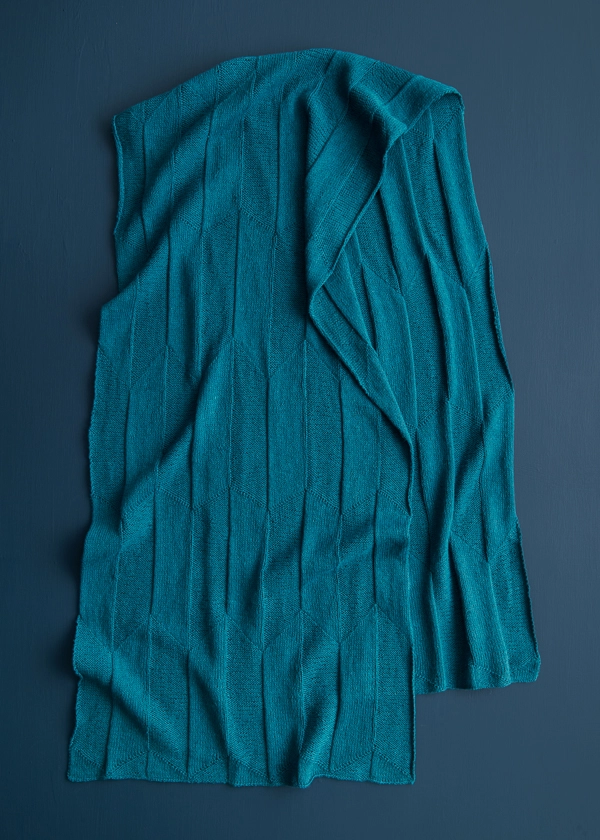
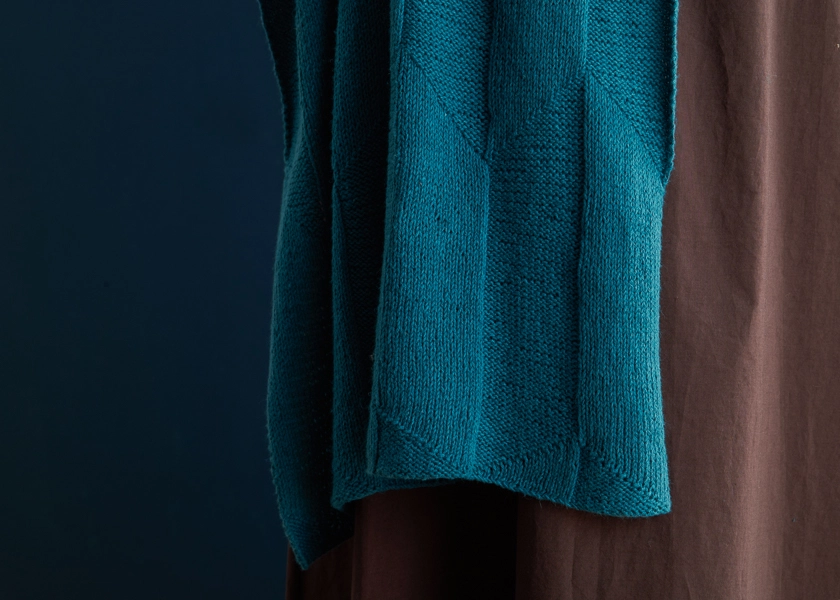
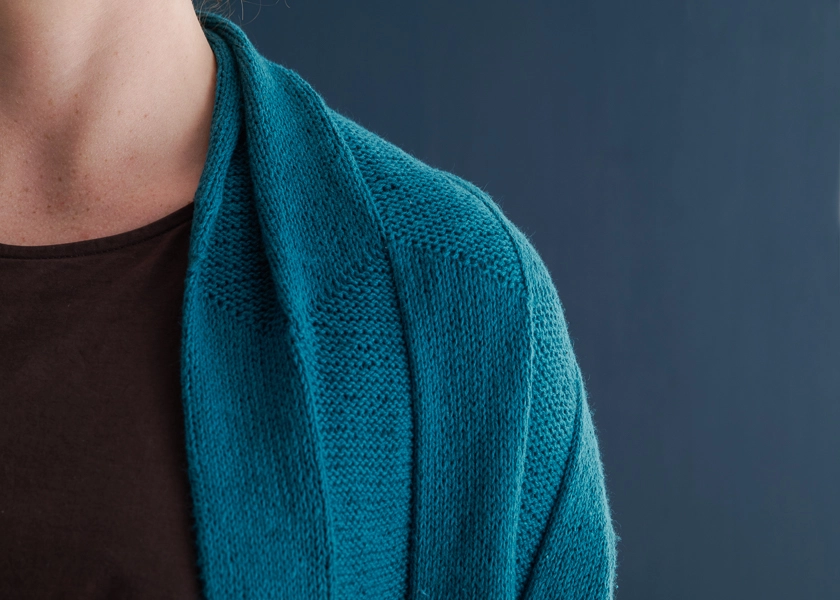
Gable Wrap
The Gable Wrap is an easy, meditative knitting pattern where slanted parallelograms meet in graceful peaks, like the rooftops of a storybook village. Cast on with Oleander, our breezy cotton-linen yarn that brings this simple pattern to life with striking clarity and form.
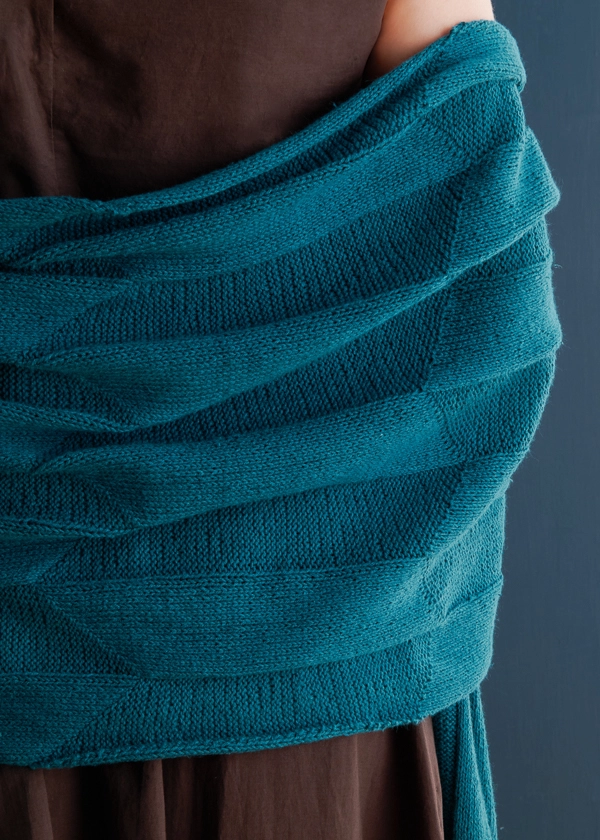
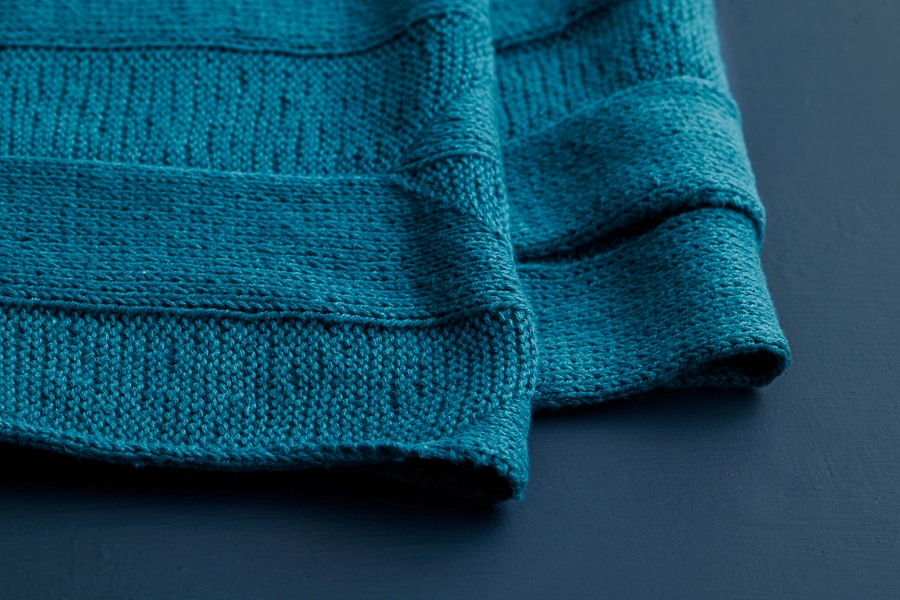
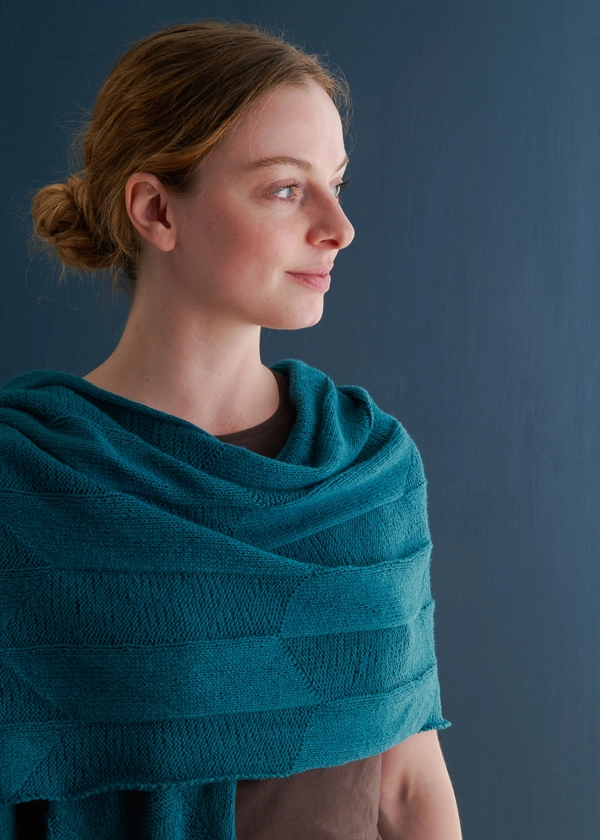
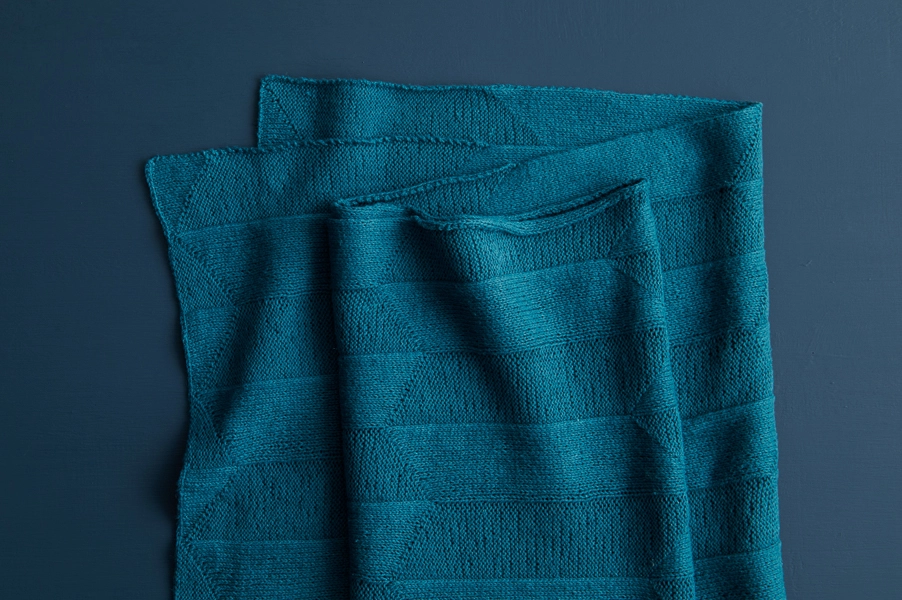
Built from a strong foundation of knits and purls, the Gable Wrap is equally beautiful on both sides. You knit the long parallelograms vertically in columns, but when the wrap is worn, they stretch across the fabric like the rooflines of neighboring houses, side by side and row after row. The interplay of raised and recessed stitches gives the fabric a dynamic, architectural feel, and gentle pleating where the shapes meet adds subtle dimension and movement.
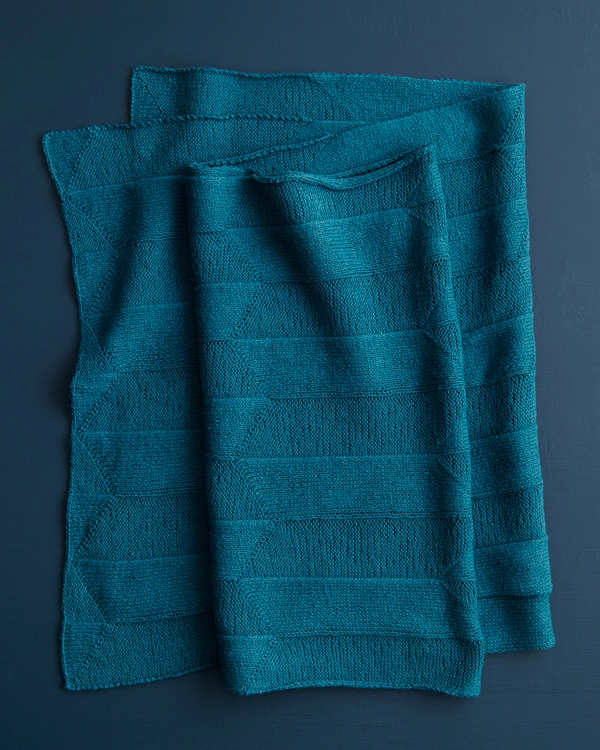
With your choice of written instructions or a chart to guide you, the Gable Wrap pattern is straightforward to follow. Simple stitches and a logical, repeating pattern make it a relaxing and satisfying project from start to finish.
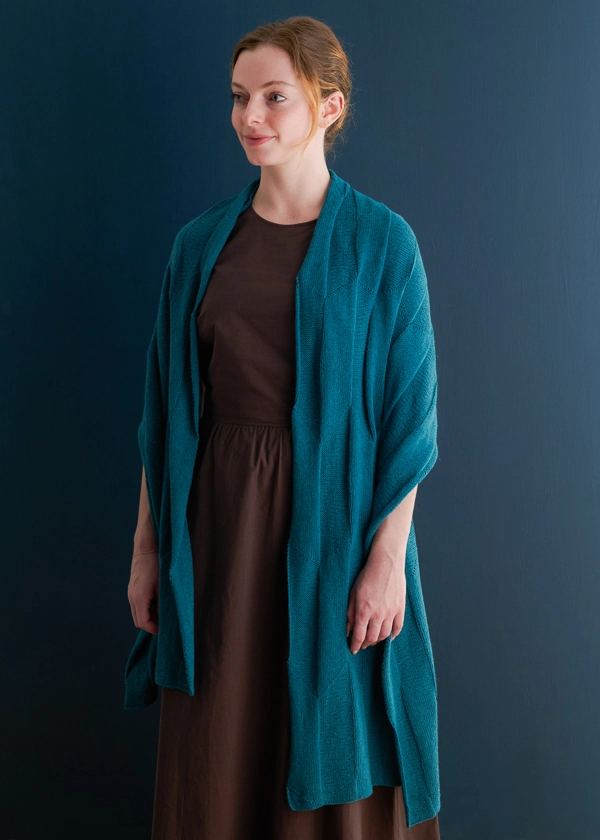
This light summer wrap is just perfect in Oleander, our lovely fingering-weight yarn that combines linen’s natural breathability and moisture-wicking with cotton’s soft, supple feel. Smooth and cool to the touch, this very beautiful yarn has a subtle luster from the linen, but an overall matte finish.
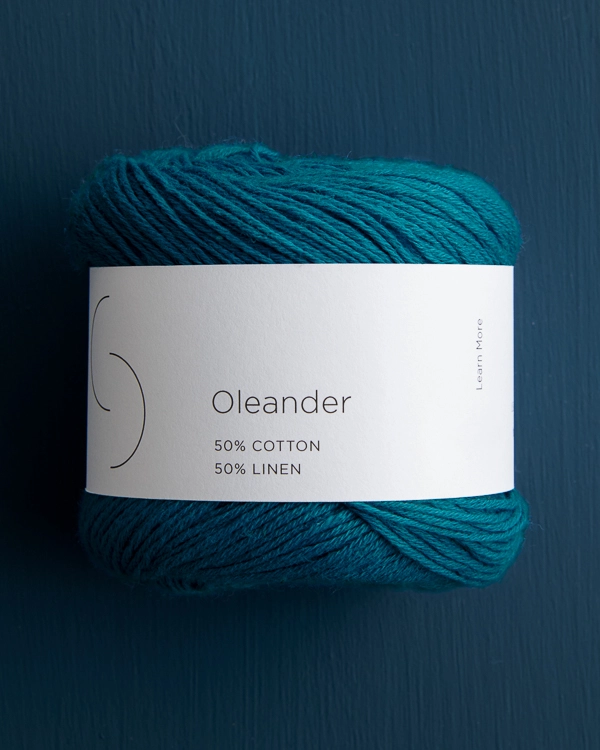
Oleander’s palette is inspired by sunlit days and blooming hillsides, with three lively new colors perfect for warm-weather projects. Among them is this deep Teal Sea, like a window flung open to the coast… Tranquil yet energizing!
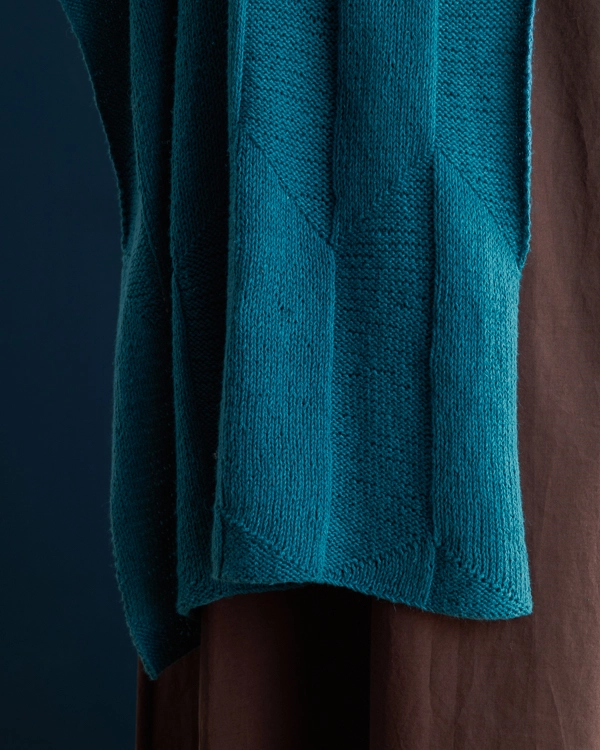
Cast on for this generous wrap or a smaller scarf version and enjoy the elegant stitchwork of Oleander as the converging angles of the Gable Wrap begin to unfold, every rooftop leading skyward in quiet, deliberate beauty.
Yarn lovers, if you adore the yarn used in this project, you’ll love exploring all of our other yarn collections! Discover over 55 thoughtfully designed yarns in nearly every natural fiber and in every spectacular color you can imagine. Only available here at Purl Soho’s online yarn store, where every skein is created with care and your creativity in mind!
Pattern designed and written by Purl Soho designer, Gianna Mueller. See even more of Gianna’s work on her Instagram!
Story written by Andrea Lotz for Purl Soho.
Want to print this pattern? On desktop, find the “print” icon in the right margin, and on mobile, scroll to the end of the pattern for it. Use the on-screen instructions to remove anything you don’t want to print!
Materials
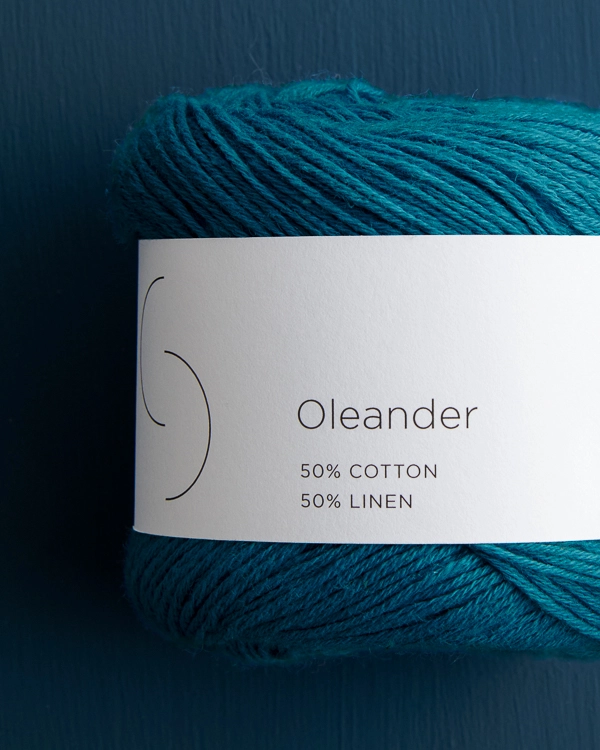
- 5 (8) balls of Purl Soho’s Oleander, 50% cotton and 50% linen. Each ball of this fingering-weight yarn is 205 yards/ 50 grams; approximately 860 (1535) yards required.
- US 3 (3.25 mm) straight or 24-inch circular knitting needles
GAUGE
28 stitches and 37 rows = 4 inches in stitch pattern
SIZES
Scarf (Wrap)
Finished Dimensions: 11¾ (20¾) inches wide x 73 inches long
NOTE
STITCH MULTIPLE
This pattern works over a multiple of 32 + 18 stitches.
PATTERN
Using a basic Long Tail Cast On, Purlwise, cast on 82 (146) stitches.
Continue to work either from Written Instructions or Chart, both below.
GABLE PATTERN: WRITTEN INSTRUCTIONS
NOTE: Throughout, slip the marker as you come to it.
SECTION A
Row 1 (right side): K1, *k1, p15, k15, p1, repeat from * to last 17 stitches, place marker, k1, p15, k1.
Row 2 (wrong side): K15, p2, *k2, p14, k14, p2, repeat from * to last stitch, k1.
Row 3: K1, *k3, p13, k13, p3, repeat from * to marker, k3, p13, k1.
Row 4: K13, p4, *k4, p12, k12, p4, repeat from * to last stitch, k1.
Row 5: K1, *k5, p11, k11, p5, repeat from * to marker, k5, p11, k1.
Row 6: K11, p6, *k6, p10, k10, p6, repeat from * to last stitch, k1.
Row 7: K1, *k7, p9, k9, p7, repeat from * to marker, k7, p9, k1.
Row 8: K9, p8, *k8, p8, k8, p8, repeat from * to last stitch, k1.
Row 9: K1, *k9, p7, k7, p9, repeat from * to marker, k9, p7, k1.
Row 10: K7, p10, *k10, p6, k6, p10, repeat from * to last stitch, k1.
Row 11: K1, *k11, p5, k5, p11, repeat from * to marker, k11, p5, k1.
Row 12: K5, p12, *k12, p4, k4, p12, repeat from * to last stitch, k1.
Row 13: K1, *k13, p3, k3, p13, repeat from * to marker, k13, p3, k1.
Row 14: K3, p14, *k14, p2, k2, p14, repeat from * to last stitch, k1.
Row 15: K1, *k15, p1, k1, p15, repeat from * to marker, k15, p1, k1.
Row 16: K1, p16, *k16, p16, repeat from * to last stitch, k1.
Row 17: K1, *k16, p16, repeat from * to marker, k16, k1.
Repeat Rows 16 and 17 twenty-four more times, then repeat Row 16 one more time.
SECTION B
Row 1 (right side): K1, *p1, k15, p15, k1, repeat from * to marker, p1, k16.
Row 2 (wrong side): K1, p14, k2, *p2, k14, p14, k2, repeat from * to last stitch, k1.
Row 3: K1, *p3, k13, p13, k3, repeat from * to marker, p3, k14.
Row 4: K1, p12, k4, *p4, k12, p12, k4, repeat from * to last stitch, k1.
Row 5: K1, *p5, k11, p11, k5, repeat from * to marker, p5, k12.
Row 6: K1, p10, k6, *p6, k10, p10, k6, repeat from * to last stitch, k1.
Row 7: K1, *p7, k9, p9, k7, repeat from * to marker, p7, k10.
Row 8: K1, p8, k8, *p8, k8, p8, k8, repeat from * to last stitch, k1.
Row 9: K1, *p9, k7, p7, k9, repeat from * to marker, p9, k8.
Row 10: K1, p6, k10, *p10, k6, p6, k10, repeat from * to last stitch, k1.
Row 11: K1, *p11, k5, p5, k11, repeat from * to marker, p11, k6.
Row 12: K1, p4, k12, *p12, k4, p4, k12, repeat from * to last stitch, k1.
Row 13: K1, *p13 k3, p3, k13, repeat from * to marker, p13, k4.
Row 14: K1, p2, k14, *p14, k2, p2, k14, repeat from * to last stitch, k1.
Row 15: K1, *p15, k1, p1, k15, repeat from * to marker, p15, k2.
Row 16: K17, *p16, k16, repeat from * to last stitch, k1.
Row 17: K1, *p16, k16, repeat from * to marker, p16, k1.
Repeat Rows 16 and 17 twenty-four more times, then repeat Row 16 one more time.
CONTINUE
Repeat Sections A and B four more times (ignoring the “place marker” instruction in Row 1… it’s already there!).
Repeat Rows 1–16 of Section A one more time.
Go on to Finishing, below.
GABLE PATTERN: CHART
NOTE: New to reading charts? Unravel the mysteries with our Reading A Chart Tutorial!
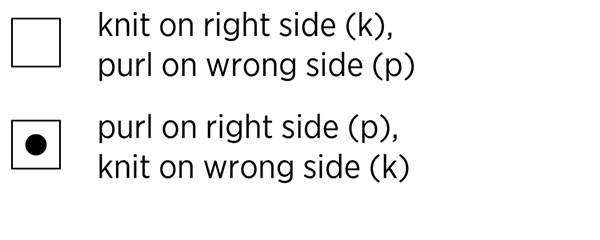
Starting in the bottom right corner of the Charts below, work right-side (odd number) rows from right to left and wrong-side (even number) rows from left to right.
Work Section A and Section B 5 five times total, then repeat Rows 1–16 of Section A one more time.
Go on to Finishing, below.
KEY
CHART
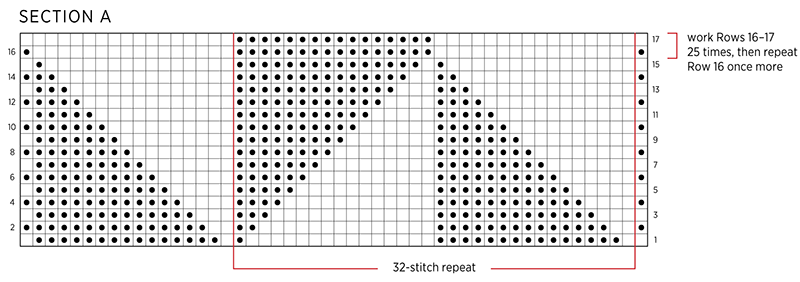
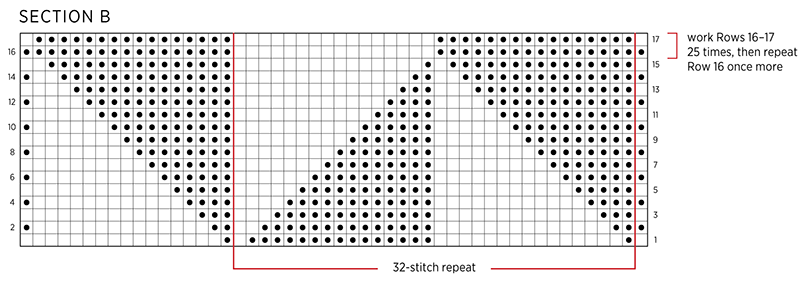
NOTE: Want to see it bigger? Download these charts (and key) as a PDF!
FINISHING
With right side facing you, bind off knitwise to end of row.
Weave in ends and gently wet block.
Share your progress and connect with the community by tagging your pics with #PurlSoho. We can’t wait to see what you make!
LEARN ABOUT OLEANDER + ALL OUR BEAUTIFUL YARNS
We used Oleander for this project because of its alluring earthiness and fine, soft touch. A fingering-weight yarn, Oleander is made in Italy from 50% Turkish cotton and 50% Belgian linen. It is the ultimate warm-weather knitting yarn, as light as a summer breeze and as lovely as an Italian hillside in bloom!
More Free Knitting Patterns
- Be sure to explore our growing collection of (mostly free!) Oleander knitting patterns and cast on!
More Fingering-Weight Yarns
- Shop our entire collection of fingering-weight yarns (What does fingering-weight yarn mean, really? Our guide to fingering-weight yarn will answer your questions and more!)
- If you want to use a different yarn, be sure to take the time to get the correct gauge. Need help? Check our All About Gauge Tutorial, our Yarn Substitution article, and our Complete Guide To Yarn for lots of helpful information.
More Yarns With Similar Fibers
- Shop cotton yarn (What helps cotton keep its cool? Learn all about this soft, natural fiber in our guide to cotton yarn!)
- Shop linen yarn
- Shop plant-based yarn
- Shop machine washable yarn
Looking for more inspiration? Explore all of our knitting patterns (including tons of free knitting patterns) and knitting tutorials, buy one of our many knitting kits and yarn bundles, and shop for beautiful yarn. We have over 55 gorgeous natural fiber yarns in 1,000s of magnificent colors, designed to bring integrity, beauty, and joy to your next knitting project and only available at Purl Soho!


Can this wrap be made from linen quill please, or any 4 ply woollen yarn
Hi Mrs. J!
You can definitely use Linen Quill for this pattern! That would make a wonderfully warm wrap but any fingering-weight yarn would work perfectly as well!
All the best,
Gavriella
I’m sorry but I don’t see the needle size recommended . Am I blind and skipping over it?
Hi Sue,
No worries at all! You can find the needle sizes located in the MATERIALS section of the pattern but just for quick reference, for the Gable Wrap we recommend US 3 (3.25 mm) straight or 24-inch circular knitting needles. Happy making!
Kindly,
Gavriella
Im confused by two things in the pattern:
“5 (8) balls of Purl Soho’s Oleander” do we need 5 or 8 balls?
and
“cast on 82 (146) stitches” do we cast on 82 or 146 stitches?
are these differences in the finished size of the wrap? did i miss something here about 2 different size options? thank you 🙂
Hi Cathy,
Thanks for reaching out! This pattern is written in two different sizes; Scarf + Wrap. So we’ve written corresponding instructions for each size. The first number is the instruction for the scarf size while the number in (parenthesis) is for the wrap. You can also always find the finished dimensions in the SIZES section of this pattern as well. I hope this helps clarify but please let us know if you have any other questions along the way!
Happy knitting,
Gavriella
How could I make this pattern i to a blanket around 36” x 36”?
Thank you
Hi Ellen,
That’s a great question! I’d recommend checking out our Woodcut Blanket for a great blanket alternative to this pattern. If you’d like to stick to the yarn and gauge of this pattern though, you will want to cast on 242 stitches for a blanket that results in about a 35″ width. From there you will just knit until your blanket is 36″ tall.
Happy knitting!
Gavriella
The pattern for the Oleander shawl says: 5 (8) balls of Purl Soho’s Oleander……..yet doesn’t say what the difference is between using 5 balls or up to 8……Please clarify size difference with each increase of 5 to 8 balls. Thanks.
Hi Patti,
Thank you so much for your interest in the Gable Wrap! This pattern is written in two different sizes; Scarf + Wrap. The scarf version of this pattern measures 11¾ inches wide x 73 inches long while the Wrap size measures 20¾ inches wide x 73 inches long. Just in case you find it helpful, you can always find the finished dimensions in the SIZES section on the pattern page. I hope this helps but please let us know if there is anything else we can do for you!
Happy knitting,
Gavriella
This is a stunning design. I was thinking of using Quartz for it. But I wonder if it’s a good substitute. Because of the alpaca content will the wrap stretch out and lose its shape with wear? More so than with the Oleander? Let me know if this is a valid concern or not!
Hi Natalie,
We are thrilled you love this design as much as we do and that’s a great question! Quartz would make a wonderful alternative for this pattern. Even with the 35% suri alpaca fiber content, your wrap is sure to keep its beautiful shape due to the 65% merino wool! I hope this helps and happy knitting!
Warmly,
Gavriella
Hi I love this pattern and wondered what you thought about using it for a lightweight throw on my couch. Perhaps doubling the width but keeping length?
Hi Nancy,
That sounds like a wonderful idea! That would make such a cozy light-weight throw. We say go for it but please let us know if you need any help along the way!
All the best,
Gavriella
Where is the print icon from the desktop? I looked and don’t see it. I’d like to print the pattern but am having difficulty.
Hi Cindy,
We’re so sorry you are running into issue printing and are glad you asked! I have included some instructions below but please let us know if you run into any issues and we’d be happy to help!
If you’re on a desktop version of the site, you will find a “print” icon in the right column just below the “Save To Favorites” button. If you’re on a mobile version of the site, you will find a “print” icon below the pattern and above the comments.
Click on this button, and a window will pop up where you can delete whichever parts of the pattern you don’t want to print. When you hover over any image or a text block, it will be highlighted in yellow and a “trash” icon will appear. Just click on this icon to delete anything that’s not necessary to the pattern! For example, you may decide to shorten the pattern by omitting certain images or the list of materials. Then, click on the “PDF” button in the upper left-hand corner of the pop-up window. Once your PDF has finished downloading, just click the “Download PDF” button, and it will be saved to your computer! (You can also just click the “Print” button if you’d like to print the pattern.)
Happy knitting!
Gavriella
I may have found a mistake. Section A Row 5. I can’t finish the final repeat because I only have 2 stitches left, not the 6 I need. The written pattern also doesn’t match the chart. It’s written as “*k5, p11, k1, p5”, but the chart says *k5, p11, k11, p5. Which is correct?
Hi Amy,
We’re so glad you noticed that and made a correction! The written instruction should read, “k11” instead of “k1”. I can confirm the chart is correct!
Please don’t hesitate to let us know if any part of that isn’t clear, and again, we really appreciate you pointing this out to us!
All the best,
Zha Zha
Beautiful wrap
With this cotton/linen blend yarn, how do you recommend weaving in the ends? I’ve always had trouble getting plant fiber based yarn ends to stay put. Thanks!
Hi Tym,
That is a great question for this project! We recommend leaving your tails twice as long as you normally would. That way you can secure them by weaving through more stitches for a more stable finish. We hope this helps but please let us know if there is anything else we can do for you!
Warmly,
Gavriella
Can the larger wrap really be knitted on straight needles? I have never learned to use circular needles, so can’t knit most of your patterns, but I’m hoping this one is an exception.
Hi Katherine,
Thank you for writing in! You can definitely knit this wrap on straight needles if you’d prefer! We’d also always be happy to go over using circular needings together on one of our free 1-on-1 zoom sessions!
Happy knitting,
Gavriella
The written instructions say repeat rows 16 and 17, 24 times, but both chart A and B say repeat the same rows 25 times, which is correct?
Hi May,
Thanks for writing in! The written instructions say to repeat Rows 16 and 17 twenty-four more times, and that “more” is the key! You work Rows 16 and 17 once, then twenty-four more times, which adds up to 25 times total. The chart, on the other hand, is just showing you the total number of times to work these rows. Both are correct–they’re just saying the same thing in slightly different ways!
All the best,
Lili
So just to clarify, I’m knitting those two rows 24 more times for a total of 48 rows, core?
Hi Jennifer,
That is correct! By repeating those two rows 24 times, that would be 48 rows in total.
Happy knitting,
Gavriella
How do I cast on purl wise? Does it really matter if I cast on in the regular knit wise manner? Thanks
Hi Dedee,
Thank you for writing in! We have a wonderful tutorial on how to cast on purlwise but you could definitely use a traditional long tail cast on if you wish!
Happy knitting!
Gavriella
This pattern looks beautiful. Could I make it work with either Cattail Silk or Blackbird linen? I’d like to make this scarf in a black or near-black color. Thanks!
Hi Ellen,
Thank you for reaching out! You could definitely use Cattail Silk for this pattern or any of our fingering weight yarns. Please let us know if you have any other questions!
All the best,
Gavriella
Hi, can you please guide me to making a gauge swatch for this pattern?
Would I cast-on 50 stitches and then follow the pattern as written?
Hi Natalie,
50 stitches should work out just perfect for your swatch!
All the best,
Gavriella
For the Gable Wrap do you complete Section A and then go to Section B to complete the wrap? Thanks, Barb
Hi Barb!
Thank you for your question! You work Section A, then Section B, and that pair makes one full repeat. You’ll repeat Sections A and B a total of five times, ignoring the “place marker” note after the first repeat since it’s already there. After that, you’ll work Rows 1–16 of Section A one final time, then move on to Finishing. I hope this helps!
Warmly,
Megan
I love the look of this pattern! Could I use Nigh Fine for a luxurious cashmere wrap with this? And we’re working all of section A and then following up with section B correct?
Hi Julie,
You could absolutely make this wrap in Nigh Fine! It will be beautiful and drapey!
You’re correct that you’ll work all of Section A (included the repeats listed in the pattern) before starting on Section B.
We hope this helps! Let us know if you have any questions.
Kindly,
Allison
Hello! I’m a brand new knitter introduced to Purl SoHo by a friend. I’m knitting my first scarf with super soft chunky merino via your Learn to Knit tool kit and video. Today I’m writing about the Gable wrap. I live in Florida and wear wraps all the time since it’s hot outside, but cold inside because of air conditioning! This wrap in cotton/linen fabric sounds perfect for Florida weather. Do you think a beginner like myself could handle this project? I like that it says it’s simple and meditative! That’s what I’m looking for. I’m ordering the yarn now, and hope to sign up for a few zoom instruction classes very soon. Thank you!
Hi Janis!
Welcome to knitting and to Purl Soho! We’re so happy you’re here! And how perfect that you’re already thinking ahead to a Florida-friendly wrap. You’re absolutely right, something breathable for chilly air conditioning is a must.
The Gable Wrap is made entirely of basic knits and purls, no tricky techniques beyond that. What really matters is placing the stitches in the correct order to create the pattern. So while the stitches themselves are beginner-friendly, you’ll want to move slowly and pay attention to where each knit and purl belongs.
If you’re comfortable knitting and purling and feel ready to follow a written pattern (or even try a chart!), this could be a wonderful next step. Many knitters find it very rhythmic and meditative once the pattern starts to click.
It sounds like you’re diving in with such enthusiasm. Please feel free to reach out if anything comes up. You’ve got this!
Happy knitting!
Megan
You answered my question about the rows worked for Lili Rows 16 and 17 repeat 24 times I get that
Just wanted to make sure I will work row 16 then 17 counting up to 24 each. Not 16 24 times then 17 24 times. Am I correct
Thank you
I am happy I found your website. I didn’t buy your yarn because I had not found you but I will in the future. Great site
Hi Laurie,
Thank you so much for your great question! I am so very glad you found us!
Yes, exactly. You’ll repeat rows 16 and 17 twenty-four times for a total of 48 rows, then work row 16 once more.
I hope this helps, but please feel free to reach back out with any other questions you might have. We can’t wait to see what you make next!
Happy knitting,
Hills
Hi! I love knitting the ‘long way’….. has anyone created this pattern for a wrap by casting on many more stitches to knit up the wrap lengthwise horizontally instead of shorter rows vertically?
I could probably figure it out, but if someone has done it, I’m sure it’s been tested and accurate.
Thanks for reading!
Joan Grove
Hi Joan,
This is a great idea! I am so glad to see you love knitting the long way!
While I couldn’t find any projects on our Ravelry page or in the comments indicating anyone had done this previously, we definitely want to encourage you to follow your vision!
We would love to see the results! If you’d like, you can upload photos of your work at the bottom of our homepage or on the Ravelry project page to share your tips with the community!
I hope this project is loads of fun for you.
All the best,
Hills
Hi,
I don’t love the look of the wrap in the photo posted. There’s another waist-up photo that appears to be of the scarf. Is that accurate? (I’m hoping so, I’m a terribly slow knitter and could never hope to complete the wrap anyway
Hi Ellen,
I can totally understand that not every project works for everyone, and I’d love to help you find a project that you love!
The photos in the post are all of the same wrap-sized project. I’d suggest checking out the Ravelry project page to see examples of the scarf-sized project.
For more ideas for a scarf (and shorter patterns), you might also consider checking out the Ribbon Scarf or the Banner Scarf, which have both been really fun projects for our community.
I hope you land on the perfect project, and please feel free to reach back out!
Happy knitting,
Hills
Hi!
I’m considering making this shawl but because I prefer a little sheen, I’m considering using Santolina rather than Oleander. Can you advise if you see any downsides to using the Santolina?
I did notice that the lack of any edge stitch pattern to prevent it, results in some curling on side edges. I also noted that the purl cast and a knitted cast off give different edges. I’m curious as to whether these are style/design selections or are intended to improve/stabilize the structural integrity of the piece?
Hi Cecily,
So glad you’re looking into the Gable Wrap. This sounds like a really wonderful project.
It looks like Santolina would be a good substitute for Oleander. It is only slightly thicker (.25 stitches per inch, or so), and the plant fibers should behave similarly. You can read more about substituting yarns in our article on Yarn Substitution Made Easy if you’d like to learn more about these factors. I would always suggest knitting (and blocking) a gauge swatch to make sure you like the fabric created and that you can meet gauge.
To prevent curling, you could consider adding a selvage edge, typically done by slipping the first stitch on each row (you would need to add two extra stitches, and might consider adding stitch markers to mark them off). You can also resolve a great deal of curling when blocking by blocking the project wrong side up and pinning the edges down.
I hope this is helpful!
Wishing you happy knitting,
Hills
With these cast on and bind off methods in this pattern, how much curling would you expect to have after blocking? It appears in the photo that based on one’s tension, that could be a concern.
Are there any 2 row alternatives to begin and end with to avoid this?
Hello Terry,
I’m so glad to hear you’re looking forward to the Gable Wrap. This is such a great question… thank you so much for reaching out!
We like to resolve curling when blocking by blocking the project wrong-side up and pinning the edges down. You may also find it helpful to use blocking wires on the edges of shawls, wraps, and scarves… really anything with a long edge you’d like to lay flat! You can insert the blocking wire into the edge, and then pin down the blocking wire, rather than the project itself…creating a crisp edge as it dries. We’ve also found great success in lightly steaming out the edges.
To prevent curling on the sides, you could consider adding a selvage edge, typically done by slipping the first stitch on each row (you would need to add two extra stitches… and might consider adding stitch markers to mark them off).
Your instinct is totally right; to prevent curling at the cast-on or bind-off, you could add a few rows of garter stitch.
I hope this helps, and happy knitting!
Hills
Thanks
11 plus inches is so wide for a petite person. Any chance scarf could be made narrower?
Hi Sylvia,
I totally hear your reluctance, and I’m happy to help!
This pattern is worked over a multiple of 32+18 stitches. The smallest number you could cast on to maintain this pattern would be 50 stitches. This should result in a scarf about 7″ wide at this gauge. You should be able to follow the instructions as written, but please feel free to reach back out if you run into any trouble!
Happy knitting!
Hills
This wrap is completely reversible, is it not?
Hi Honnay,
Thanks so much for reaching out! I think the Gable Wrap would look beautiful on either side. The pattern will be reversed on the wrong side when compared to the right side… in a similar fashion to ribbing, both sides should look finished and lovely for wear.
I hope this helps! Please reach back out anytime.
Happy knitting,
Hills