Your basket is empty.
Continue Shopping
Tin Ceiling Blanket
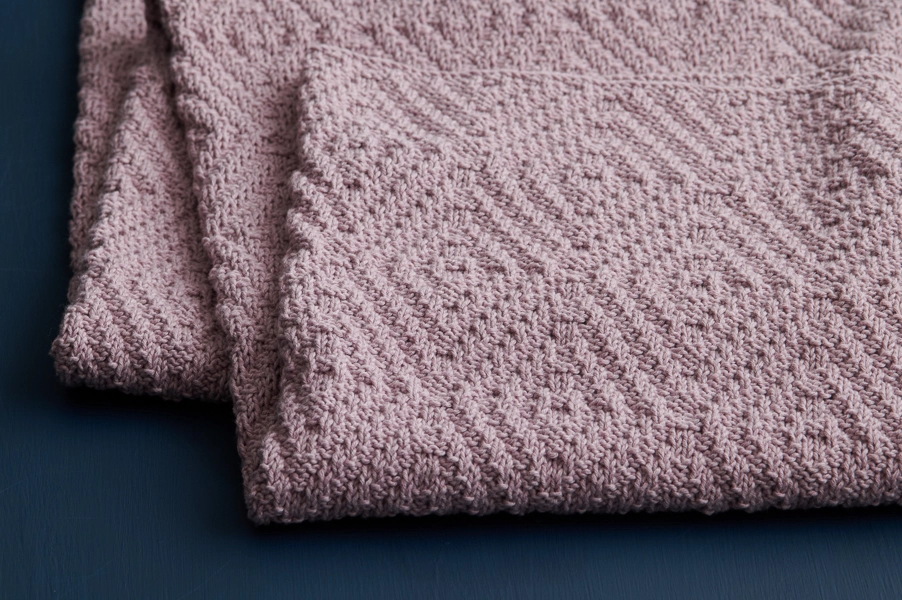
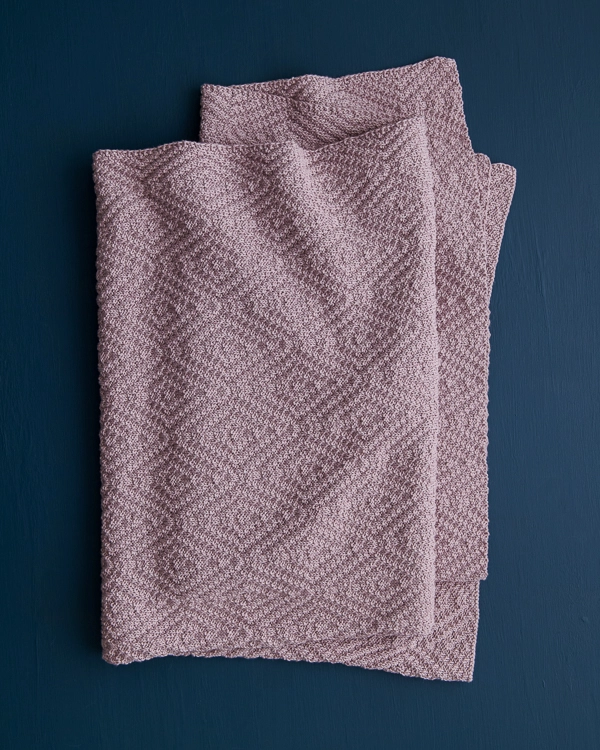
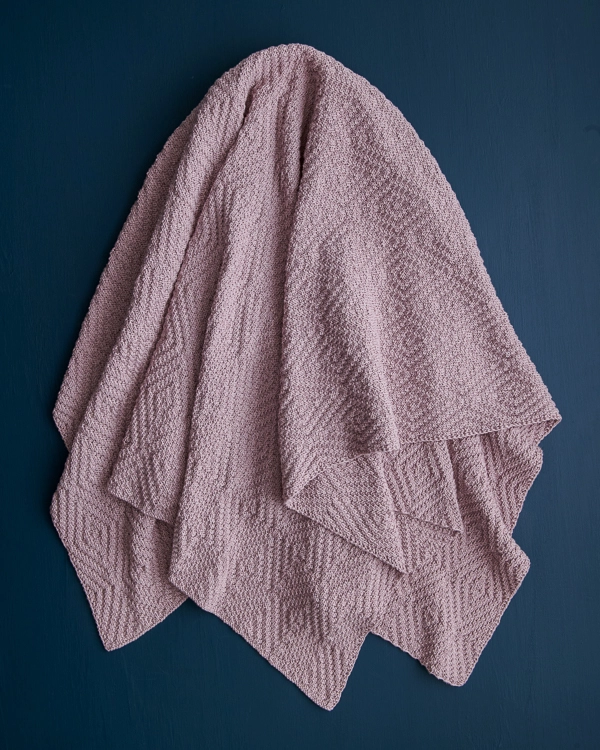
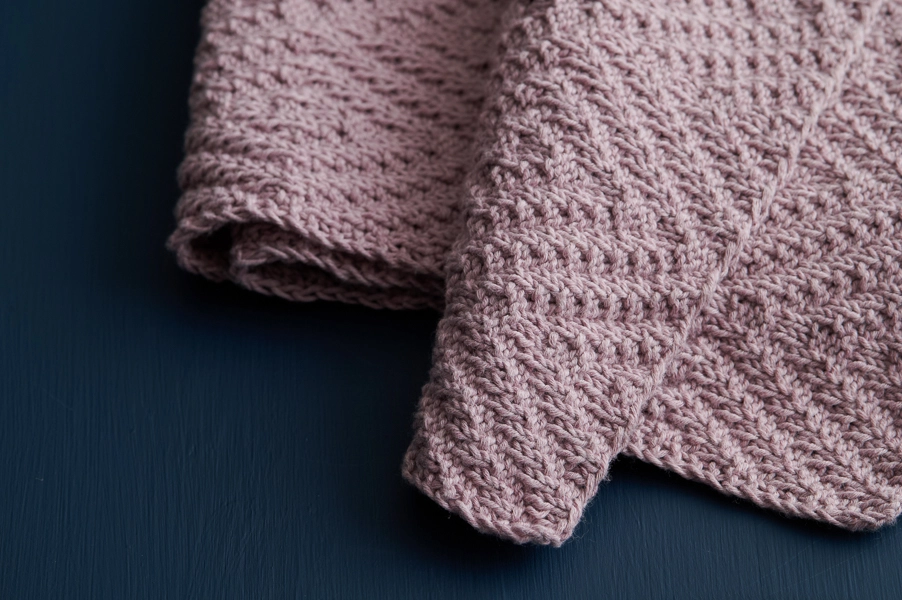
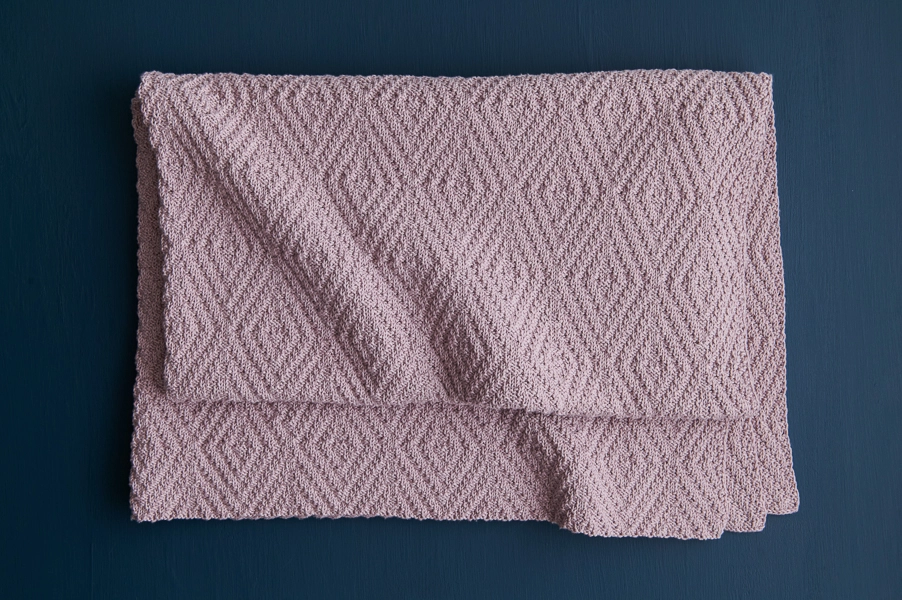
The beauty of a pressed tin ceiling lies in how its dimensional pattern invites the eye to wander, absorbed by the enduring charm. Designer Sandi Rosner captured that allure in her Tin Ceiling Washcloth + Hand Towel pattern, and now this favorite stitch pattern is back in the form of a blanket! The Tin Ceiling Blanket knitting pattern brings the same rhythmic texture to a larger scale, knit with Cotton Pure On A Cone, our 100% organically grown cotton yarn that highlights every detail.
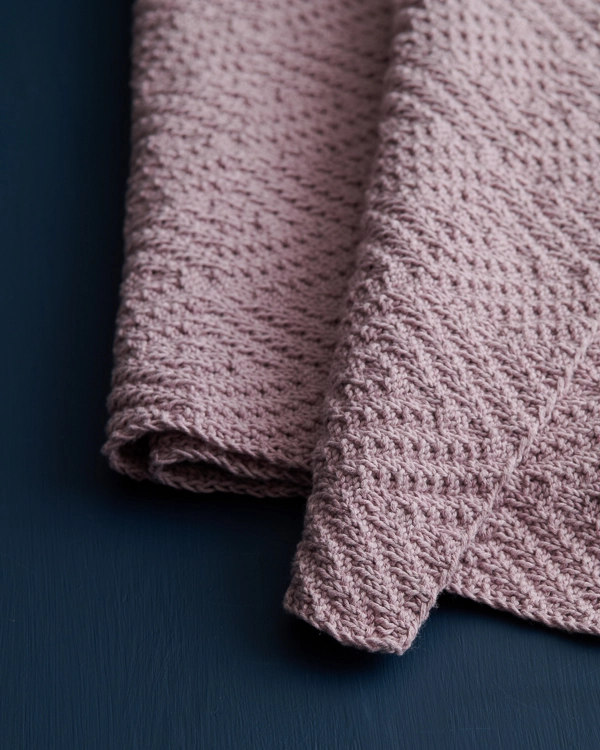
A simple interplay of knits and purls creates rippling concentric diamonds that catch the light like embossed metalwork. The effect is a timeless graphic take on the intricate turn-of-the-century ceilings that inspired it.
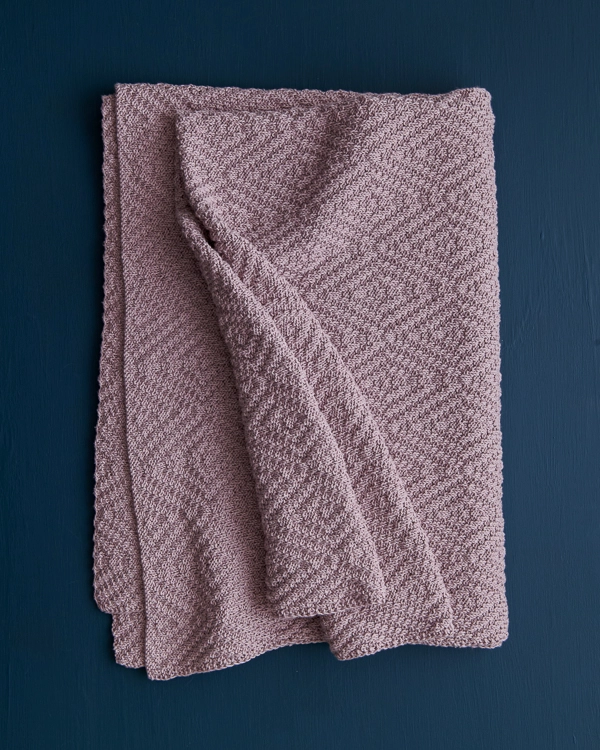
Cotton Pure On A Cone is the perfect choice for a textural stitch pattern. This sport-weight, 100% organically grown cotton yarn has a multi-strand structure that gives this blanket its smooth, even feel and crisp stitch definition. Cotton Pure’s strength and balance make it a joy to work with, while its unmercerized finish feels soft against the skin. And it’s machine washable, too, so the finished blanket is as practical as it is beautiful!
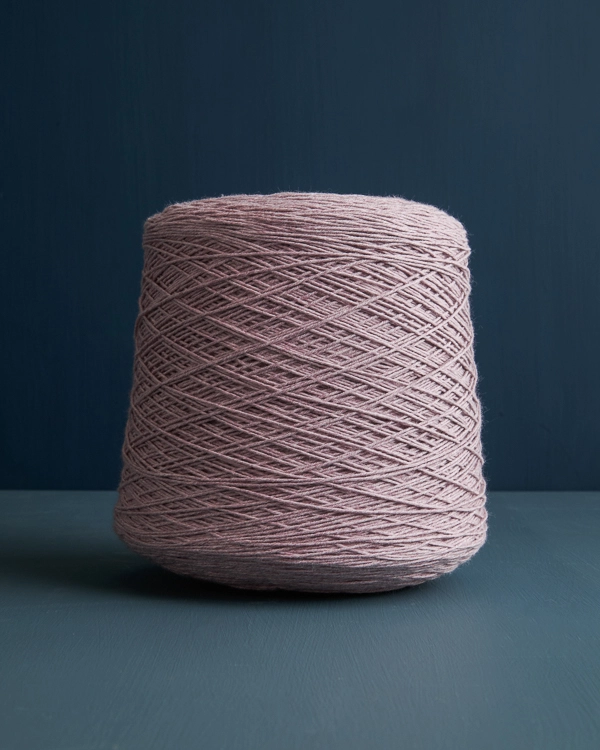
Just one 1000-gram Cotton Pure On A Cone makes the Throw size, offering seamless knitting and effortless flow (no skeins to wind, and only two ends to weave in!), or you can pick up 6 skeins of Cotton Pure to knit the Crib size. Choose from 34 stunning colors drawn from a full-bloom landscape. Pick the one you’ll most love to see unfold as you knit… We chose soft Silver Berry!
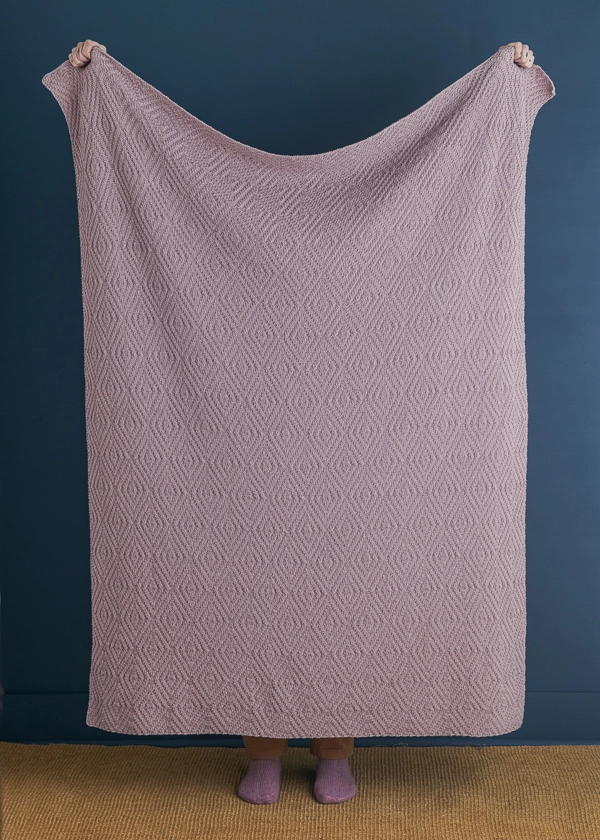
Cast on for the Tin Ceiling Blanket pattern and savor the satisfying rhythm of each row and the joy of knitting such dimensional tin-ceiling beauty!
Yarn lovers, if you adore the yarn used in this project, you’ll love exploring all of our other yarn collections! Discover over 55 thoughtfully designed yarns in nearly every natural fiber and in every spectacular color you can imagine. Only available here at Purl Soho’s online yarn store, where every skein is created with care and your creativity in mind!
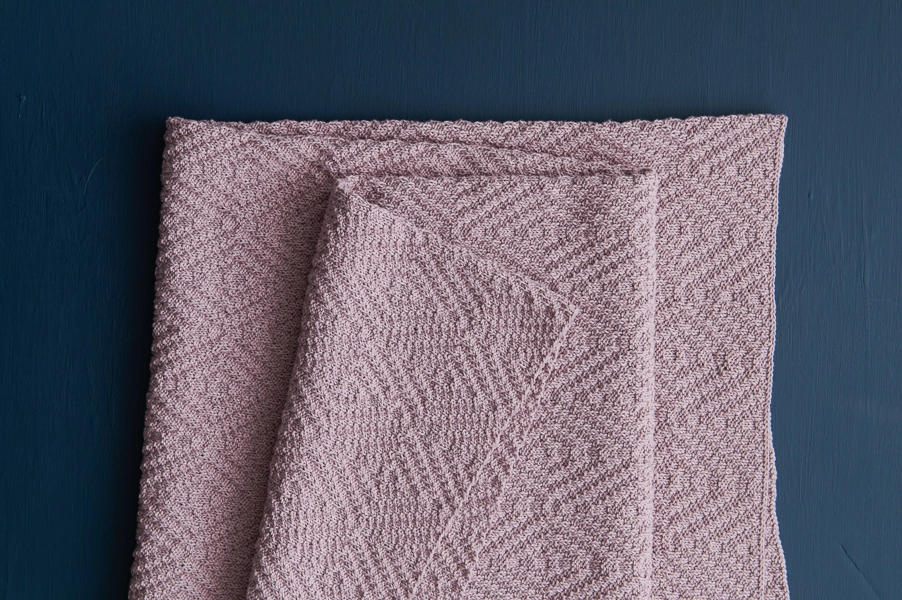
Based on the Tin Ceiling Washcloth + Hand Towel by Sandi Rosner, updated as a blanket by Purl Soho designer, Gianna Mueller. Click here to see even more of Gianna’s designs!
Story written by Andrea Lotz for Purl Soho.
Want to print this pattern? On desktop, find the “print” icon in the right margin, and on mobile, scroll to the end of the pattern for it. Use the on-screen instructions to remove anything you don’t want to print!
Materials
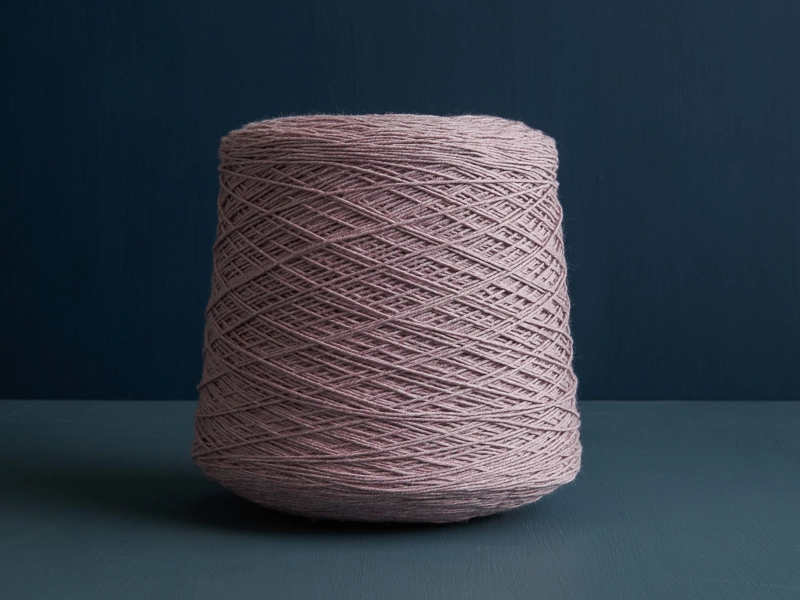
- 1 Cotton Pure On A Cone, 100% organically grown cotton yarn. Each cone of this sport-weight yarn is approximately 2,789 yards/ 1,000 grams; approximately 1,675 (2,780) yards required. We used the color Silver Berry.
- US 4 (3.5 mm) 32- or 40-inch circular knitting needles
- Stitch markers
PLEASE NOTE: If you prefer skeins, you’ll need 6 (10) skeins of Purl Soho’s Cotton Pure.
GAUGE
28 stitches and 36 rows = 4 inches in stitch pattern
SIZES
Crib (Throw)
Finished Dimensions: 31½ inches wide x 43 inches long (41¾ inches wide x 54 inches long)
SAMPLE: We knit the Throw size.
NOTES
STITCH MULTIPLE
This stitch pattern works over a multiple of 24 plus 4 stitches.
SLIP STITCHES
Slip all stitches purlwise with yarn in front (wyif).
PATTERN
Cast on 220 (292) stitches. We used a basic Long Tail Cast On.
Work from Written Instructions or Chart, both below.
TIN CEILING PATTERN: WRITTEN INSTRUCTIONS
Row 1 (right side): Slip 1 (see Notes), k1, place marker (pm), [k1, p2, (k2, p2) 5 times, k1, pm] 9 (12) times, k2.
Row 2 (wrong side): Slip 1, k1, slip marker (sm), [p1, (k2, p2) 5 times, k2, p1, sm] 9 (12) times, k2.
Row 3: Slip 1, k1, sm, [k2, (p2, k2) 2 times, p4, (k2, p2) 2 times, k2, sm] 9 (12) times, k2.
Row 4: Slip 1, k1, sm, [p2, (k2, p2) 2 times, k4, (p2, k2) 2 times, p2, sm] 9 (12) times, k2.
Row 5: Slip 1, k1, sm, [p1, k2, (p2, k2) 5 times, p1, sm] 9 (12) times, k2.
Row 6: Slip 1, k1, sm, [k1, (p2, k2) 5 times, p2, k1, sm] 9 (12) times, k2.
Row 7: Slip 1, k1, sm, [p2, (k2, p2) 2 times, k4, (p2, k2) 2 times, p2, sm] 9 (12) times, k2.
Row 8: Slip 1, k1, sm, [k2, (p2, k2) 2 times, p4, (k2, p2) 2 times, k2, sm] 9 (12) times, k2.
Rows 9–24: Repeat Rows 1–8 two more times.
Row 25 (right side): Slip 1, k1, sm, [k1, p2, (k2, p2) 5 times, k1, sm] 9 (12) times, k2.
Row 26 (wrong side): Slip 1, k1, sm, [p1, (k2, p2) 5 times, k2, p1, sm] 9 (12) times, k2.
Row 27: Slip 1, k1, sm, [p2, (k2, p2) 2 times, k4, (p2, k2) 2 times, p2, sm] 9 (12) times, k2.
Row 28: Slip 1, k1, sm, [k2, (p2, k2) 2 times, p4, (k2, p2) 2 times, k2, sm] 9 (12) times, k2.
Row 29: Slip 1, k1, sm, [p1, k2, (p2, k2) 5 times, p1, sm] 9 (12) times, k2.
Row 30: Slip 1, k1, sm, [k1, (p2, k2) 5 times, p2, k1, sm] 9 (12) times, k2.
Row 31: Slip 1, k1, sm, [k2, (p2, k2) 2 times, p4, (k2, p2) 2 times, k2, sm] 9 (12) times, k2.
Row 32: Slip 1, k1, sm, [p2, (k2, p2) 2 times, k4, (p2, k2) 2 times, p2, sm] 9 (12) times, k2.
Rows 33–48: Repeat Rows 25–32 two more times.
Repeat Rows 1–48 seven (9) more times, then work Rows 1 and 2 one more time, removing stitch markers on the last row.
TIN CEILING PATTERN: CHART
NOTE: New to reading charts? Unravel the mysteries with our Reading A Chart Tutorial!
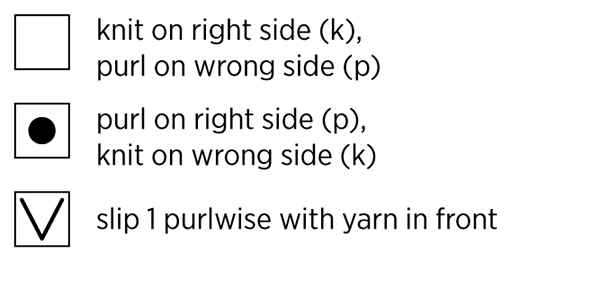
Starting in the bottom right corner of the Chart below, work right-side (odd number) rows from right to left and wrong-side (even number) rows from left to right.
Work Rows 1–48 eight (10) times, then repeat Rows 1 and 2 one more time. Remove all stitch markers on final row.
KEY
CHART
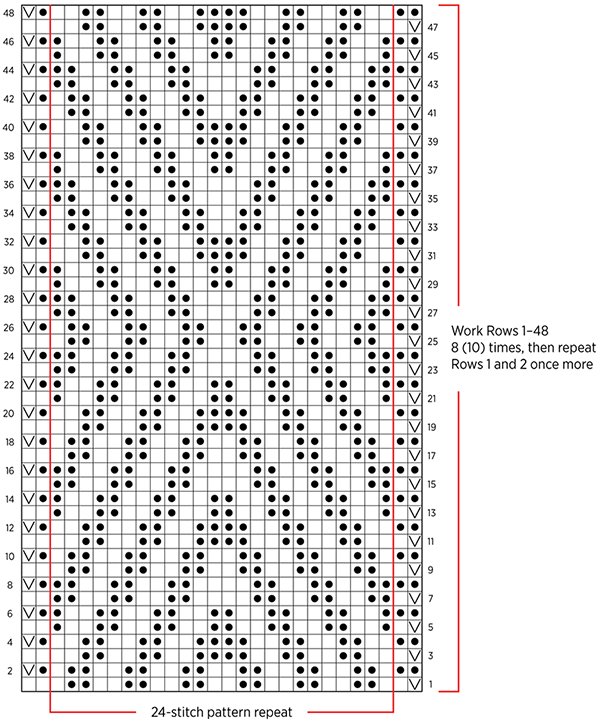
NOTE: Want to see it bigger? Download this chart (and key) as a PDF!
FINISHING
With right side facing you, bind off all stitches purlwise.
Weave in all ends and gently wet block.
Share your progress and connect with the community by tagging your pics with #PurlSoho. We can’t wait to see what you make!
Learn About Cotton Pure On A Cone + All Our Beautiful Yarns
Cotton Pure On A Cone is the ultimate yarn for amazing cotton blankets and garments! 2,789 whopping yards of 100% organically grown cotton yarn, you’ll have only two ends to weave in when you’re done… Music to every knitter’s ears! Cotton Pure is also a true natural beauty. This sport-weight yarn feels wonderfully soft and supple and comes in tons of gently heathered colors you won’t find anywhere else! Need some contrast colors or not quite so much yarn? Shop our collection of Cotton Pure 100-gram skeins, too!
More Free Knitting Patterns
- Be sure to explore our vast collection of (mostly free!) Cotton Pure knitting patterns and cast on!
More Sport-Weight Yarns
- Shop our entire collection of sport-weight yarns (What is sport-weight yarn, really? Learn all about sport-weight yarn in our deep-dive article!)
- If you want to use a different yarn, be sure to take the time to get the correct gauge. Need help? Check our All About Gauge Tutorial, our Yarn Substitution article, and our Complete Guide To Yarn for lots of helpful information.
More Yarns With Similar Fiber
- Shop cotton yarn (What helps cotton keep its cool? Learn all about this soft, natural fiber in our guide to cotton yarn!)
- Shop plant-based yarn
- Shop machine-washable yarn
Looking for more inspiration? Explore all of our knitting patterns (including tons of free knitting patterns) and knitting tutorials, buy one of our many knitting kits and yarn bundles, and shop for beautiful yarn. We have over 55 gorgeous natural fiber yarns in 1,000s of magnificent colors, designed to bring integrity, beauty, and joy to your next knitting project and only available at Purl Soho!



Very fashionable stitch, I love it! The look of quality is foremost.
Hi Gilda,
Thank you so much for your kind comment! We’re thrilled you’re a fan of this project and hope you give this pattern a try!
Kindly,
Cat
I love this pattern!!! But I have trouble knitting with 100% cotton yarn. Are there any other yarns that you might suggest for this pattern/blanket?
Hi!
This pattern will work great with most yarns since it’s easy to modify for any yarn weight! If you want to stick to the same gauge, I’d recommend using another sportweight yarn like Good Wool or Wigeon. Some other yarns that I think would be lovely options as well are Knitting Yarn and Daily Wool, though these are slightly thicker and would require some stitch count adjusting. But all of the yarns I recommended have great stitch definition which is the most important thing for a pattern like this!
All the best,
Lili
I am considering making this with Knitting Yarn on a Cone. Can you explain what you mean by “stitch count adjusting”? Thank you
Hi Adrienne!
Thanks so much for your thoughtful question. Here’s how to adjust your stitch count, which is the number of stitches you’ll be casting on for this project!
Since this pattern was originally written for Cotton Pure On A Cone, a sport weight, and Knitting Yarn DK On A Cone is slightly thicker as it’s a DK weight, you’ll need to reduce the amount of stitches you cast on to achieve the same blanket width. We recommend first knitting a gauge swatch in the stitch pattern featured in the blanket to find out the number of stitches per inch you’re getting! Once you have that number, multiply that with the width of the project in inches. Then, make sure that number aligns with the stitch multiple outlined for the stitch pattern. For this blanket, the stitch pattern is worked over a multiple of 24 stitches plus 4, so you’ll just need to keep that in mind for your swatch and final cast-on number! Once you’ve made sure the cast-on is is a multiple of 24 plus 4 more stitches, you’re all set to start your project. Please let me know if you have any questions at all!
Happy knitting!
Hillary
Try wearing silk gloves, it’s the friction that xan ve uncomfortable if you suffer from static. People who get headaches can’t always knit with different textures, cotton gloves, silk gloves both xan help, its an individual thing.
I love this! I’m hoping my family will buy this yarn for my birthday.
This is a beautiful pattern. Always looking for something new
Beautiful! I am thinking of using Serif or the new June Worsted for this. Beyond getting gauge is there any reason not to consider one of those?
Hi Chermia,
I would recommend using June Worsted over Serif for this pattern! Since Serif is very “nubbly,” it doesn’t have the best stitch definition, which is important for a textured pattern like this. June Worsted is more smoothly spun, so the stitch pattern will come across much more clearly! You will need to adjust your cast-on though, since it’s a lot thicker than Cotton Pure. This pattern works over any multiple of 24 + 4 stitches!
All the best,
Lili
I attempted a Serif swatch and you are 100% right on the stitch definition. I’ll give the June Worsted a go. Thank you!
Textural patterns like this one that highlight quality of Cotton Pure are always awesome. Sometimes simplicity rules the day!
I have two full cones of Cotton Pure and would like to use all of it for a blanket. Any suggestions as to number of cast on stitches for what finished size? I’m guessing there are other Cotton Pure addicts out there who will go bigger, too! Thanks
Hi Carrie,
We’re so glad you love Cotton Pure! The largest blanket you’ll be able to make with 2 cones of Cotton Pure would measure approximately 59 by 77 inches (twice the surface area of the original blanket). To figure out your cast-on number, you would need to multiply the number of stitches per inch (7 stitches, according to the gauge of the pattern) by the width and round that number to the nearest multiple of 24 + 4 stitches. Doing the math, that comes to 412 stitches!
All the best,
Lili
As always, thank you. Your quick responses to all of our issues is always amazing! 🧶🧶♥️♥️
Hi there! If you did do this larger sized blanket, would you follow the pattern as written except add more repeats, for example instead of the 9 or 12 times, enough to get your stitch count, then knit 2 at the end? Just having trouble envisioning and don’t want to end up with a blanket with random nubs!
Hi Holli,
Yes, exactly! You can follow the pattern as written, and it’ll result in the same stitch pattern!
All the best,
Lili
I would like to try the crib blanket with June worsted yarn. Because it is aran worsted weight I thought I would use a slightly larger needle, perhaps a six or seven, and decrease the cast on number of stitches based on the 24+4 you mentioned. Any thoughts?
Hi Louise,
June Worsted would be a lovely choice for this pattern! And yes exactly, you’ll just want to decrease the stitch count according to the stitch multiple.
The best way to figure out your new cast-on number is to first knit a gauge swatch in pattern. Once you know how many stitches you are getting per inch, you can multiply that number by the width that you would like and cast on the nearest multiple of 24 + 4 stitches. Then you can follow the pattern as written!
All the best,
Lili
I’ll be coming back to look at this wonderful website x
Try wearing silk gloves, it’s the friction that xan ve uncomfortable if you suffer from static. People who get headaches can’t always knit with different textures, cotton gloves, silk gloves both xan help, its an individual thing.
Needles, don’t use metal as this can aggravated static. Wooden needles oreferabke. Hope you find tgevright ones for you.
I would like to make this blanket, but only bigger (twin size). Your recommendations.
Hi Marion,
Thanks for writing in! To figure out your new cast-on number, you can multiply the number of stitches per inch (7 stitches, according to the gauge of the pattern) by the width that you would like and cast on the nearest multiple of 24 plus 4 stitches. Then you can follow the pattern as written!
Blankets for twin beds are typically about 66 by 90 inches, so you’d want to calculate your cast-on number using 66 (or something close to that) as the width. You’ll also need a total of about 7,325 yards for a blanket of those dimensions. That would equate to either 3 cones, or 2 cones and 7 skeins, or 27 skeins.
I hope this helps you plan your project!
All the best,
Lili
Lovely pattern. What would you recommend for a border that I can be knit right along with the main pattern?
Is this pattern reversible?
Hi Fran,
Aww we’re so glad you think so! This pattern has a border built in already–it’s a 2-stitch border with a slipped stitch at the very edge. If you’d like a wider border though, you can absolutely add on more stitches to your cast-on! Since the stitch pattern itself is very busy, I’d recommend something subtle like a 3-stitch I-cord border.
And yes, the pattern is reversible!
All the best,
Lili
Thank you for your thoughtful comments. The Ichord sounds good. I’m excited to try the pattern.
How many skeins of June worsted are needed to make the crib size?
Hi Karen,
Thanks for writing in! I did some calculations, and I’d recommend getting 8 skeins of June Worsted to knit the Crib size of this blanket. Hope this helps you plan your project!
All the best,
Lili
Hi,
I just received the Pure Cotton on a cone for this project and it’s beautiful, however, the constant tangling is a nightmare ..I feel I’m spending more time untangling than knitting..
Any suggestions to remedy this?
Thanks😊
Hi Brenda,
I’m so sorry to hear that Cotton Pure is giving you so much trouble! It sounds like the yarn is overtwisting, which, although frustrating, naturally happens to some yarns with many plies spun in the same direction. You may feel the urge to smooth out any irregularities in the texture before knitting each stitch, but this actually causes the twisting to build up further. I’d recommend letting the slight twists of the yarn go into your stitches as they appear. This will make a huge difference without altering the appearance of the knitted fabric! And even if you do notice some odd stitches, these will even out once you block your finished project.
All the best,
Lili
Hello! I encountered this twisting and I think it’s because the cone doesn’t get turned as we pull the yarn off. (The way balls get turned and tossed as we pull the yarn off of them.)So I put my cone on a lazy Susan and that has solved the problem completely!
Hi Christy!
That is an amazing idea! Thank you so much for sharing as I know this will be helpful to other knitters as well!
Happy making,
Gavriella
I’m currently about 20% complete on this blanket & I love it. It looks great and is a very rhythmic knit.
I’m using the knitting yarn on a cone and if you place markers every 24 stitches, it’s easy keep track of your place (and I don’t do charts :))
Thanks Purl Soho
Hi Sherri!
Thank you so much for the wonderful feedback! We are so happy you are enjoying your project and appreciate the extra tips for other makers!
Happy knitting,
Gavriella
Hi,
I love this pattern for my baby cousin’s first crib! I’m new to knitting though and am having a hart time reading the directions though. I know brackets and parentheses are meant be worked as many times as instructed, but there are a few numbers and brackets back to back.
“Row 1 (right side): Slip 1 (see Notes), k1, place marker (pm), [k1, p2, (k2, p2) 5 times, k1, pm] 9 (12) times, k2.”
Just to clarify, I would knit one and put a place marker?Then I would knit one, purl two.? Then I would knit two then purl two 5 times? Then I would knit one then put a place marker. According to this I would repeat this step 9 times? Or would I do this 12 times? I would end this with two knits?
Hi Kutura,
That is a great question and we are so happy you asked! You have the directions exactly right as far as your explanation of the stitches. Great work there! As for the 9 and (12), these are to indicate the different instruction depending on the size you are making. So if you are making the crib size you will follow the instruction 9 times. If you are making the throw size, you will follow the instruction 12 times. I hope this helps but please let us know if you have any other questions or need further explanation and we’d be happy to help!
All the best,
Gavriella
I’m hoping to adapt this pattern for a king-size blanket (80″ x 76″). I saw an earlier comment and answer that 2 cones would only get finished dimensions of 59′ x 77″. So I would need 3 cones? Also, any tips for adapting the pattern for this size? i’m still a relative beginner! Thanks!!
Hi Cynthia,
Thanks for asking! This stitch pattern works over a multiple of 24 plus 4 stitches. So you will multiply your stitch gauge by the desired size and choose the multiple closest to your desired dimensions. That is exactly correct, you will need 3 cones for a king size blanket!
Happy knitting,
Gavriella
Hello, this is a really exciting pattern, and I am really looking forward seeing and feeling the texture, this pattern will achieve. I can’t wait to start!! I will be making the throw, and my question is about the gauge: when making this sample gauge, does it need to be in the tin ceiling repeat, or it can be done in stockinette? Does it need to be blocked to achieve the gauge?
Also, is the dimension of the throw 41¾ inches wide x 54 inches long been given after blocking or just after it has been finished knitted.
Should I expect shrinkage after I washing the item on a regular basis?
Did the throw shrink at all after the first wash? How did the yarn behave after normal washing?
I am so looking forward to the reply on these questions to begin my birthday throw! Thank you! Yeeeehaw!!
Hi Juliette!
Thanks for asking! All measurements are after blocking and we didn’t experience any shrinkage. You can wash and dry your swatch to test on your own as well. We suggest swatching in pattern for the most accurate results. I hope this helps clarify and happy knitting!
All the best,
Gavriella
I have started this project and am struggling with using such a small needle size (I needed a size 3 to achieve gauge). Do you think this project would work with the yarn held double and larger needles? If not, can you recommend any other project that would work with the yarn held double? Thank you.
Hi Charlene,
We’re so sorry this has been a difficult knitting experience and you can definitely knit this pattern with your yarn doubled! To modify this pattern, you’ll want to start with a gauge swatch. Then measure your stitches per inch and multiply that number by the desired width of your blanket. This will give you your cast-on number. One thing to keep in mind is that this blanket pattern is worked over a multiple of 24 + 4, so you’ll want to start with an number that is both a multiple of 24 and then add 4 additional stitches. I hope this helps, but please let us know if you have any other questions!
All the best,
Gavriella
I’m nearly done with this project in a hybrid crib/throw size. It says to cast off in purl stitch. Is this a basic cast off in purl stitch?
Thank you!
Hi Naomi!
Thank you for writing in! Yes, that’s correct. It’s just a standard bind off worked purlwise. You’re almost there!
Warmly,
Megan
I can’t wait to start knitting this pattern. I’m having a hard time making the stitches add up to 292 per row for the THROW size.
Could you indicate the instructions for rows 1 and 2 without the alternate size. I’m not sure what to do five times and what to do 12 times.
My math for row 1:
Slip 1 Knit 1 = 2 stitches
–K2, P2 x5 = 20 stitches
–Add K1 to the 20 stitches = 21 stitches
21 stitches x 12 = 252 stitches
Add K2 = TOTAL of 254 stitches per row
I’m missing 38 stitches somewhere.
Hi Stacy!
Thanks so much for reaching out with this great question. I’m happy to help! I’ll provide the instructions for Row 1 and 2 for just the throw size, written out for a bit for extra clarity.
Our first row is originally written as follows…Row 1 (Right side): Slip 1, K1, pm, [(k1, p2, (k2, p2)) 5 times, k1, pm)] 12 times, K2
The smaller (K2, p2) is a smaller section repeated 5 times within a larger repeat. The larger stitch pattern in brackets is repeated 12 times.
Rewritten it could look like : Slip 1, K1, pm, [k1, p2, (k2, p2, k2, p2, k2, p2, k2, p2, k2, p2,) k1, pm ] 12 times, k2. You’ll repeat from [k1, p2 (k2,p2)…] 12 times, k2. So, you repeat what is within the parentheses 5 times and what is within the brackets 12 times.
The second row is originally written as…Row 2 (wrong side): Slip 1, k1, slip marker (sm), [p1, (k2, p2) 5 times, k2, p1, sm] (12) times, k2.
This row can be rewritten as: Row 2 (ws): Slip 1, k1, sm, [p1 (k2,p2,k2,p2,k2,p2,k2,p2,k2,p2,) k2, p1, sm) 12 times, k2.
Here’s a breakdown of the math for Row 1 which you provided and I have updated with all of this in mind:
I hope this helps! Please reach out with any other questions you might have!
Happy knitting!
Hills
Thank you so much! I see where I was confused. I can get on with the project!
I am loving knitting this blanket and thought I was making a crib size and realized after 5 skeins in that I somehow cast on the 292 rather than the 220 stitches. I am obviously not going to start over. Can you recommend how I might resolve this as best as possible. I am sick over this.
Hi Lisa!
Thanks so much for writing in! I’m glad to hear you’re loving working on the Tin Ceiling Blanket!
Oh no! I understand how this could be a little anxiety provoking to realize mid-project.
Rest assured, we have solutions! If you’re not planning to restart, we have have two options: to purchase more yarn (you’d need an extra 4 skeins) or, to knit a blanket that would end up being more of a square than a rectangle.
Please feel free to email us at [email protected] with the name of the yarn, the colorway, and we would be happy to check for matching skeins!
I hope this helps and that you continue to enjoy knitting your Tin Ceiling Blanket!
Hills
Thank you! I ended up screaming into a pillow and ripping it out and starting over to make the crib size. One more question, since this will be a gift, how do you recommend machine washing? I assume on gentle spin in cool or cold water? Can you throw it in the dryer on a light cycle?
Hi Lisa,
Thank you so much for your reply! I am so sorry to hear you had to start over, but I hope the project moves quickly the second time around!
If you’re using the Cotton Pure on a Cone, then we recommend “Machine wash cold, tumble dry low.”
I hope this helps!
Hills
Dear Lili,
I love the Tin Ceiling pattern and would like to make it in the smaller (crib) size in worsted wool. Would the “Knitting Yarn DK” be a good choice to show the beautiful stitch pattern? Thanks so much.
Hi Elisabeth,
Thank you so much for reaching out. I’m really glad to see the Tin Ceiling Blanket caught your eye!
I think this sounds like a lovely idea! It should knit up to be somewhere around 20% smaller. We would love to see the results!
I hope this helps, and please feel free to reach out with any other questions you might have!
Happy knitting,
Hills
Thank you, Hillary. I appreciate the information.
So happy to help, Elisabeth! Happy knitting! – Hills
Hello, I am knitting the gauge on this and have a few questions please before I continue on to knit the throw.
After 24rows, the width is 4″ and the length is 4″. But the gauge says that it’s supposed to be 4″ at 36 rows. If I use a smaller needle to fit more rows into the 36 rows, it will narrow the gauge sample. I am using needle size 5 (3 3/4). So I’m unsure how to get 4″ wide & 4″ long with this needle size & yarn weight.
Also, I bought a Cotton on a Cone of that lovely silver berry that is in the demo above and I am concerned about having enough yarn. It says the throw size uses the entire cone with 9 yards leftover. This isn’t leaving much leeway of extra yarn. Therefore, the gauge is critical. I would gladly buy an extra skein of the same colour to make up if I need more, however, it says that the skeins can have slight colour variations from the cones of similar colour. I don’t want to have to buy another entire cone if I need just a bit more at the end of the blanket. What do you suggest?
Thank you for your help with these two questions.
~ Kate
Hi Kate,
Thank you so much for reaching out! I’m really glad to see you’re working on the Tin Ceiling Blanket!
You might achieve gauge on a different material needle, but typically row gauge isn’t quite as crucial for accessories or blankets (rather than garments that need armholes, etc.).
I would recommend sending a photo of your swatch (with a ruler in the image, please!) to [email protected]. You can also include the note about potentially needing more yarn. We would be so glad to help you with both of these concerns!
We’ll keep an eye out for your email!
Happy knitting,
Hills
I’m getting ready to cast on for this blanket *but* I’m hesitant to use a long-tail cast on because I’m worried about leaving too much tail and running out of yarn at the end of the blanket (as the pattern calls for exactly one cone). Is there a different cast on you would recommend that would resolve that issue but not create a weird/mismatched for edge?
Hi Amanda,
This is a wonderful question! I totally understand your thinking here, and I’m happy to help!
One tip for long-tail cast-ons… You can wrap your yarn around your needle 10 times to estimate the width of 10 stitches. If you multiply that number by the number of stitches you’re casting on, you can measure out the perfect tail!
With this in mind, there is a cast-on that avoids the long-tail altogether, and many knitters prefer to use it for all of their projects as it can be quite versatile! I’d suggest checking out the cable cast-on for a low-tail experience. I really hope this works well for you!
Please reach back out with any other questions you might have!
Kindly,
Hills
Beautiful and it looks like it will be interesting to knit.
If I want to knit a blanket and add a border what would you recommend
Is this pattern reversible?
Hi Fran,
Thanks for your kind words; the Tin Ceiling Blanket pattern is indeed reversible! The pattern already features a slipped stitch edge that is worked as you knit up the pattern. If you would like to make this a bit more prominent, we would recommend a 3- or 4-stitch I-Cord border. I’m afraid that any other kind of patterned border might get lost in the pattern as the blanket is already quite textured.
Happy knitting!
Mia